
Penny Dreadfuls, 1887 · page 23 of 24
The War Library: Phil, the Scout — page 23: what you’re looking at
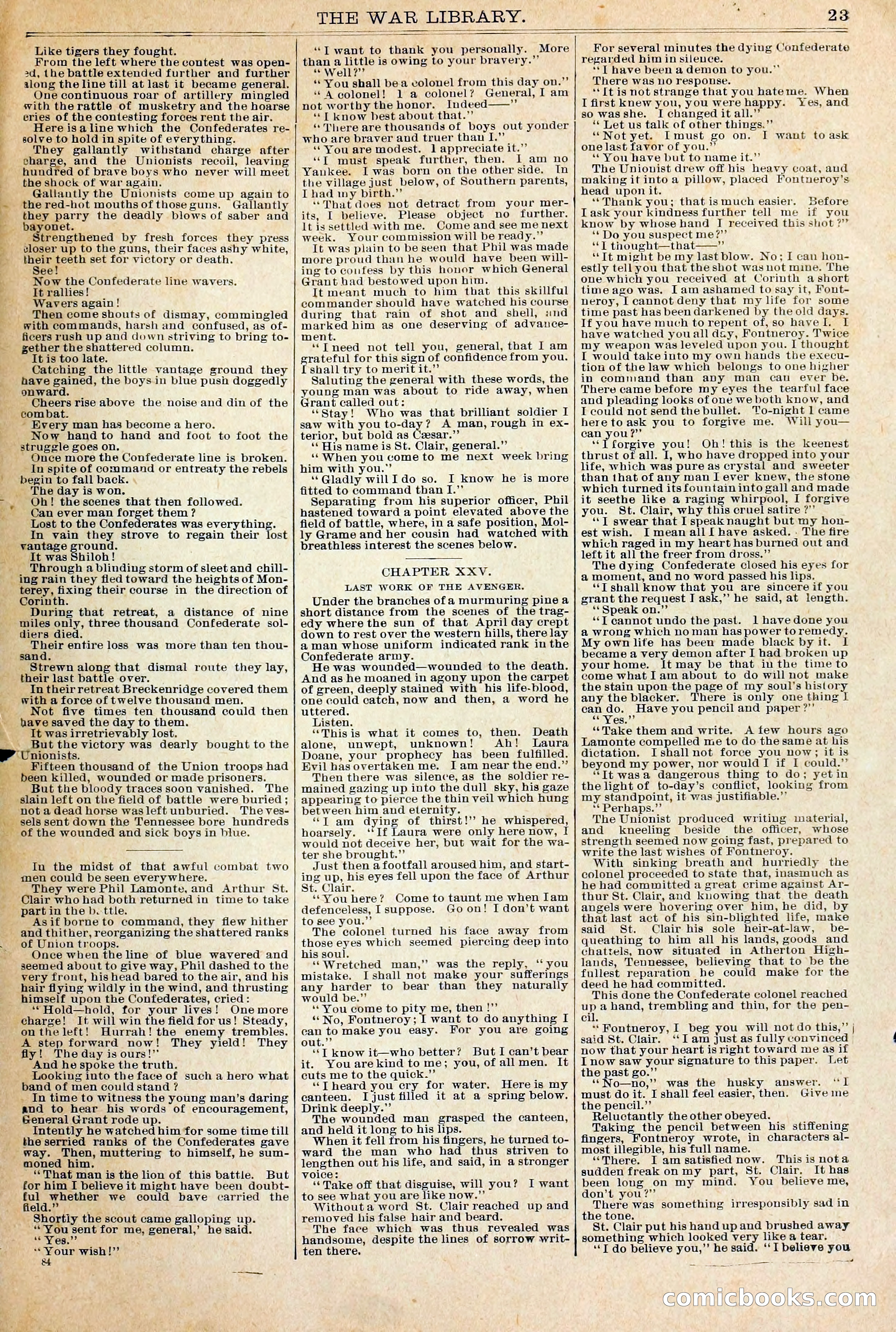
A restored page from Penny Dreadfuls, 1887. Page through the whole issue in the reader above.
📄 Transcribed text from this page (OCR, searchable)
Machine-transcribed from the original scan — historical spelling and the odd misread are preserved.
¥ » / : , Like tigers they fought. From the left where the contest was open- 2d, the battle extended further and further along the line till at last it became general. One continuous roar of artillery mingled with therattle of musketry and the hoarse eries of the contesting forces rent the air. Here isaline which the Confederates re- solve to hold in spite of everything. They gallantly withstand charge after charge, and the Unionists recoil, leaving hundred of brave boys who never will meet the shock of war again. Gallantly the Unionists come up again to the red-hot mouths of thoseguns. Gallantly they parry the deadly blows of saber and bayonet. Strengthened by fresh forces they press vloser up to the guns, their faces ashy white, their teeth set for victory or death. See! — Now the Confederate line wavers. It rallies! Wavers again! Then come shouts of dismay, commingled with commands, harsh and confused, as of- ficers rush up and down striving to bring to- gether the shattered column. It is too late. < Catching the little vantage ground they _ have gained, the boysin blue push doggedly onward. Cheers rise above the noise and din of the - combat. _ Every man has become a hero. ; Now hand to hand and foot to foot the _ struggle goes on. } Ouce more the Confederate line is broken. | In spite of command or entreaty the rebels begin to fall back. The day is won. 7 Oh! the scenes that then followed. "Can ever man forget them ? Lost to the Confederates was everything. In vain they strove to regain their Tost _ vantage ground. _ It was Shiloh! __ Through a blinding storm of sleet and chill- ing rain they fled toward the heights of Mon- terey, fixing their course in the direction of Corinth. During that retreat, a distance of nine miles only, three thousand Confederate sol- diers died. Their entire loss was more than ten thou- sand. _ Strewn along that dismal route they lay, their last battle over. In their retreat Breckenridge covered them with a force of twelve thousand men. _ Not five times ten thousand could then ave saved the day to them. 7 It was irretrievably lost. _ But the victory was dearly bought to the ‘Unionists -* * _ Fifteen thousand of the Union troops had - been killed, wounded or made prisoners. _ _ But the bloody traces soon vanished. The slain left on the field of battle were buried ; _ nota dead horse wasleft unburied. The ves- sels sent down the Tennessee bore hundreds _of the wounded and sick boys in blue. * ¥ In the midst of that awful combat two men could be seen everywhere. They were Phil Lamonte, and Arthur St. Clair who had both returned in time to take part in the b. ttle. Asif borne to command, they flew hither - and thither, reorganizing the shattered ranks of Union troops. Once when the line of blue wavered and seemed about to give way, Phil dashed to the very front, his head bared to the air, and his hair flying wildly in the wind, and thrusting himself upon the Confederates, cried: ‘*Hold—hold, for your lives! One more charge! It will win the field for us! Steady, ontheleft! Hurrah! the enemy trembles. A step forward now! They yield! They fly! The day is ours!”’ And he spoke the truth. Looking into the face of such a hero what band of men could stand ? . In time to witness the young man’s daring and to hear his words of encouragement, General Grant rode up. Intently he watched him for some time till _ theserried ranks of the Confederates gave way. Then, muttering to himself, he sum- moned him, ‘That man is the lion of this battle. But for him I believe it might have been doubt- ful whether we could bave carried the field.” i Shortly the scout came galloping up. “You sent for me, general,’ he said. ae Yes.’ ‘Your wish!”’ & vas). =o a <a ‘ . rs s - is al P a Bed ee 1 i ‘ % THRE WAR LIBRARY. “T want to thank you personally. More than a little is owing to your bravery.” “Well?” ‘*-You shall bea volonel from this day on.” ‘“ A golonel! 1 a colonel? General, I am not worthy the honor. Indeed——”’ ‘““T know best about that.”’ ‘* There are thousands of boys out yonder who are braver and truer than I.” ‘You are modest. l appreciate it.” ‘“T must speak further, then. I am no Yankee. I was born on the other side, In the village just below, of Southern parents, I had wy birth.” “That does not detract from your mer- its, [ believe. Please object no further. lt is settled with me. Come and see me next week. Your commission will be ready.” It was plain to be seen that Phil was made more proud than he would have been will- ing to confess by this honor which General Grant bad bestowed upon him. It meant much to him that this skillful commander should have watched his course during that rain of shot and shell, und marked him as one deserving of advance- ment. ‘*T need not tell you, general, that 1 am grateful for this sign of confidence from you. I shall try to merit it.” Saluting the general with these words, the young man was about to ride away, when Grant called out: ‘“Stay! Who was that brilliant soldier I saw with you to-day ? A man, rough in ex- terior, but bold as Ceesar,.”’ ‘“‘His name is St. Clair, general.” ‘‘When you come to me next week bring him with you.”’ ‘‘Gladly willI do so. I know he is more fitted to command than I.”’ Separating from his superior officer, Phil hastened toward a point elevated above the field of battle, where, in a safe position, Mol- ly Grame and her cousin had watched with breathless interest the scenes below. CHAPTER XXV. LAST WORK OF THE AVENGER. Under the branches ofa murmuring pine a short distance from the scenes of the trag- edy where the sun of that April day crept down to rest over the western hills, there lay aman whose uniform indicated rank in the Confederate army. He was wounded—wounded to the death. And as he moaned in agony upon the carpet of green, deeply stained with his life-blood, one could catch, now and then, a word he uttered. Listen. “This is what it comes to, then. Death alone, unwept, unknown! Ah! Laura Doane, your prophecy has been fulfilled. Evil hasovertaken me. I am near the end.” Then there was silence, as the soldier re- mained gazing up into the dull sky, his gaze appearing to pierce the thin veil which hung between him and eternity. ‘“T am dying of thirst!’’ he whispered, hoarsely. ‘‘If Laura were only here now, I would not deceive her, but wait for the wa- ter she brought.” Just then a footfall aroused him, and start- ing up, his eyes fell upon the face of Arthur St. Clair. ‘*You here? defenceless, I suppose. to see you.”’ The colonel turned his face away from those eyes which seemed piercing deep into his soul. ‘‘ Wretched man,’ was the reply, ‘‘ you mistake. I shall not make your sufferings any harder to bear than they naturally would be.”’ ‘“You come to pity me, then !”’ ‘‘No, Fontneroy; [ want to do anything I can to make you easy. For you are going out.” ‘‘T know it—who better? But 1 can’t bear it. You are kind to me; you, of allmen. It cuts me to the quick.” ‘‘T heard you cry for water. Here is my canteen. I just filled it at a spring below. Drink deeply.”’ The wounded man grasped the canteen, and held it long to his lips. When it fell from his fingers, he turned to- ward the man who had thus striven to lengthen out his life, and said, in a stronger voice: ‘Take off that disguise, will you? I want to see what you are like now.” Withouta word St. Clair reached up and removed his false hair and beard. The face which was thus revealed was handsome, despite the lines of sorrow writ- ten there, Come to taunt me when Iam Go on! I don’t want ee 23 aoe — ———Ss For several minutes the dying Confederate regarded him in sileuce. ‘‘T have been a demon to you.” There was lo response. ‘‘Itis not strange that you hateme. When I first knew you, you were happy. ‘Yes, and so wasshe. I changed it all.” ‘« Let us talk of other things.”’ ‘““Not yet. Imust go on. I want to ask one last favor of you.”’ ‘“*You have but to name it.”’ The Uniouist drew off his heavy coat, aud making it into a pillow, placed Fontueroy’s head upon it. ‘“*Thank you; that is much easier. Before Task your kindness further tell me if you know by whose hand I received this shot ?” ‘Do you suspect me?”’ “T thought—that——”’ ‘“‘Tt might be my last blow. No; I can hon- estly tell you that the shot was not mine. The one which you received at Corinth a short time ago was. Lam ashamed to say it, Font- neroy, | cannot deny that my life for some time past has been darkened by the old days. If you have much to repent of, so havel. IL have watched youall dzy, Fontneroy. Twice my weapon was leveled upon you. I thought I would take into my own hands the execu- tion of the law which belongs to one higher in command than apy man can ever be. There came before my eyes the tearful face and pleading looks of one we both know, and I could not send the bullet. To-night 1 came here to ask you to forgive me. Will you— can you?”’ ‘“‘] forgive you! Oh! this is the keenest thrust of all. I, who have dropped into your life, which was pure as crystal and sweeter than that of any man [ ever knew, the stone which turned its fountain into gall and made it seethe like a raging whirpool, I forgive you. St. Clair, why this cruel satire ?”’ ‘‘T swear that I speak naught but my hon- est wish. I mean allI have asked. : The fire which raged in my heart has burned out and left it all the freer from dross,”’ The dying Confederate closed his eyes for a moment, and no word passed his lips. ‘‘T shall know that you are sincere if you grant the request I ask,’’ he said, at length. ‘*Speak on.”’ ‘“‘T cannot undo the past. 1 havedone you a wrong which noman has power toremedy. My own life has been made black byit. L became a very demon after I had broken up your home. It may be that in the time to come whut Iam about to do will not make the stain upon the page of my soul's history any the blacker. There is only one thing | can do. Have you pencil and paper ?”’ VCH “Take them and write. A few hours ago Lamonte compelled me to do the same at his dictation. Ishall not force you now; it is beyond my power, nor would I if I could.” “Tt wasa dangerous thing to do; yetin the light of to-day’s conflict, looking from my standpoint, it was justifiable.”’ ‘*Perhaps.”’ The Unionist produced writing material, and kneeling beside the officer, whose strength seemed now going fast, prepared to write the last wishes of Fontneroy. With sinking breath and hurriedly the colonel proceeded to state that, inasmuch as he had committed a great crime against Ar- thur St. Clair, and kuowing that the death angels were hovering over him, he did, by that last act of his sin-blighted life, make said St. Clair his sole heir-at-law, be- queathing to him all his lands, goods and chattels, now situated in Atherton High- lands, Tennessee, believing that to be the fullest reparation he could make for the deed he had committed. This done the Confederate colonel reached up a hand, trembling and thin, for the pen- cil, **Fontneroy, I beg you will not do this,’’ ; said St. Clair. ‘‘I am just as fully convinced now that your heart is right toward me as if I now saw your signature to this paper. Let the past go.”’ ‘‘No—no,’’ was the husky answer. “Il must do it. I shall feel easier, then. Give ime the pencil.”’ Reluctantly the other obeyed. Taking the pencil between his stiffening fingers, Fontneroy wrote, in characters al- most illegible, his full name. “There. I am satisfied now. This is nota sudden freak on my part, St. Clair. It has been long on my mind. You believe me, don’t you?” There was something irresponsibly sad in the tone. St. Clair put his hand up and brushed away something which looked very like a tear, ‘T do believe you,”’ he said. ‘‘I believe you —-<+ — ~ _—.- EORMIE OOKS (E()