
Penny Dreadfuls, 1887 · page 14 of 24
The War Library: Phil, the Scout — page 14: what you’re looking at
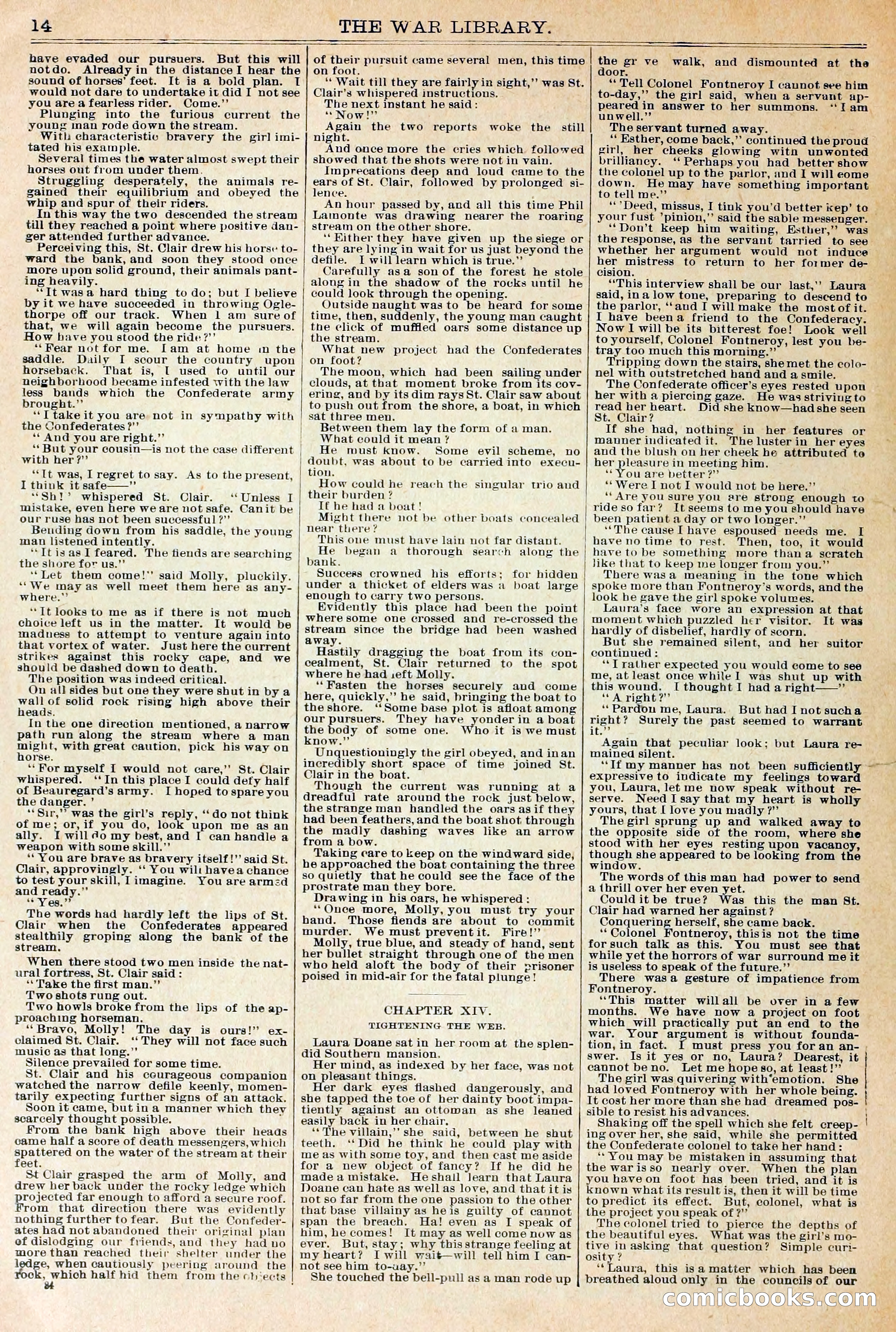
A restored page from Penny Dreadfuls, 1887. Page through the whole issue in the reader above.
📄 Transcribed text from this page (OCR, searchable)
Machine-transcribed from the original scan — historical spelling and the odd misread are preserved.
14 have evaded our pursuers. But this will notdo. Already in the distancelI hear the sound of horses’ feet. It is a bold plan. I would not dare to undertake it did I not see you are a fearless rider. Come.’’ Plunging into the furious current the young man rode down the stream. With characteristic bravery the girl imi- tated his example. Several times the water almost swept their horses out from under them. Struggling desperately, the animals re- gained their equilibrium and obeyed the whip and spur of their riders. In this way the two descended the stream till they reached a point where positive dan- ger attended further advance. Perceiving this, St. Clair drew his horse to- ward the bank, and soon they stood once more upon solid ground, their animals pant- ing heavily. ‘It wasa hard thing to do; but I believe by it we have succeeded in throwing Ogle- thorpe off our track. When 1 am sure of that, we will again become the pursuers. How bave you stood the ride ?”’ ‘“‘Rear not for me. [am at home in the saddle. Daily I scour the country upon horseback. That is, [ used to until our neighborhood became infested with the law less bands which the Confederate army brought.”’ ‘‘T take it you are not in sympathy with the Confederates ?"’ ‘* And you are right.”’ ‘*But your cousin—is not the case different with her ?”’ *“It was, I regret to say. As to the present, I think it safe——” ‘““Sh!’ whispered St. Clair. ‘Unless I mistake, even here we are not safe. Canit be our ruse has not been successful ?”’ Beuding down from his saddle, the young man listened intently. ‘‘Itisas I feared. The tiends are searching the shore for us.”’ ‘*Let them come!"’ said Molly, pluckily. ‘‘We may as well meet them here as any- where.” ‘‘Tt looks to me as if there is not much choice left us in the matter. It would be madness to attempt to venture again into that vortex of water. Just here the current strikes against this rocky cape, and we should be dashed down to death. The position was indeed critical. On all sides but one they were shut in by a wall of solid rock rising high above their heads. In the one direction mentioned, a narrow path run along the stream where a man might, with great caution, pick his way on horse. ‘‘For myself I would not care,’ St. Clair whispered. ‘‘In this place I could defy half of Beauregard’s army. I hoped tospare you the danger. ’ ‘*Sir,”’ was the girl’s reply, ‘‘do not think of me; or, if you do, look upon me as an ally. I will do my best, and I can handle a weapon with some skill.”’ ‘* You are brave as bravery itself!" said St. Clair, approvingly. ‘‘ You wilt havea chance to test your skill, lIimagine. You are arm:d and ready.’ ‘fy 68." The words had hardly left the lips of St. Clair when the Confederates appeared stealthily groping along the bank of the stream. When there stood two men inside the nat- ural fortress, St. Clair said : ‘* Take the first man.” Two shots rung out. Two howls broke from the lips of the ap- proaching horseman. ‘‘ Bravo, Molly! The day is ours!” ex- claimed St. Clair. ‘‘ They will not face such music as that long.”’ Silence prevailed for some time. St. Clair and his courageous companion watched the narrow defile keenly, momen- tarily expecting further signs of an attack. Soon it came, but in a manner which they scarcely thought possible. From the bank high above their heads came half a score of death messengers, which spattered on the water of the stream at their feet. St Clair grasped the arm of Molly, and drew her back under the rocky ledge which projected far enough to afford a secure roof. From that direction there was evidently nothing further to fear. But the Confeder- ates had not abandoned their original plan of dislodging our friends, and they had no more than reached their shelter under the ledge, when cautiously peering around the rock, which half hid them from the oh ‘ects A } THE WAR LIBRARY. lt of their pursuit came several men, this time | the gr ve walk, and dismounted at the on foot. ‘“ Wait till they are fairly iz sight,’’ was St. Clair’s whispered instructions. The next instant he said: ‘““Now!” Again the two reports night. And once more the cries which followed showed that the shots were not in vain. Imprecations deep and loud came to the ears of St. Clair, followed by prolonged si- lence. An hour passed by, and all this time Phil Lamonte was drawing nearer the roaring stream on the other shore. ‘“Kither they have given up the siege or they are lying in wait for us just beyond the defile. I will learn which is true.”’ Carefully asa son of the forest he stole along in the shadow of the rocks until he could look through the opening. Outside naught was to be heard for some time, then, suddenly, the young man caught the click of muffled oars some distance up the stream. What new project had the Confederates on foot? The moon, which had been sailing under clouds, at that moment broke from its cov- ering, and by its dim rays St. Clair saw about to push out from the shore, a boat, in which sat three men. Between them lay the form of a man. What could it mean 7 He must know. Some evil scheme, no doubt, was about to be carried into execu- tion. How could he reach the singular trio and their burden ? If he had a boat ! Might there not be hear there? This one must have lain not far distant. He began a thorough search along the bank. Success crowned his efforts; under a thicket of elders was a boat large enough to carry two persons. Evidently this place had been the point where some one crossed and re-crossed the stream since the bridge had been washed away. Hastily dragging the boat from its con- cealment, St. Clair returned to the spot where he had :eft Molly. ‘‘Fasten the horses securely and come here, quickly,’”’ he said, bringing the boat to the shore. ‘‘Some base plot is afloat among our pursuers. They have yonder in a boat the body of some one. Who it is we must know.” Unquestioningly the girl obeyed, and inan incredibly short space of time joined St. Clair in the boat. Though the current was running at a dreadful rate around the rock just below, the strange man handled the oars asif they had been feathers, and the boat shot through the madly dashing waves like an arrow from a bow. Taking care to keep on the windward side, he approached the boat containing the three so quietly that he could see the face of the prostrate man they bore. Drawing in his oars, he whispered : ‘“Once more, Molly, you must try your hand. Those fiends are about to commit murder. We must preventit. Fire!’’ Molly, true blue, and steady of hand, sent her bullet straight through one of the men who held aloft the body of their prisoner poised in mid-air for the fatal plunge! woke the still CHAPTER XIV. TIGHTENING THE WEB. Laura Doane sat in her room at the splen- did Southern mansion. Her mind, as indexed by her face, was not on pleasant things. Her dark eyes flashed dangerously, and she tapped the toe of her dainty boot impa- tiently against an ottoman as she leaned easily back in her chair, ‘* The villain,’’ she said, between he shut teeth. ‘Did he think he could play with me as with some toy, and then cast me aside for a new object of fancy? If he did he madeamistake. Heshall Jearn that Laura Doane can hate as well as love, and thatit is not so far from the one passion to the other that base villainy as heis guilty of cannot span the breach. Ha! even as I speak of him, he comes! It may as well come now as ever. But, stay; why this strange feeling at my heart? I will wait—will tell him I can- not see him to-uay.”’ She touched the bell-pull as a man rode up | other boats concealed | for hidden | door. “Tell Colonel Fontneroy I caunot see him to-day,” the girl said, when a servant up- peared in answer to her summons. ‘fam unwell.’’ The servant turned away. diene ‘‘ Esther, come back,”’ continued the proud girl, her cheeks glowing witn unwonted brillianey. ‘Perhaps you had better show the colonel up to the parlor, and I will eome down. He may have something important to tell me.”’ ‘e / & a4 7. - ‘‘’Deed, missus, I tink you'd better icep’ to — your fust ’pinion,’’ said the sable messenger. ‘“Don’t Keep him waiting, Esther,’? was the response, as the servant tarried to see whether her argument would not induce her mistress to return to her former de- cision. “This interview shall be our last,’’ Laura said, inalow tone, preparing to descend to the parlor, ‘‘and I will make the mostof it. I have beena friend to the Confederacy. Now I will be its bitterest foe! Look well to yourself, Colonel Fontneroy, lest you be- tray too much this morning.”’ Tripping down the stairs, she met the colo- nel with outstretched hand and a smile. The Confederate officer’s eyes rested upon her with a piercing gaze. He was striviug to read her heart. Did she know—had she seen St. Clair? If she had, nothing in her features or manner indicated it. The luster in her eyes and the blush on her cheek he attributed toe her pleasure in meeting him. ‘““You are better ?” ‘Were I not I would not be here.”’ ‘‘Are you sure you are strong enough to ride so far? Itseems to me you should have been patient a day or two longer.” ‘“The cause [have espoused needs me. I have no time to rest. Then, too, it would have to be something more thana scratch like that to keep me longer from you.” There wasa meaning in the tone which spoke more than Fontneroy’s words, and the look he gave the girl spoke volumes. Laura’s face wore an expression at that moment which puzzled her visitor. It was hardly of disbelief, hardly of scorn. But she remained silent, and her suitor continued : ‘‘T rather expected you would come to see me, at least once while 1 was shut up with this wound. [ thought I had a right——”’ ‘A right?” ‘*Pardon me, Laura. But had I not sucha right? Surely the past seemed to warrant 1657" Again that peculiar look; but Laura re- mained silent. ‘If my manner has not been sufficiently ~~~ expressive to indicate my feelings toward you, Laura, let me now speak without re- serve. Need I say that my heart is wholly yours, that [ love you madly ?”’ The girl sprung up and walked away to the opposite side of the room, where she stood with her eyes resting upon vacancy, though she appeared to be looking from the window. The words of this man had power to send a thrill over her even yet. Could it be true? Was this the man St. Clair had warned her against ? Conquering herself, she came back. ‘*Colonel Fontneroy, thisis not the time for such talk as this. You must see that while yet the horrors of war surround me it is useless to speak of the future.”’ There wasa gesture of impatience from Fontneroy. “This matter willall be over in a few months. We have now a project on foot which will practically put an end to the war. Your argument is without founda- tion, in fact. must press you foran an- swer. Is it yes or no, Laura? Dearest, it cannot beno. Let me hope so, at least!” The girl was quivering with‘emotion. She had loved Fontneroy with her whole being. It cost her more than she had dreamed pos- sible to resist his advances. Shaking off the spell which she felt creep- ing over her, she said, while she permitted the Confederate colonel to take her hand: ‘* You may be mistaken in assuming that the warisso nearly over. When the plan you have on foot has been tried, and it is known what its result is, then it will be time to predict its effect. But, colonel, what is the project you speak of ?”’ The colonel tried to pierce the depths of the beautiful eyes. What was the girl’s mo- tive in asking that question? Simple curi- osity ? ‘*Laura, this isa matter which has been breathed aloud only in the councils of our Gomircbooks co ‘ “ye f | ' m1 ‘