
Penny Dreadfuls, 1850 · page 52 of 400
The Gift of the Sailor: The String of Pearls & Sweeney Todd, the Demon Barber of Fleet Street — page 52: what you’re looking at
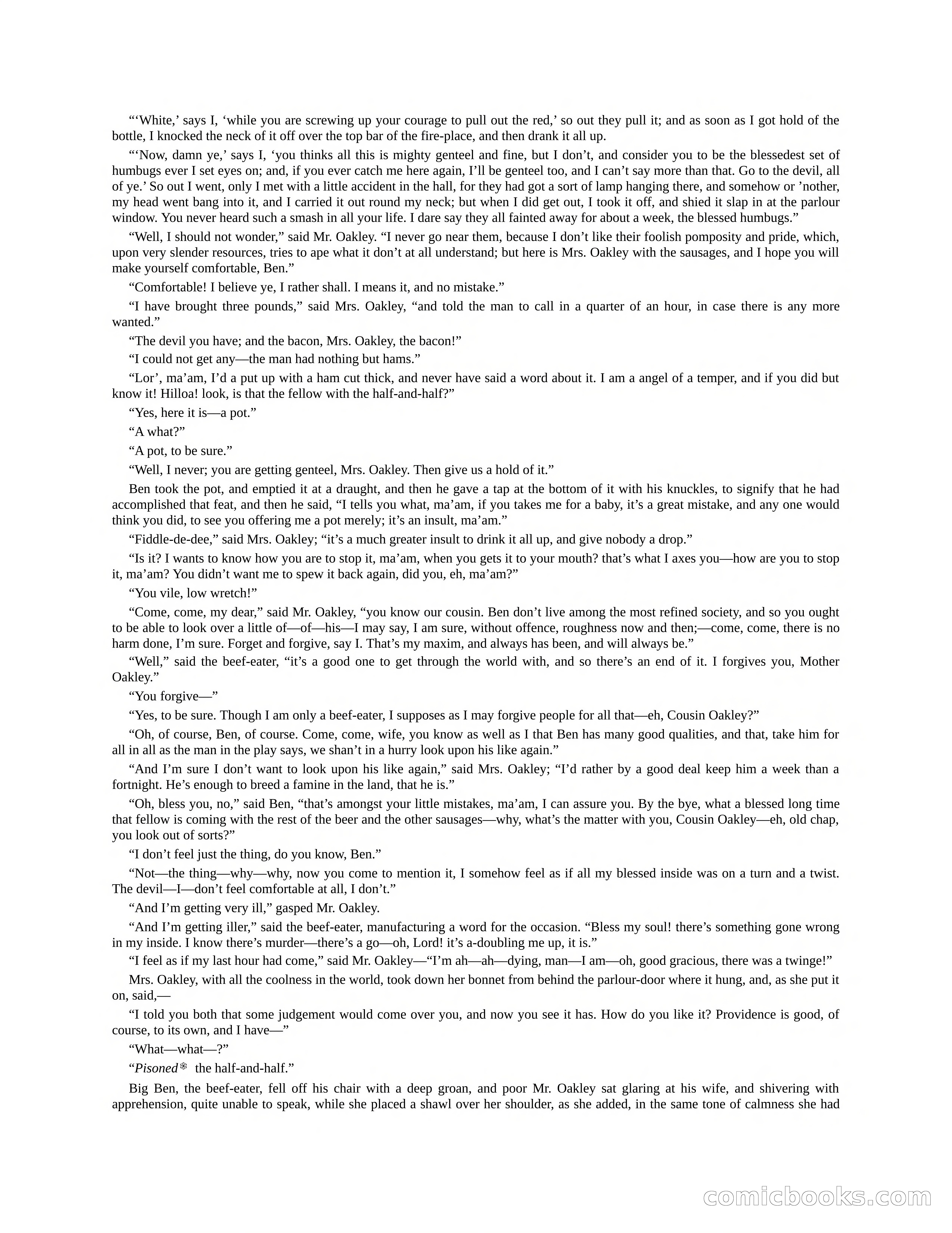
A restored page from Penny Dreadfuls, 1850. Page through the whole issue in the reader above.
📄 Transcribed text from this page (OCR, searchable)
Machine-transcribed from the original scan — historical spelling and the odd misread are preserved.
““White,’ says I, ‘while you are screwing up your courage to pull out the red,’ so out they pull it; and as soon as I got hold of the bottle, I knocked the neck of it off over the top bar of the fire-place, and then drank it all up. ““Now, damn ye,’ says I, ‘you thinks all this is mighty genteel and fine, but I don’t, and consider you to be the blessedest set of humbugs ever I set eyes on; and, if you ever catch me here again, I’|l be genteel too, and I can’t say more than that. Go to the devil, all of ye.’ So out I went, only I met with a little accident in the hall, for they had got a sort of lamp hanging there, and somehow or ’nother, my head went bang into it, and I carried it out round my neck; but when I did get out, I took it off, and shied it slap in at the parlour window. You never heard such a smash in all your life. I dare say they all fainted away for about a week, the blessed humbugs.” “Well, I should not wonder,” said Mr. Oakley. “I never go near them, because I don’t like their foolish pomposity and pride, which, upon very slender resources, tries to ape what it don’t at all understand; but here is Mrs. Oakley with the sausages, and I hope you will make yourself comfortable, Ben.” “Comfortable! I believe ye, I rather shall. I means it, and no mistake.” “T have brought three pounds,” said Mrs. Oakley, “and told the man to call in a quarter of an hour, in case there is any more wanted.” “The devil you have; and the bacon, Mrs. Oakley, the bacon!” “T could not get any—the man had nothing but hams.” “Lor’, ma’am, I’d a put up with a ham cut thick, and never have said a word about it. I am a angel of a temper, and if you did but know it! Hilloa! look, is that the fellow with the half-and-half>” “Yes, here it is—a pot.” “A what?” “A pot, to be sure.” “Well, I never; you are getting genteel, Mrs. Oakley. Then give us a hold of it.” Ben took the pot, and emptied it at a draught, and then he gave a tap at the bottom of it with his knuckles, to signify that he had accomplished that feat, and then he said, “I tells you what, ma’am, if you takes me for a baby, it’s a great mistake, and any one would think you did, to see you offering me a pot merely; it’s an insult, ma’am.” “Fiddle-de-dee,” said Mrs. Oakley; “it’s a much greater insult to drink it all up, and give nobody a drop.” “Ts it? I wants to know how you are to stop it, ma’am, when you gets it to your mouth? that’s what I axes you—how are you to stop it, ma’am? You didn’t want me to spew it back again, did you, eh, ma’am?” “You vile, low wretch!” “Come, come, my dear,” said Mr. Oakley, “you know our cousin. Ben don’t live among the most refined society, and so you ought to be able to look over a little of —of—his—I may say, I am sure, without offence, roughness now and then;—come, come, there is no harm done, I’m sure. Forget and forgive, say I. That’s my maxim, and always has been, and will always be.” “Well,” said the beef-eater, “it’s a good one to get through the world with, and so there’s an end of it. I forgives you, Mother Oakley.” “You forgive—” “Yes, to be sure. Though I am only a beef-eater, I supposes as I may forgive people for all that—eh, Cousin Oakley?” “Oh, of course, Ben, of course. Come, come, wife, you know as well as I that Ben has many good qualities, and that, take him for all in all as the man in the play says, we shan’t in a hurry look upon his like again.” “And I’m sure I don’t want to look upon his like again,” said Mrs. Oakley; “I’d rather by a good deal keep him a week than a fortnight. He’s enough to breed a famine in the land, that he is.” “Oh, bless you, no,” said Ben, “that’s amongst your little mistakes, ma’am, I can assure you. By the bye, what a blessed long time that fellow is coming with the rest of the beer and the other sausages—why, what’s the matter with you, Cousin Oakley—eh, old chap, you look out of sorts?” “T don’t feel just the thing, do you know, Ben.” “Not—the thing—why—why, now you come to mention it, I somehow feel as if all my blessed inside was on a turn and a twist. The devil—I—don’t feel comfortable at all, I don’t.” “And I’m getting very ill,” gasped Mr. Oakley. “And I’m getting iller,” said the beef-eater, manufacturing a word for the occasion. “Bless my soul! there’s something gone wrong in my inside. I know there’s murder—there’s a go—oh, Lord! it’s a-doubling me up, it is.” “T feel as if my last hour had come,” said Mr. Oakley—“I’m ah—ah—dying, man—I am—oh, good gracious, there was a twinge!” Mrs. Oakley, with all the coolness in the world, took down her bonnet from behind the parlour-door where it hung, and, as she put it on, said,— “T told you both that some judgement would come over you, and now you see it has. How do you like it? Providence is good, of course, to its own, and I have—” “What—what—?” “Pisoned® the half-and-half.” Big Ben, the beef-eater, fell off his chair with a deep groan, and poor Mr. Oakley sat glaring at his wife, and shivering with apprehension, quite unable to speak, while she placed a shawl over her shoulder, as she added, in the same tone of calmness she had CORniclooo S CO)