
Penny Dreadfuls, 1850 · page 383 of 400
The Gift of the Sailor: The String of Pearls & Sweeney Todd, the Demon Barber of Fleet Street — page 383: what you’re looking at
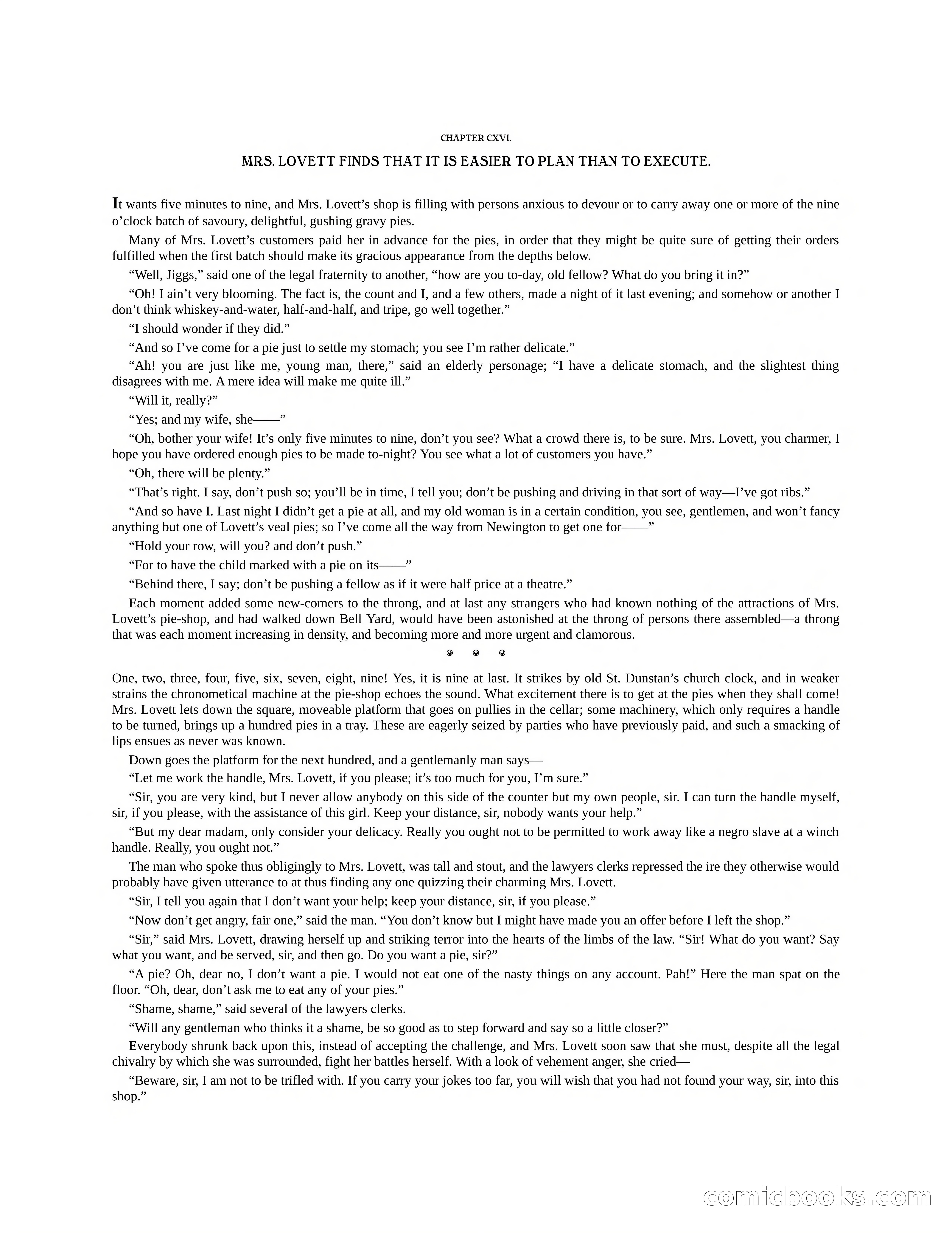
A restored page from Penny Dreadfuls, 1850. Page through the whole issue in the reader above.
📄 Transcribed text from this page (OCR, searchable)
Machine-transcribed from the original scan — historical spelling and the odd misread are preserved.
CHAPTER CXVI. MRS. LOVETT FINDS THAT IT IS EASIER TO PLAN THAN TO EXECUTE. It wants five minutes to nine, and Mrs. Lovett’s shop is filling with persons anxious to devour or to carry away one or more of the nine o’clock batch of savoury, delightful, gushing gravy pies. Many of Mrs. Lovett’s customers paid her in advance for the pies, in order that they might be quite sure of getting their orders fulfilled when the first batch should make its gracious appearance from the depths below. “Well, Jiggs,” said one of the legal fraternity to another, “how are you to-day, old fellow? What do you bring it in?” “Oh! I ain’t very blooming. The fact is, the count and I, and a few others, made a night of it last evening; and somehow or another I don’t think whiskey-and-water, half-and-half, and tripe, go well together.” “T should wonder if they did.” “And so I’ve come for a pie just to settle my stomach; you see I’m rather delicate.” “Ah! you are just like me, young man, there,” said an elderly personage; “I have a delicate stomach, and the slightest thing disagrees with me. A mere idea will make me quite ill.” “Will it, really>?” “Yes; and my wife, she 39 “Oh, bother your wife! It’s only five minutes to nine, don’t you see? What a crowd there is, to be sure. Mrs. Lovett, you charmer, I hope you have ordered enough pies to be made to-night? You see what a lot of customers you have.” “Oh, there will be plenty.” “That’s right. I say, don’t push so; you’ll be in time, I tell you; don’t be pushing and driving in that sort of way—I’ve got ribs.” “And so have I. Last night I didn’t get a pie at all, and my old woman is in a certain condition, you see, gentlemen, and won’t fancy anything but one of Lovett’s veal pies; so I’ve come all the way from Newington to get one for - “Hold your row, will you? and don’t push.” 33 “For to have the child marked with a pie on its “Behind there, I say; don’t be pushing a fellow as if it were half price at a theatre.” Each moment added some new-comers to the throng, and at last any strangers who had known nothing of the attractions of Mrs. Lovett’s pie-shop, and had walked down Bell Yard, would have been astonished at the throng of persons there assembled—a throng that was each moment increasing in density, and becoming more and more urgent and clamorous. eo e® @o One, two, three, four, five, six, seven, eight, nine! Yes, it is nine at last. It strikes by old St. Dunstan’s church clock, and in weaker strains the chronometical machine at the pie-shop echoes the sound. What excitement there is to get at the pies when they shall come! Mrs. Lovett lets down the square, moveable platform that goes on pullies in the cellar; some machinery, which only requires a handle to be turned, brings up a hundred pies in a tray. These are eagerly seized by parties who have previously paid, and such a smacking of lips ensues as never was known. Down goes the platform for the next hundred, and a gentlemanly man says— “Let me work the handle, Mrs. Lovett, if you please; it’s too much for you, I’m sure.” “Sir, you are very kind, but I never allow anybody on this side of the counter but my own people, sir. I can turn the handle myself, sir, if you please, with the assistance of this girl. Keep your distance, sir, nobody wants your help.” “But my dear madam, only consider your delicacy. Really you ought not to be permitted to work away like a negro slave at a winch handle. Really, you ought not.” The man who spoke thus obligingly to Mrs. Lovett, was tall and stout, and the lawyers clerks repressed the ire they otherwise would probably have given utterance to at thus finding any one quizzing their charming Mrs. Lovett. “Sir, I tell you again that I don’t want your help; keep your distance, sir, if you please.” “Now don’t get angry, fair one,” said the man. “You don’t know but I might have made you an offer before I left the shop.” “Sir,” said Mrs. Lovett, drawing herself up and striking terror into the hearts of the limbs of the law. “Sir! What do you want? Say what you want, and be served, sir, and then go. Do you want a pie, sir?” | “A pie? Oh, dear no, I don’t want a pie. I would not eat one of the nasty things on any account. Pah floor. “Oh, dear, don’t ask me to eat any of your pies.” Here the man spat on the “Shame, shame,” said several of the lawyers clerks. “Will any gentleman who thinks it a shame, be so good as to step forward and say so a little closer?” Everybody shrunk back upon this, instead of accepting the challenge, and Mrs. Lovett soon saw that she must, despite all the legal chivalry by which she was surrounded, fight her battles herself. With a look of vehement anger, she cried— “Beware, sir, I am not to be trifled with. If you carry your jokes too far, you will wish that you had not found your way, sir, into this shop.” CORniclooo S CO)