
Penny Dreadfuls, 1850 · page 185 of 400
The Gift of the Sailor: The String of Pearls & Sweeney Todd, the Demon Barber of Fleet Street — page 185: what you’re looking at
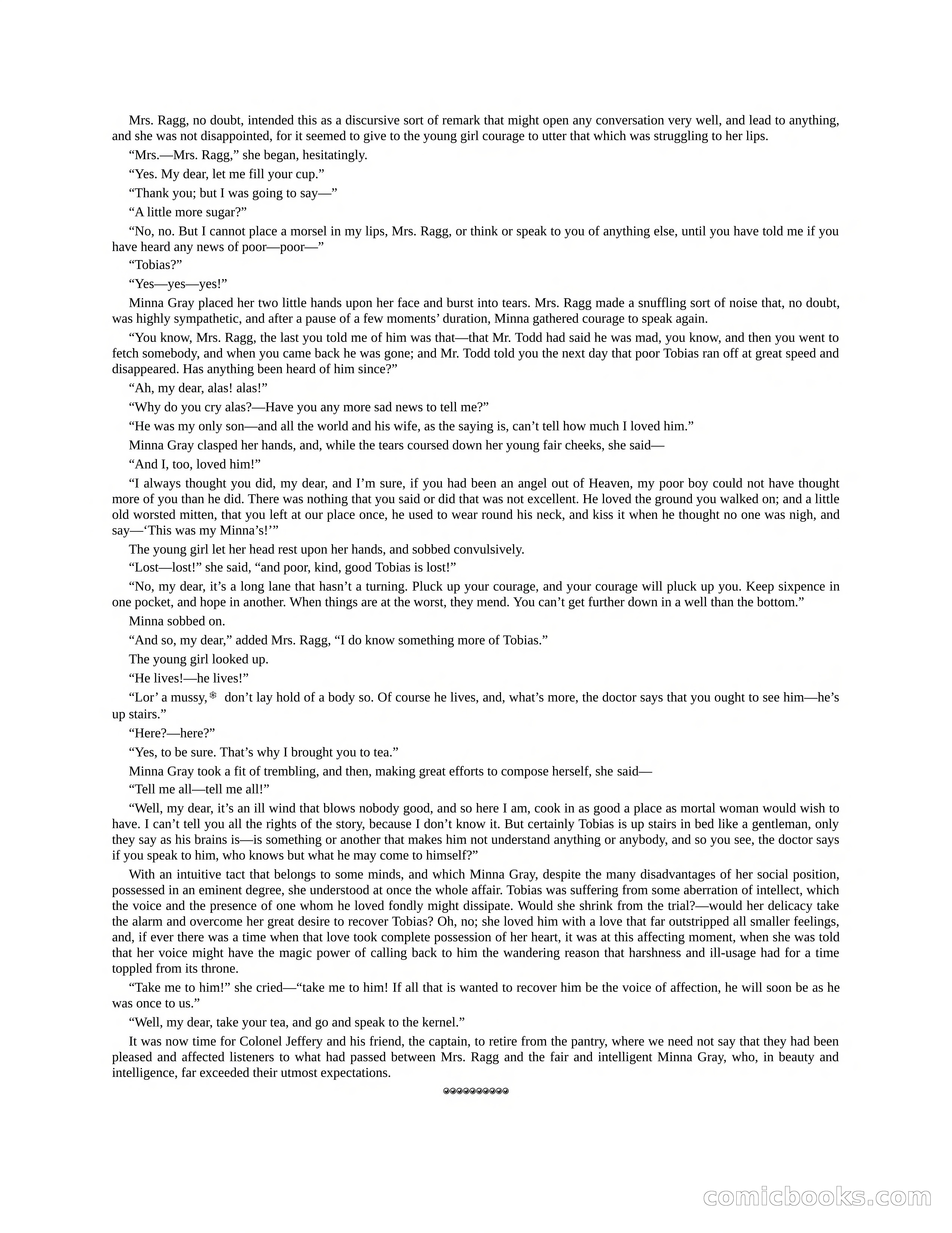
A restored page from Penny Dreadfuls, 1850. Page through the whole issue in the reader above.
📄 Transcribed text from this page (OCR, searchable)
Machine-transcribed from the original scan — historical spelling and the odd misread are preserved.
Mrs. Ragg, no doubt, intended this as a discursive sort of remark that might open any conversation very well, and lead to anything, and she was not disappointed, for it seemed to give to the young girl courage to utter that which was struggling to her lips. “Mrs.—Mrs. Ragg,” she began, hesitatingly. “Yes. My dear, let me fill your cup.” “Thank you; but I was going to say—” “A little more sugar?” “No, no. But I cannot place a morsel in my lips, Mrs. Ragg, or think or speak to you of anything else, until you have told me if you have heard any news of poor—poor—” “Tobias?” “Yes—yes—yes!” Minna Gray placed her two little hands upon her face and burst into tears. Mrs. Ragg made a snuffling sort of noise that, no doubt, was highly sympathetic, and after a pause of a few moments’ duration, Minna gathered courage to speak again. “You know, Mrs. Ragg, the last you told me of him was that—that Mr. Todd had said he was mad, you know, and then you went to fetch somebody, and when you came back he was gone; and Mr. Todd told you the next day that poor Tobias ran off at great speed and disappeared. Has anything been heard of him since?” “Ah, my dear, alas! alas!” “Why do you cry alas?—Have you any more sad news to tell me?” “He was my only son—and all the world and his wife, as the saying is, can’t tell how much I loved him.” Minna Gray clasped her hands, and, while the tears coursed down her young fair cheeks, she said— “And I, too, loved him!” “T always thought you did, my dear, and I’m sure, if you had been an angel out of Heaven, my poor boy could not have thought more of you than he did. There was nothing that you said or did that was not excellent. He loved the ground you walked on; and a little old worsted mitten, that you left at our place once, he used to wear round his neck, and kiss it when he thought no one was nigh, and say—‘This was my Minna’s!’” The young girl let her head rest upon her hands, and sobbed convulsively. “Lost—lost!” she said, “and poor, kind, good Tobias is lost!” “No, my dear, it’s a long lane that hasn’t a turning. Pluck up your courage, and your courage will pluck up you. Keep sixpence in one pocket, and hope in another. When things are at the worst, they mend. You can’t get further down in a well than the bottom.” Minna sobbed on. “And so, my dear,” added Mrs. Ragg, “I do know something more of Tobias.” The young girl looked up. “He lives!—he lives!” “Lor’ a mussy,® don’t lay hold of a body so. Of course he lives, and, what’s more, the doctor says that you ought to see him—he’s up stairs.” “Here?—here?” “Yes, to be sure. That’s why I brought you to tea.” Minna Gray took a fit of trembling, and then, making great efforts to compose herself, she said— “Tell me all—tell me all!” “Well, my dear, it’s an ill wind that blows nobody good, and so here I am, cook in as good a place as mortal woman would wish to have. I can’t tell you all the rights of the story, because I don’t know it. But certainly Tobias is up stairs in bed like a gentleman, only they say as his brains is—is something or another that makes him not understand anything or anybody, and so you see, the doctor says if you speak to him, who knows but what he may come to himself?” With an intuitive tact that belongs to some minds, and which Minna Gray, despite the many disadvantages of her social position, possessed in an eminent degree, she understood at once the whole affair. Tobias was suffering from some aberration of intellect, which the voice and the presence of one whom he loved fondly might dissipate. Would she shrink from the trial?—would her delicacy take the alarm and overcome her great desire to recover Tobias? Oh, no; she loved him with a love that far outstripped all smaller feelings, and, if ever there was a time when that love took complete possession of her heart, it was at this affecting moment, when she was told that her voice might have the magic power of calling back to him the wandering reason that harshness and ill-usage had for a time toppled from its throne. “Take me to him!” she cried—“take me to him! If all that is wanted to recover him be the voice of affection, he will soon be as he was once to us.” “Well, my dear, take your tea, and go and speak to the kernel.” It was now time for Colonel Jeffery and his friend, the captain, to retire from the pantry, where we need not say that they had been pleased and affected listeners to what had passed between Mrs. Ragg and the fair and intelligent Minna Gray, who, in beauty and intelligence, far exceeded their utmost expectations. Q9OOOOOOOO CORniclooo S CO)