
Penny Dreadfuls, 1850 · page 150 of 400
The Gift of the Sailor: The String of Pearls & Sweeney Todd, the Demon Barber of Fleet Street — page 150: what you’re looking at
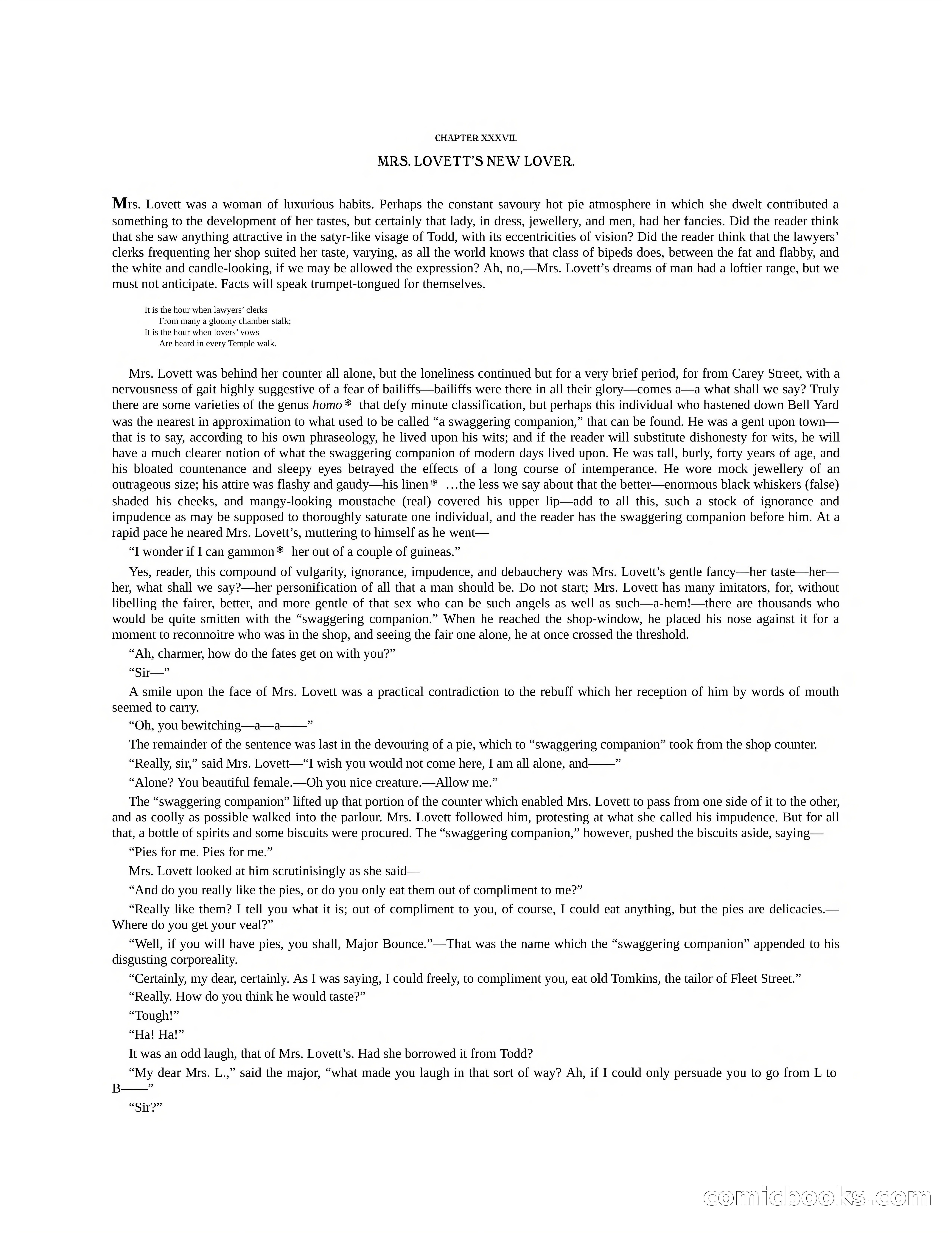
A restored page from Penny Dreadfuls, 1850. Page through the whole issue in the reader above.
📄 Transcribed text from this page (OCR, searchable)
Machine-transcribed from the original scan — historical spelling and the odd misread are preserved.
CHAPTER XXXVI. MRS. LOVETT’S NEW LOVER. Mrs. Lovett was a woman of luxurious habits. Perhaps the constant savoury hot pie atmosphere in which she dwelt contributed a something to the development of her tastes, but certainly that lady, in dress, jewellery, and men, had her fancies. Did the reader think that she saw anything attractive in the satyr-like visage of Todd, with its eccentricities of vision? Did the reader think that the lawyers’ clerks frequenting her shop suited her taste, varying, as all the world knows that class of bipeds does, between the fat and flabby, and the white and candle-looking, if we may be allowed the expression? Ah, no,—Mrs. Lovett’s dreams of man had a loftier range, but we must not anticipate. Facts will speak trumpet-tongued for themselves. It is the hour when lawyers’ clerks From many a gloomy chamber stalk; It is the hour when lovers’ vows Are heard in every Temple walk. Mrs. Lovett was behind her counter all alone, but the loneliness continued but for a very brief period, for from Carey Street, with a nervousness of gait highly suggestive of a fear of bailiffs—bailiffs were there in all their glory—comes a—a what shall we say? Truly there are some varieties of the genus homo® that defy minute classification, but perhaps this individual who hastened down Bell Yard was the nearest in approximation to what used to be called “a swaggering companion,” that can be found. He was a gent upon town— that is to say, according to his own phraseology, he lived upon his wits; and if the reader will substitute dishonesty for wits, he will have a much clearer notion of what the swaggering companion of modern days lived upon. He was tall, burly, forty years of age, and his bloated countenance and sleepy eyes betrayed the effects of a long course of intemperance. He wore mock jewellery of an outrageous size; his attire was flashy and gaudy—his linen® ...the less we say about that the better—enormous black whiskers (false) shaded his cheeks, and mangy-looking moustache (real) covered his upper lip—add to all this, such a stock of ignorance and impudence as may be supposed to thoroughly saturate one individual, and the reader has the swaggering companion before him. At a rapid pace he neared Mrs. Lovett’s, muttering to himself as he went— “T wonder if I can gammon® her out of a couple of guineas.” Yes, reader, this compound of vulgarity, ignorance, impudence, and debauchery was Mrs. Lovett’s gentle fancy—her taste—her— her, what shall we say?—her personification of all that a man should be. Do not start; Mrs. Lovett has many imitators, for, without libelling the fairer, better, and more gentle of that sex who can be such angels as well as such—a-hem!—there are thousands who would be quite smitten with the “swaggering companion.” When he reached the shop-window, he placed his nose against it for a moment to reconnoitre who was in the shop, and seeing the fair one alone, he at once crossed the threshold. “Ah, charmer, how do the fates get on with you?” “Sir—” A smile upon the face of Mrs. Lovett was a practical contradiction to the rebuff which her reception of him by words of mouth seemed to cary. “Oh, you bewitching—a—a _ The remainder of the sentence was last in the devouring of a pie, which to “swaggering companion” took from the shop counter. “Really, sir,” said Mrs. Lovett—“I wish you would not come here, I am all alone, and 2 “Alone? You beautiful female-—Oh you nice creature.—Allow me.” The “swaggering companion” lifted up that portion of the counter which enabled Mrs. Lovett to pass from one side of it to the other, and as coolly as possible walked into the parlour. Mrs. Lovett followed him, protesting at what she called his impudence. But for all that, a bottle of spirits and some biscuits were procured. The “swaggering companion,” however, pushed the biscuits aside, saying— “Pies for me. Pies for me.” Mrs. Lovett looked at him scrutinisingly as she said— “And do you really like the pies, or do you only eat them out of compliment to me?” “Really like them? I tell you what it is; out of compliment to you, of course, I could eat anything, but the pies are delicacies.— Where do you get your veal?” “Well, if you will have pies, you shall, Major Bounce.”——That was the name which the “swaggering companion” appended to his disgusting corporeality. “Certainly, my dear, certainly. As I was saying, I could freely, to compliment you, eat old Tomkins, the tailor of Fleet Street.” “Really. How do you think he would taste?” “Tough!” “Ha! Ha!” It was an odd laugh, that of Mrs. Lovett’s. Had she borrowed it from Todd? “My dear Mrs. L.,” said the major, “what made you laugh in that sort of way? Ah, if I could only persuade you to go from L to BRB _” “Sir?” CORniclooo S CO)