
Penny Dreadfuls, 1850 · page 125 of 400
The Gift of the Sailor: The String of Pearls & Sweeney Todd, the Demon Barber of Fleet Street — page 125: what you’re looking at
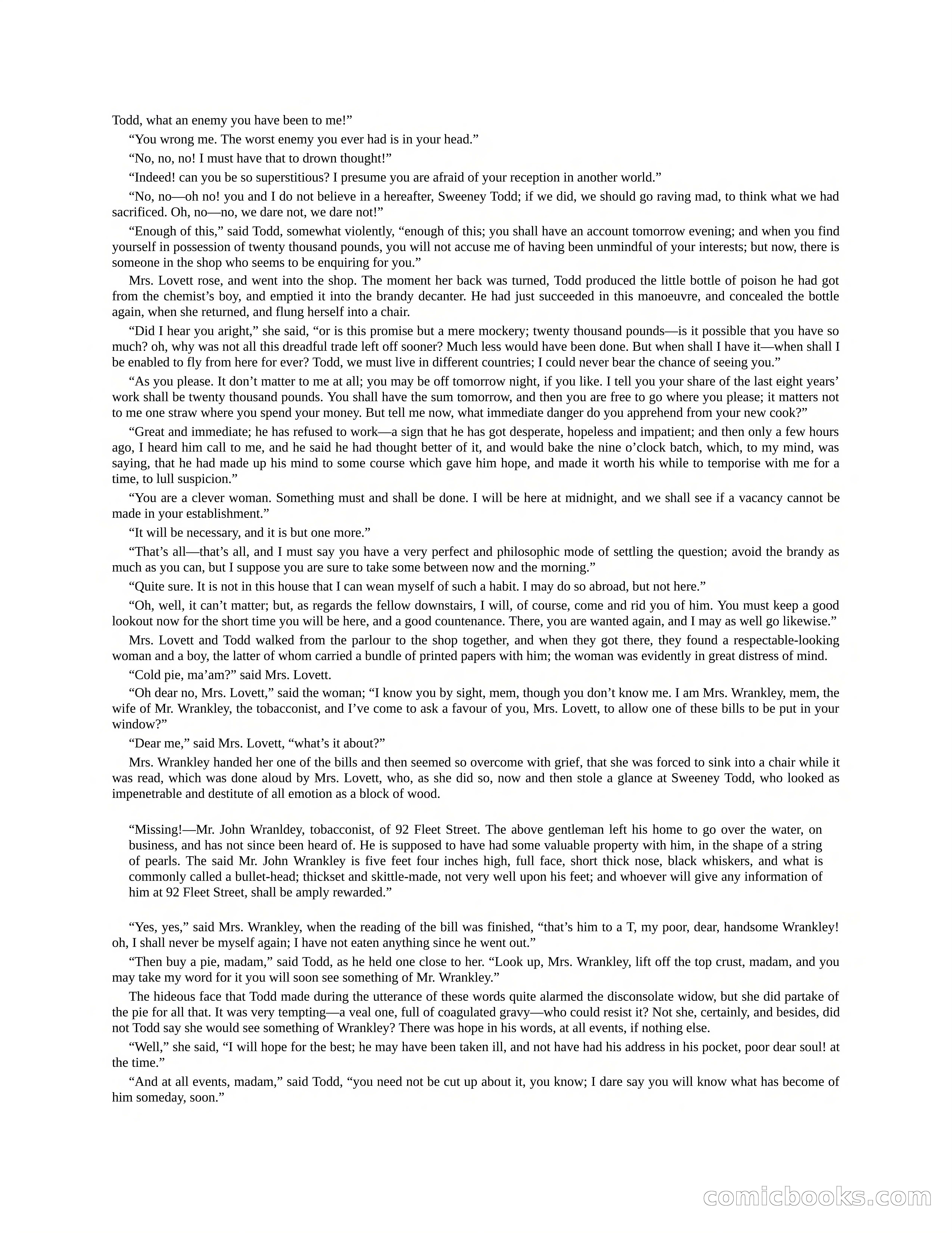
A restored page from Penny Dreadfuls, 1850. Page through the whole issue in the reader above.
📄 Transcribed text from this page (OCR, searchable)
Machine-transcribed from the original scan — historical spelling and the odd misread are preserved.
33 | Todd, what an enemy you have been to me “You wrong me. The worst enemy you ever had is in your head.” “No, no, no! I must have that to drown thought!” “Indeed! can you be so superstitious? I presume you are afraid of your reception in another world.” “No, no—oh no! you and I do not believe in a hereafter, Sweeney Todd; if we did, we should go raving mad, to think what we had sacrificed. Oh, no—no, we dare not, we dare not!” “Enough of this,” said Todd, somewhat violently, “enough of this; you shall have an account tomorrow evening; and when you find yourself in possession of twenty thousand pounds, you will not accuse me of having been unmindful of your interests; but now, there is someone in the shop who seems to be enquiring for you.” Mrs. Lovett rose, and went into the shop. The moment her back was turned, Todd produced the little bottle of poison he had got from the chemist’s boy, and emptied it into the brandy decanter. He had just succeeded in this manoeuvre, and concealed the bottle again, when she returned, and flung herself into a chair. “Did I hear you aright,” she said, “or is this promise but a mere mockery; twenty thousand pounds—is it possible that you have so much? oh, why was not all this dreadful trade left off sooner? Much less would have been done. But when shall I have it—when shall I be enabled to fly from here for ever? Todd, we must live in different countries; I could never bear the chance of seeing you.” “As you please. It don’t matter to me at all; you may be off tomorrow night, if you like. I tell you your share of the last eight years’ work shall be twenty thousand pounds. You shall have the sum tomorrow, and then you are free to go where you please; it matters not to me one straw where you spend your money. But tell me now, what immediate danger do you apprehend from your new cook?” “Great and immediate; he has refused to work—a sign that he has got desperate, hopeless and impatient; and then only a few hours ago, I heard him call to me, and he said he had thought better of it, and would bake the nine o’clock batch, which, to my mind, was saying, that he had made up his mind to some course which gave him hope, and made it worth his while to temporise with me for a time, to lull suspicion.” “You are a clever woman. Something must and shall be done. I will be here at midnight, and we shall see if a vacancy cannot be made in your establishment.” “Tt will be necessary, and it is but one more.” “That’s all—that’s all, and I must say you have a very perfect and philosophic mode of settling the question; avoid the brandy as much as you can, but I suppose you are sure to take some between now and the morning.” “Quite sure. It is not in this house that I can wean myself of such a habit. I may do so abroad, but not here.” “Oh, well, it can’t matter; but, as regards the fellow downstairs, I will, of course, come and rid you of him. You must keep a good lookout now for the short time you will be here, and a good countenance. There, you are wanted again, and I may as well go likewise.” Mrs. Lovett and Todd walked from the parlour to the shop together, and when they got there, they found a respectable-looking woman and a boy, the latter of whom carried a bundle of printed papers with him; the woman was evidently in great distress of mind. “Cold pie, ma’am?” said Mrs. Lovett. “Oh dear no, Mrs. Lovett,” said the woman; “I know you by sight, mem, though you don’t know me. I am Mrs. Wrankley, mem, the wife of Mr. Wrankley, the tobacconist, and I’ve come to ask a favour of you, Mrs. Lovett, to allow one of these bills to be put in your window?” “Dear me,” said Mrs. Lovett, “what’s it about?” Mrs. Wrankley handed her one of the bills and then seemed so overcome with grief, that she was forced to sink into a chair while it was read, which was done aloud by Mrs. Lovett, who, as she did so, now and then stole a glance at Sweeney Todd, who looked as impenetrable and destitute of all emotion as a block of wood. “Missing!—Mr. John Wranldey, tobacconist, of 92 Fleet Street. The above gentleman left his home to go over the water, on business, and has not since been heard of. He is supposed to have had some valuable property with him, in the shape of a string of pearls. The said Mr. John Wrankley is five feet four inches high, full face, short thick nose, black whiskers, and what is commonly called a bullet-head; thickset and skittle-made, not very well upon his feet; and whoever will give any information of him at 92 Fleet Street, shall be amply rewarded.” “Yes, yes,” said Mrs. Wrankley, when the reading of the bill was finished, “that’s him to a T, my poor, dear, handsome Wrankley! oh, I shall never be myself again; I have not eaten anything since he went out.” “Then buy a pie, madam,” said Todd, as he held one close to her. “Look up, Mrs. Wrankley, lift off the top crust, madam, and you may take my word for it you will soon see something of Mr. Wrankley.” The hideous face that Todd made during the utterance of these words quite alarmed the disconsolate widow, but she did partake of the pie for all that. It was very tempting—a veal one, full of coagulated gravy—who could resist it? Not she, certainly, and besides, did not Todd say she would see something of Wrankley? There was hope in his words, at all events, if nothing else. “Well,” she said, “I will hope for the best; he may have been taken ill, and not have had his address in his pocket, poor dear soul! at the time.” “And at all events, madam,” said Todd, “you need not be cut up about it, you know; I dare say you will know what has become of him someday, soon.” CORniclooo S CO)