
Penny Dreadfuls, 1850 · page 118 of 400
The Gift of the Sailor: The String of Pearls & Sweeney Todd, the Demon Barber of Fleet Street — page 118: what you’re looking at
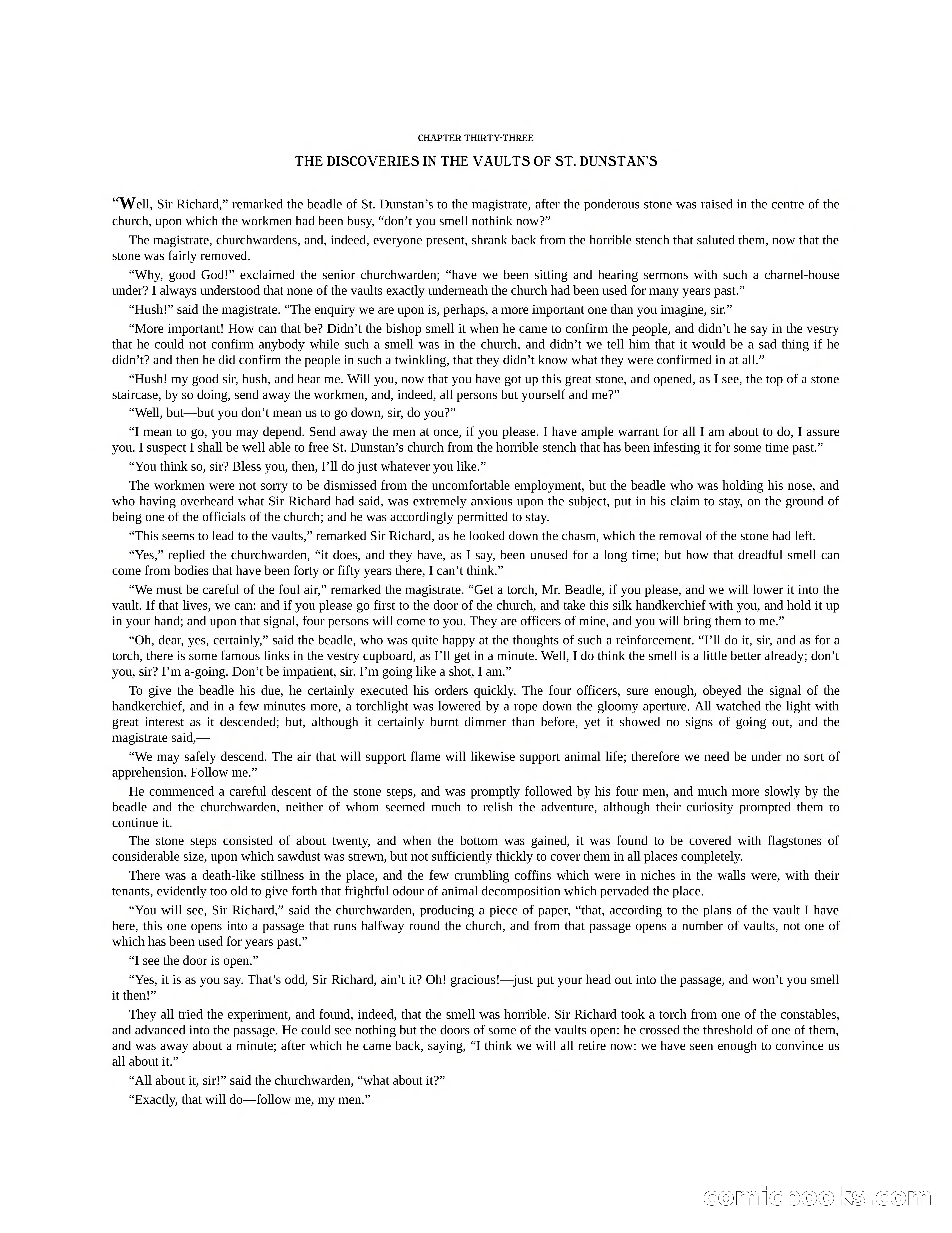
A restored page from Penny Dreadfuls, 1850. Page through the whole issue in the reader above.
📄 Transcribed text from this page (OCR, searchable)
Machine-transcribed from the original scan — historical spelling and the odd misread are preserved.
CHAPTER THIRTY-THREE THE DISCOVERIES IN THE VAULTS OF ST. DUNSTAN’S “Well, Sir Richard,” remarked the beadle of St. Dunstan’s to the magistrate, after the ponderous stone was raised in the centre of the church, upon which the workmen had been busy, “don’t you smell nothink now?” The magistrate, churchwardens, and, indeed, everyone present, shrank back from the horrible stench that saluted them, now that the stone was fairly removed. “Why, good God!” exclaimed the senior churchwarden; “have we been sitting and hearing sermons with such a charnel-house under? I always understood that none of the vaults exactly underneath the church had been used for many years past.” “Hush!” said the magistrate. “The enquiry we are upon is, perhaps, a more important one than you imagine, sir.” “More important! How can that be? Didn’t the bishop smell it when he came to confirm the people, and didn’t he say in the vestry that he could not confirm anybody while such a smell was in the church, and didn’t we tell him that it would be a sad thing if he didn’t? and then he did confirm the people in such a twinkling, that they didn’t know what they were confirmed in at all.” “Hush! my good sir, hush, and hear me. Will you, now that you have got up this great stone, and opened, as I see, the top of a stone staircase, by so doing, send away the workmen, and, indeed, all persons but yourself and me?” “Well, but—but you don’t mean us to go down, sir, do you?” “T mean to go, you may depend. Send away the men at once, if you please. I have ample warrant for all I am about to do, I assure you. I suspect I shall be well able to free St. Dunstan’s church from the horrible stench that has been infesting it for some time past.” “You think so, sir? Bless you, then, I’Il do just whatever you like.” The workmen were not sorry to be dismissed from the uncomfortable employment, but the beadle who was holding his nose, and who having overheard what Sir Richard had said, was extremely anxious upon the subject, put in his claim to stay, on the ground of being one of the officials of the church; and he was accordingly permitted to stay. “This seems to lead to the vaults,” remarked Sir Richard, as he looked down the chasm, which the removal of the stone had left. “Yes,” replied the churchwarden, “it does, and they have, as I say, been unused for a long time; but how that dreadful smell can come from bodies that have been forty or fifty years there, I can’t think.” “We must be careful of the foul air,” remarked the magistrate. “Get a torch, Mr. Beadle, if you please, and we will lower it into the vault. If that lives, we can: and if you please go first to the door of the church, and take this silk handkerchief with you, and hold it up in your hand; and upon that signal, four persons will come to you. They are officers of mine, and you will bring them to me.” “Oh, dear, yes, certainly,” said the beadle, who was quite happy at the thoughts of such a reinforcement. “I’ll do it, sir, and as fora torch, there is some famous links in the vestry cupboard, as I’ ll get in a minute. Well, I do think the smell is a little better already; don’t you, sir? I’m a-going. Don’t be impatient, sir. I’m going like a shot, I am.” To give the beadle his due, he certainly executed his orders quickly. The four officers, sure enough, obeyed the signal of the handkerchief, and in a few minutes more, a torchlight was lowered by a rope down the gloomy aperture. All watched the light with great interest as it descended; but, although it certainly burnt dimmer than before, yet it showed no signs of going out, and the magistrate said,— “We may safely descend. The air that will support flame will likewise support animal life; therefore we need be under no sort of apprehension. Follow me.” He commenced a careful descent of the stone steps, and was promptly followed by his four men, and much more slowly by the beadle and the churchwarden, neither of whom seemed much to relish the adventure, although their curiosity prompted them to continue it. The stone steps consisted of about twenty, and when the bottom was gained, it was found to be covered with flagstones of considerable size, upon which sawdust was strewn, but not sufficiently thickly to cover them in all places completely. There was a death-like stillness in the place, and the few crumbling coffins which were in niches in the walls were, with their tenants, evidently too old to give forth that frightful odour of animal decomposition which pervaded the place. “You will see, Sir Richard,” said the churchwarden, producing a piece of paper, “that, according to the plans of the vault I have here, this one opens into a passage that runs halfway round the church, and from that passage opens a number of vaults, not one of which has been used for years past.” “T see the door is open.” “Yes, it is as you say. That’s odd, Sir Richard, ain’t it? Oh! gracious!—just put your head out into the passage, and won’t you smell it then!” They all tried the experiment, and found, indeed, that the smell was horrible. Sir Richard took a torch from one of the constables, and advanced into the passage. He could see nothing but the doors of some of the vaults open: he crossed the threshold of one of them, and was away about a minute; after which he came back, saying, “I think we will all retire now: we have seen enough to convince us all about it.” “All about it, sir!” said the churchwarden, “what about it?” “Exactly, that will do—follow me, my men.” CORniclooo S CO)