
Penny Dreadfuls, 1850 · page 107 of 400
The Gift of the Sailor: The String of Pearls & Sweeney Todd, the Demon Barber of Fleet Street — page 107: what you’re looking at
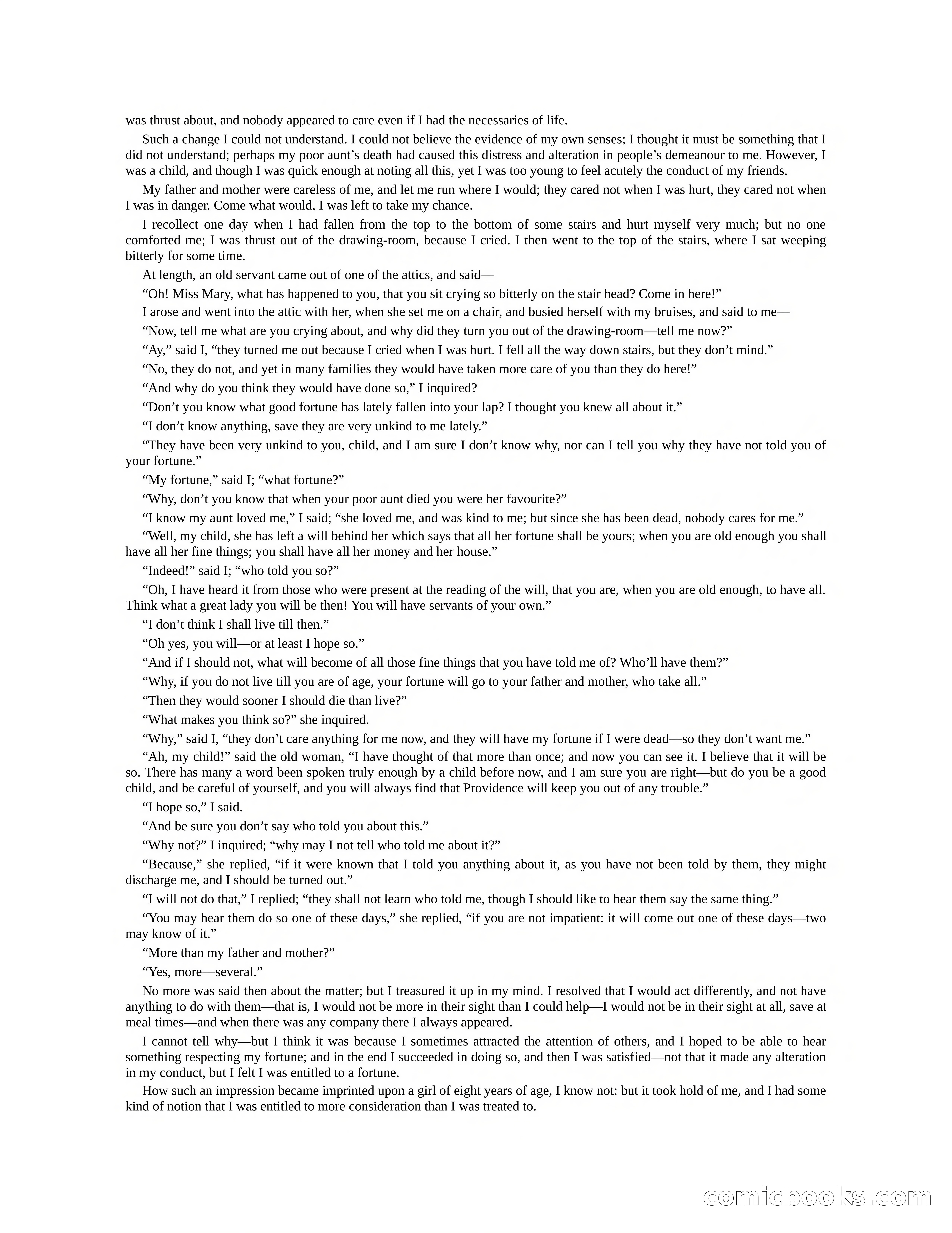
A restored page from Penny Dreadfuls, 1850. Page through the whole issue in the reader above.
📄 Transcribed text from this page (OCR, searchable)
Machine-transcribed from the original scan — historical spelling and the odd misread are preserved.
was thrust about, and nobody appeared to care even if I had the necessaries of life. Such a change I could not understand. I could not believe the evidence of my own senses; I thought it must be something that I did not understand; perhaps my poor aunt’s death had caused this distress and alteration in people’s demeanour to me. However, I was a Child, and though I was quick enough at noting all this, yet I was too young to feel acutely the conduct of my friends. My father and mother were careless of me, and let me run where I would; they cared not when I was hurt, they cared not when I was in danger. Come what would, I was left to take my chance. I recollect one day when I had fallen from the top to the bottom of some stairs and hurt myself very much; but no one comforted me; I was thrust out of the drawing-room, because I cried. I then went to the top of the stairs, where I sat weeping bitterly for some time. At length, an old servant came out of one of the attics, and said— “Oh! Miss Mary, what has happened to you, that you sit crying so bitterly on the stair head? Come in here!” I arose and went into the attic with her, when she set me on a chair, and busied herself with my bruises, and said to me— “Now, tell me what are you crying about, and why did they turn you out of the drawing-room—tell me now?” “Ay,” said I, “they turned me out because I cried when I was hurt. I fell all the way down stairs, but they don’t mind.” “No, they do not, and yet in many families they would have taken more care of you than they do here!” “And why do you think they would have done so,” I inquired? “Don’t you know what good fortune has lately fallen into your lap? I thought you knew all about it.” “T don’t know anything, save they are very unkind to me lately.” “They have been very unkind to you, child, and I am sure I don’t know why, nor can I tell you why they have not told you of your fortune.” “My fortune,” said I; “what fortune?” “Why, don’t you know that when your poor aunt died you were her favourite?” “T know my aunt loved me,” I said; “she loved me, and was kind to me; but since she has been dead, nobody cares for me.” “Well, my child, she has left a will behind her which says that all her fortune shall be yours; when you are old enough you shall have all her fine things; you shall have all her money and her house.” “Indeed!” said I; “who told you so?” “Oh, I have heard it from those who were present at the reading of the will, that you are, when you are old enough, to have all. Think what a great lady you will be then! You will have servants of your own.” “T don’t think I shall live till then.” “Oh yes, you will—or at least I hope so.” “And if I should not, what will become of all those fine things that you have told me of? Who’ Il have them?” “Why, if you do not live till you are of age, your fortune will go to your father and mother, who take all.” “Then they would sooner I should die than live?” “What makes you think so?” she inquired. “Why,” said I, “they don’t care anything for me now, and they will have my fortune if I were dead—so they don’t want me.” “Ah, my child!” said the old woman, “I have thought of that more than once; and now you can see it. I believe that it will be so. There has many a word been spoken truly enough by a child before now, and I am sure you are right—but do you be a good child, and be careful of yourself, and you will always find that Providence will keep you out of any trouble.” “T hope so,” I said. “And be sure you don’t say who told you about this.” “Why not?” I inquired; “why may I not tell who told me about it?” “Because,” she replied, “if it were known that I told you anything about it, as you have not been told by them, they might discharge me, and I should be turned out.” “T will not do that,” I replied; “they shall not learn who told me, though I should like to hear them say the same thing.” “You may hear them do so one of these days,” she replied, “if you are not impatient: it will come out one of these days—two may know of it.” “More than my father and mother?” “Yes, more—several.” No more was said then about the matter; but I treasured it up in my mind. I resolved that I would act differently, and not have anything to do with them—that is, I would not be more in their sight than I could help—I would not be in their sight at all, save at meal times—and when there was any company there I always appeared. I cannot tell why—but I think it was because I sometimes attracted the attention of others, and I hoped to be able to hear something respecting my fortune; and in the end I succeeded in doing so, and then I was satisfied—not that it made any alteration in my conduct, but I felt I was entitled to a fortune. How such an impression became imprinted upon a girl of eight years of age, I know not: but it took hold of me, and I had some kind of notion that I was entitled to more consideration than I was treated to. CORniclooo S CO)