
Penny Dreadfuls, 1848 · page 206 of 398
The Mysteries of the Court of London by Pauline Clarendon — page 206: what you’re looking at
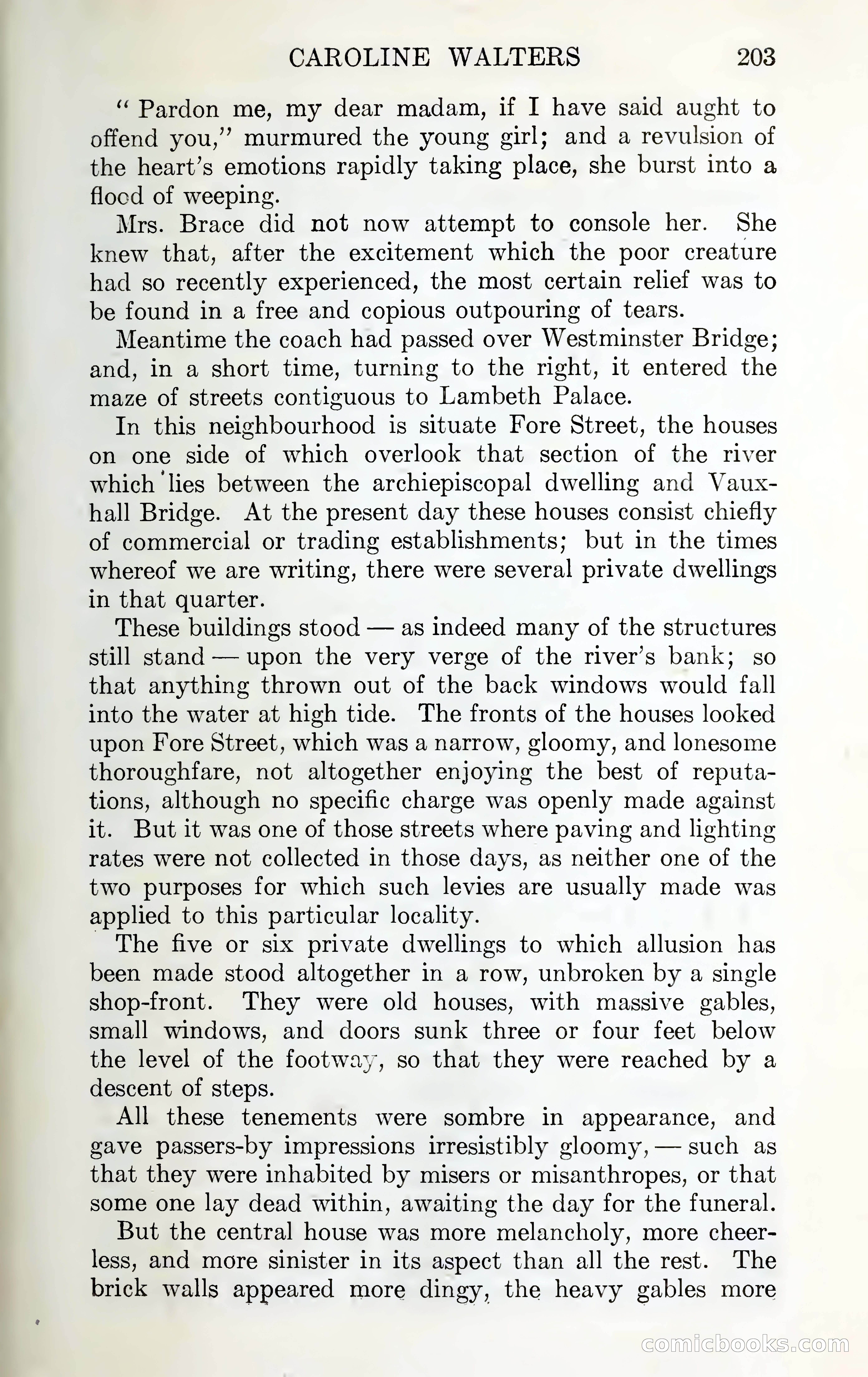
A restored page from Penny Dreadfuls, 1848. Page through the whole issue in the reader above.
📄 Transcribed text from this page (OCR, searchable)
Machine-transcribed from the original scan — historical spelling and the odd misread are preserved.
CAROLINE WALTERS 203 “ Pardon me, my dear madam, if I have said aught to offend you,’ murmured the young girl; and a revulsion of the heart’s emotions rapidly taking place, she burst into a flocd of weeping. Mrs. Brace did not now attempt to console her. She knew that, after the excitement which the poor creature had so recently experienced, the most certain reliel was to be found in a free and copious outpouring ol tears. Meantime the coach had passed over Westminster Bridge; and, in a short time, turning to the right, it entered the maze of streets contiguous to Lambeth Palace. In this neighbourhood is situate Fore Street, the houses on one side of which overlook that section of the river which lies between the archiepiscopal dwelling and Vaux- hall Bridge. At the present day these houses consist chiefly of commercial or trading establishments; but in the times whereof we are writing, there were several private dwellings in that quarter. These buildings stood — as indeed many of the structures still stand — upon the very verge of the river’s bank; so that anything thrown out of the back windows would fall into the water at high tide. The fronts of the houses looked upon Fore Street, which was a narrow, gloomy, and lonesome thoroughfare, not altogether enjoying the best of reputa- tions, although no specific charge was openly made against it. But it was one of those streets where paving and lighting rates were not collected in those days, as neither one of the two purposes for which such levies are usually made was applied to this particular locality. - The five or six private dwellings to which allusion has been made stood altogether in a row, unbroken by a single shop-front. They were old houses, with massive gables, small windows, and doors sunk three or four feet below the level of the footway, so that they were reached by a descent of steps. All these tenements were sombre in appearance, and gave passers-by impressions irresistibly gloomy,— such as that they were inhabited by misers or misanthropes, or that some one lay dead within, awaiting the day for the funeral. But the central house was more melancholy, more cheer- less, and more sinister in its aspect than all the rest. The brick walls appeared more dingy, the heavy gables more CONnniclooolKs (GO)