
Penny Dreadfuls, 1895 · page 4 of 20
The Halfpenny Surprise, Vol. I, No. 20 — page 4: what you’re looking at
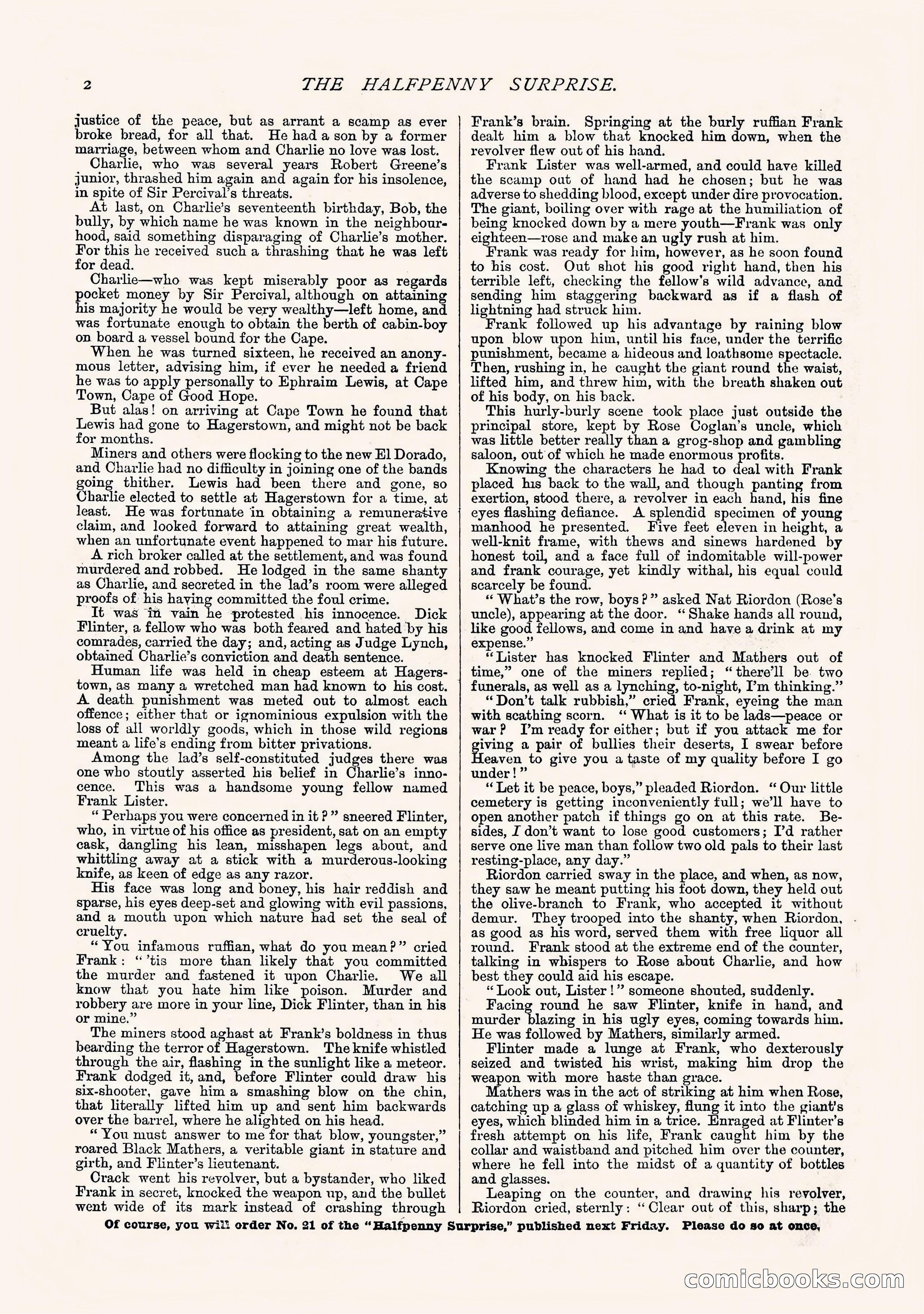
A restored page from Penny Dreadfuls, 1895. Page through the whole issue in the reader above.
📄 Transcribed text from this page (OCR, searchable)
Machine-transcribed from the original scan — historical spelling and the odd misread are preserved.
2 THE HALFPENNY SURPRISE. justice of the peace, but as arrant a scamp as ever broke bread, for all that. He had ason by a former marriage, between whom and Charlie no love was lost. Charlie, who was several years Robert Greene’s junior, thrashed him again and again for his insolence, in spite of Sir Percival’s threats. At last, on Charlie's seventeenth birthday, Bob, the bully, by which name he was known in the neighbour- hood, said something disparaging of Charlie’s mother. For this he received such a thrashing that he was left for dead. Charlie—who was kept miserably poor as regards pocket money by Sir Percival, although on attaining his majority he would be very wealthy—left home, and was fortunate enough to obtain the berth of cabin-boy on board a vessel bound for the Cape. When he was turned sixteen, he received an anony- mous letter, advising him, if ever he needed a friend he was to apply personally to Ephraim Lewis, at Cape Town, Cape of Good Hope. But alas! on arriving at Cape Town he found that Lewis had gone to Hagerstown, and might not be back for months. Miners and others were flocking to the new El Dorado, and Charlie had no difficulty in joining one of the bands going thither. Lewis had been there and gone, so Charlie elected to settle at Hagerstown for a time, at least. He was fortunate in obtaining a remunerative claim, and looked forward to attaining great wealth, when an unfortunate event happened to mar his future. A rich broker called at the settlement, and was found murdered and robbed. He lodged in the same shanty as Charlie, and secreted in the lad’s room were alleged proofs of his having committed the foul crime. It was im vain he protested his innocence. Dick Flinter, a fellow who was both feared and hated by his comrades, carried the day; and, acting as Judge Lynch, obtained Charlie’s conviction and death sentence. Human life was held in cheap esteem at Hagers- town, as many a wretched man had known to his cost. A death punishment was meted out to almost each offence; either that or ignominious expulsion with the loss of all worldly goods, which in those wild regions meant a life’s ending from bitter privations. Among the lad’s self-constituted judges there was one who stoutly asserted his belief in Charlie’s inno- cence. This was a handsome young fellow named Frank Lister. “ Perhaps you were concerned in it P” sneered Flinter, who, in virtue of his office as president, sat on an empty cask, dangling his lean, misshapen legs about, and whittling away at a stick with a murderous-looking Imife, as keen of edge as any razor. His face was long and boney, his hair reddish and sparse, his eyes deep-set and glowing with evil passions, and a mouth upon which nature had set the seal of cruelty. “You infamous ruffian, what do you mean?” cried Frank: “’tis more than likely that you committed the murder and fastened it upon Charlie. We all know that you hate him like poison. Murder and robbery are more in your line, Dick Flinter, than in his or mine.” The miners stood aghast at Frank’s boldness in thus bearding the terror of Hagerstown. The knife whistled through the air, flashing in the sunlight like a meteor. Frank dodged it, and, before Flinter could draw his six-shooter, gave hima smashing blow on the chin, that literally lifted him up and sent him backwards over the barrel, where he alighted on his head. “You must answer to me for that blow, youngster,” roared Black Mathers, a veritable giant in stature and girth, and Flinter’s lieutenant. Crack went his revolver, but a bystander, who liked Frank in secret, knocked the weapon up, and the bullet went wide of its mark instead of crashing through Frank’s brain. Springing at the burly ruffian Frank dealt him a blow that knocked him down, when the revolver flew out of his hand. Frank Lister was well-armed, and could have killed the scamp out of hand had he chosen; but he was adverse to shedding blood, except under dire provocation. The giant, boiling over with rage at the humiliation of being knocked down by a mere youth—Frank was only eighteen—rose and make an ugly rush at him. Frank was ready for him, however, as he soon found to his cost. Out shot his good right hand, then his terrible left, checking the fellow's wild advance, and sending him staggering backward as if a flash of lightning had struck him. Frank followed up his advantage by raining blow upon blow upon him, until his face, under the terrific punishment, became a hideous and loathsome spectacle. Then, rushing in, he caught the giant round the waist, lifted him, and threw him, with the breath shaken out of his body, on his back. This hurly-burly scene took place just outside the principal store, kept by Rose Coglan’s uncle, which was little better really than a grog-shop and gambling saloon, out’ of which he made enormous profits. Knowing the characters he had to deal with Frank placed his back to the wall, and though panting from exertion, stood there, a revolver in each hand, his fine eyes flashing defiance. A splendid specimen of young manhood he presented. Five feet eleven in height, a well-knit frame, with thews and sinews hardened by honest toil, and a face full of indomitable will-power and frank courage, yet kindly withal, his equal could scarcely be found. ““ What’s the row, boys?” asked Nat Riordon (Rose’s uncle), appearing at the door. “Shake hands all round, like good fellows, and come in and have a drink at my expense.” “Lister has knocked Flinter and Mathers out of time,” one of the miners replied; “there’ll be. two funerals, as well as a lynching, to-night, I’m thinking.” “Don't talk rubbish,” cried Frank, eyeing the man with scathing scorn. ‘‘ What is it to be lads—peace or war? I’m ready for either; but if you attack me for iving a pair of bullies their deserts, I swear before Remreu to give you ataste of my quality before I go under!” “Let it be peace, boys,” pleaded Riordon. ‘“ Our little cemetery is getting inconveniently full; we'll have to open another patch if things go on at this rate. Be- sides, I don’t want to lose good customers; I’d rather serve one live man than follow two old pals to their last resting-place, any day.” Riordon carried sway in the place, and when, as now, they saw he meant putting his foot down, they held out the olive-branch to Frank, who accepted it without demur. They trooped into the shanty, when Riordon, - as good as his word, served them with free liquor all round. Frank stood at the extreme end of the counter, talking in whispers to Rose about Charlie, and how best they could aid his escape. “Look out, Lister!” someone shouted, suddenly. Facing round he saw Flinter, knife in hand, and murder ies in his ugly eyes, coming towards him. He was followed by Mathers, similarly armed. Flinter made a lunge at Frank, who dexterously seized and twisted his wrist, making him drop the weapon with more haste than grace. Mathers was in the act of striking at him when Rose, catching up a glass of whiskey, flung it into the giant's eyes, which blinded him in a trice. Enraged at Flinter’s fresh attempt on his life, Frank caught him by the collar and waistband and pitched him over the counter, where he fell into the midst of a quantity of bottles and glasses. Leaping on the counter, and drawing his revolver, Riordon cried, sternly: “Clear out of this, sharp; the Of course, you will order No. 21 of the “ Halfpenny Surprise,” published next Friday. Please do so at once, comiclbooks.comn