
Penny Dreadfuls, 1897 · page 53 of 64
The Arm Chair Library No. 79: The Haunted Homestead — page 53: what you’re looking at
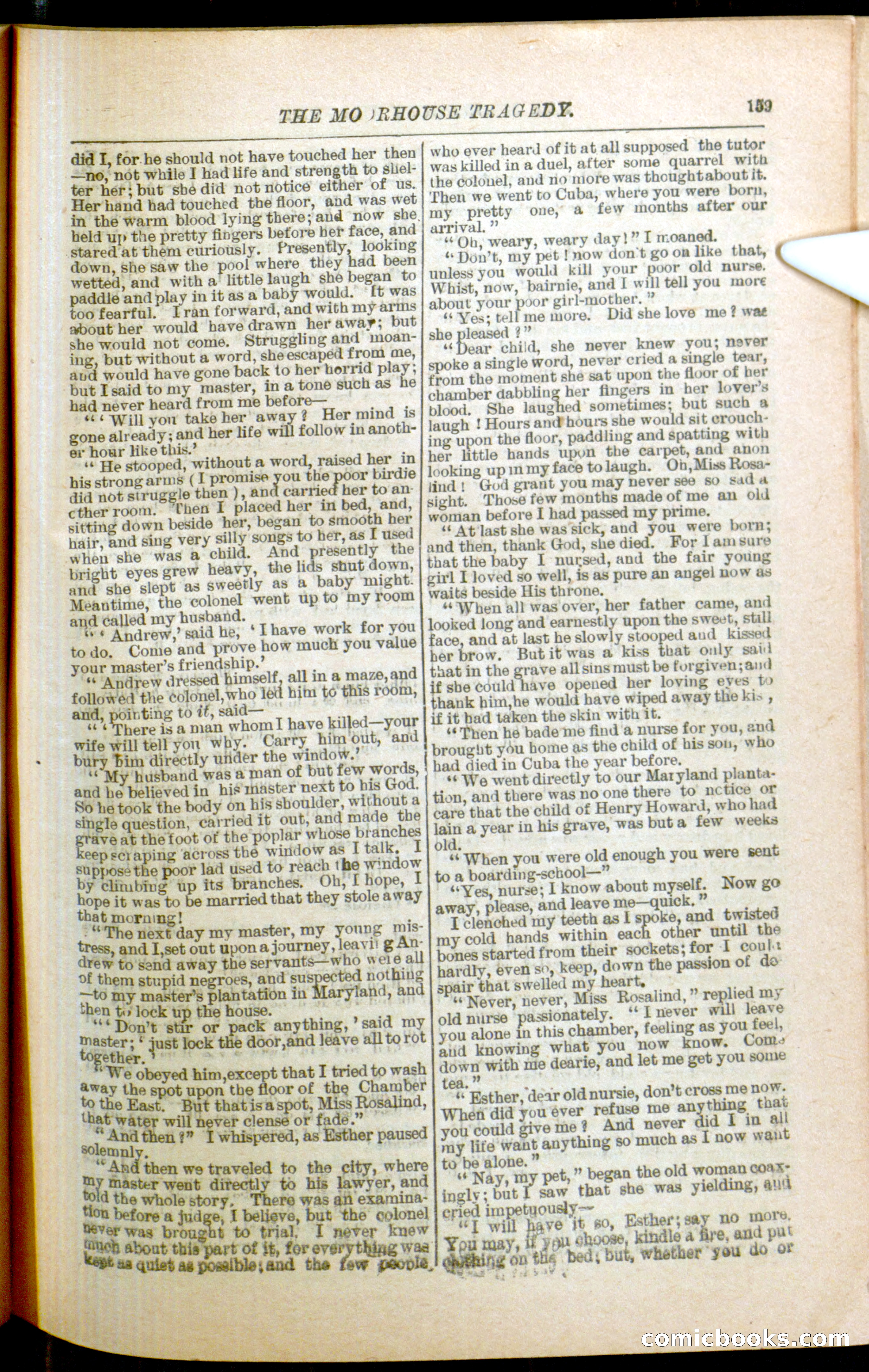
A restored page from Penny Dreadfuls, 1897. Page through the whole issue in the reader above.
📄 Transcribed text from this page (OCR, searchable)
Machine-transcribed from the original scan — historical spelling and the odd misread are preserved.
THE MO )RHOUSE TRAGEDY. 189 aan ——_--—-— did I, for.he should not have touched her then —no, not while T had life and strength to sliel- ter her: but shé did not notice either of us. Her hand had touched the floor, and was wet in the warm blood lying there; and now she. held up the pretty fingers before her face, and stared atthem curiously. Presently, looking had been wetted, and with a little laugh’ she began to paddie and play in it as a baby would. ‘{t was “ran forward, and with my arms about her would have drawn her away; but she would not come. Struggling and moan- down, she saw the pool where they too fearful. ing, but without a word, sheescaped from mie, avd would have gone back to her horrid play; but Isaid to my master, in a tone such as he had never heard from me before— ¢¢¢ Will you take her away ? Her mind is gone already; and her life will follow in anoth- hour like this.’ ‘¢ He stooped, without a word, raised her in his strong arms (I promise you the poor birdie did not struggle then ), and carried her to an- ctherroom. ‘hen I placed her in bed, and, sitting down beside her, began to smooth her hair, and sing very silly songs to her, as I used when she was a cbild. And presently the bright eyes grew heavy, the lids shut down, and she slept as sweetly as a baby might. Meantime, the colonel went up to my room and called my husband. * Andrew,’ said he, ‘ Thave work for you todo. Come and prove how much you value your master’s friendship.’ ‘* Andrew dressed himself, all in a maze, and followed the colonel, who led hiti to this room, and, pointing to if, said— “¢ Phere is a man whom have killed—your wife will tell you why. Carry him out, ‘and bury Bim directly under the window.’ ‘My husband was a man of but few words, and he believed in his iiaster next to his God. So he took the body on his shoulder, without a single question, carried it out, and made the sett at the toot of the poplar whose branches eep scraping across the window as I talk, I Supposs the poor lad used to reach the window by climbing up its branches. Oh, I hope, I hope it was to be married that they stole away that morning! “The next day my master, my young mis- ane and I set out upon a journey, leav!! g An- rew to'send away the servants—who weie all of them stupid negroes, and suspected nothing —to my master’s plantation in Aland, and *** Don’t: or pack anything, ’said my Betlice just lock the déor,and léave all to rot | y “We obeyed him,except that I tried to wash rate eat upon the floor of the Chamber nat wa et clensé or fade.” jal, I never knew “ And Esthe nd then we traveled to the where my aster went wore to his iver, and rs Hach ged ek fd 8 was an examina- people! quehing on tlie bed, but, whether you do oF who ever heard of it at all supposed the tutor was killed in a duel, after some quarrel with the colonel, and no more was thoughtabout it. Then we went to Cuba, where you were born, my pretty one, a few months after our arrival. ” “Oh, weary, weary day!” I moaned. «Don’t, my pet |! now don't go on like that, unless you would kill your poor old nurse. Whist, now, bairnie, and | will tell you moreé about your poor girl-mother. % ‘Yes; tellme more. Did she love me? wat she pleased ?” “Pear child, she never knew you; nover spoke a single word, never cried a single tear, from the moment she sat upon the floor of her chamber dabbling her fingers in her lover’s blood. She laughed sometimes, but such a laugh ! Hours and’ hours she would sit erouch- ing upon the floor, paddling and spatting with her little hands upon the carpet, and anon looking up m my face to laugh. Onn, Miss Rosa- find! God grant you may never see so sad a sight. Those few months made of me an old woman before I had passed my prime. ‘¢ At last she was sick, and you were born; and then, thank God, she died. For lamsure that the baby I nursed, and the fair young girl I loved so well, is as pure an angel now as waits beside His throne. +‘ When all was over, her father came, and looked long and earnestly upon the sweet, stall face, and at last he slowly stooped aud kissed her brow. Butit was a kiss that only satd that in the grave all sins must be furgiven;and if sbe could have opened her loving eyes to thank him,he would have wiped away the kis , if it had taken the skin with 1t. ‘Ten hé bade me find ‘a nurse for you, and brought you home as the child of his sou, who had died in Cuba the year before. ‘© We went directly to our Maryland planta- tion, and there was no one there to nctice or care that the child of Henry Howard, who had lain a year in his grave, was buta few weeks old. ‘+ When you were old enough you were sent to a boarding-scbool—’ “Yes, nurse; I know about myself. Now go away, please, and leave me—quick, ” : I clenched my teeth as I spoke, and twisted my cold hands within each other until the bones started from their sockets, for I coul: hardly, éven so, keep, down the passion of do spair that swelled my heart, ‘¢ Never, never, Miss Rosalind, ” replied my old niirse passionately. ‘‘ I never will leave ou alone in this chamber, feeling as you feel, aiid knowing what you now know. Come down with me dearie, and let me get you some ? ‘ Bsther, dear old nursie, don’t cross me now: Wher did you éver refuse me anything that you could give me @ And never did I in all my life want anything so much as I now want iby, ; t.” began the old woman coa% ay, my pet,” began the old woman cobs ingly ; bat yt iaw that she was yielding, anit > eried impetyously—~ “T will have it 60, Esther; say no more. You may, if you choose, kindle a fire, and put * boo a ae" 7 0 eo ete rs .