
Penny Dreadfuls, 1897 · page 3 of 64
The Arm Chair Library No. 79: The Haunted Homestead — page 3: what you’re looking at
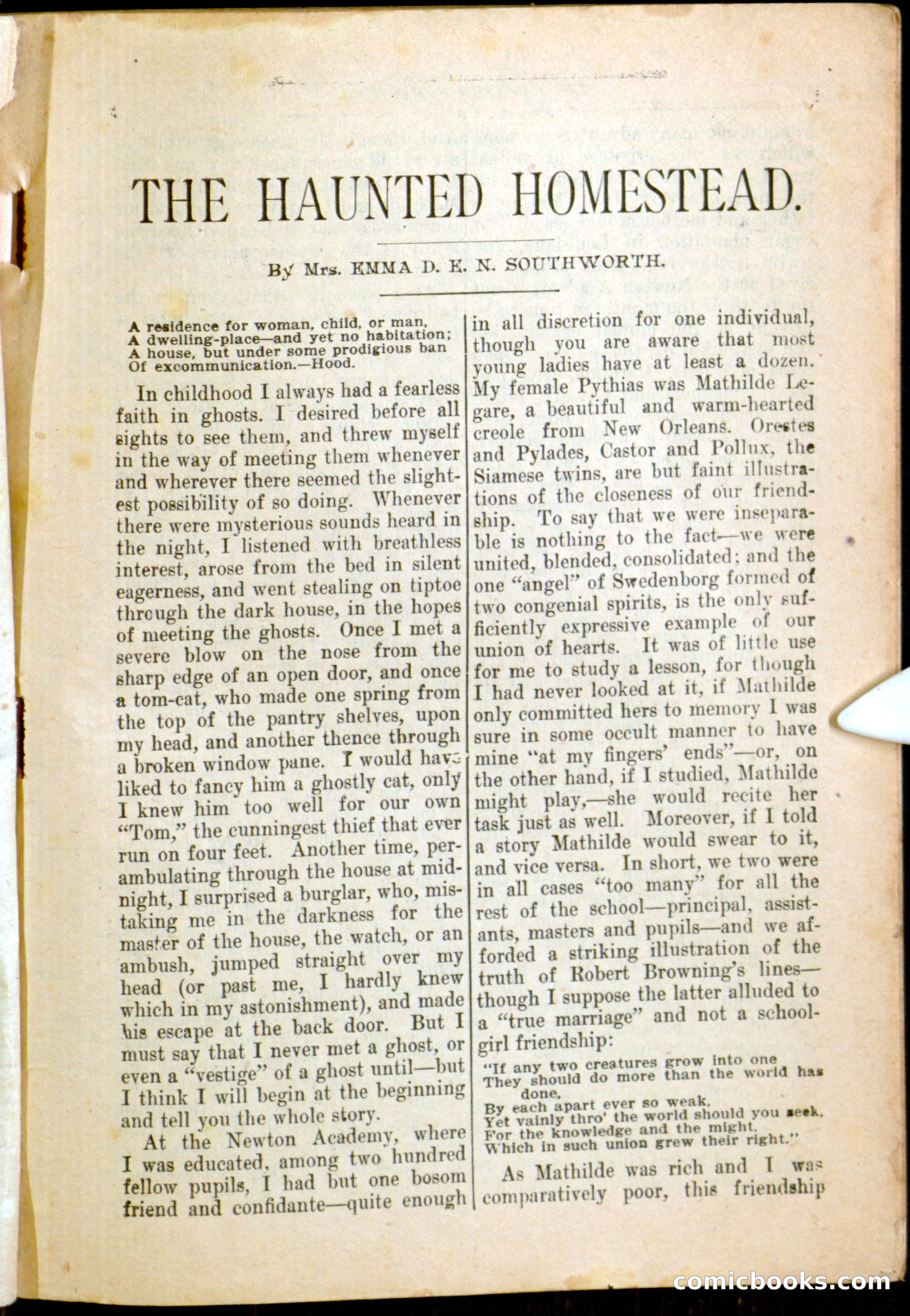
A restored page from Penny Dreadfuls, 1897. Page through the whole issue in the reader above.
📄 Transcribed text from this page (OCR, searchable)
Machine-transcribed from the original scan — historical spelling and the odd misread are preserved.
eS es =e + ct TP v ve, tpt Loe fat * ‘4 way ~ t 4 THE HAUNTED HOMESTEAD By Mrs. EMMA D. EK. N. SOUTH WORTH. A residence for woman, child, or man, A dwelling-place—and yet no habitation; A house, but under some prodigious ban Of excommunication.—Hood. In childhood I always had a fearless faith in ghosts. I desired before all sights to see them, and threw myself in the way of meeting them whenever and wherever there seemed the slight- est possibility of so doing. Whenever there were mysterious sounds heard in the night, I listened with breathless interest, arose from the bed in silent eagerness, and went stealing on tiptoe through the dark house, in the hopes of meeting the ghosts. Once I met a severe blow on the nose from the sharp edge of an open door, and once a tom-cat, who made one spring from the top of the pantry shelves, upon my head, and another thence through a broken window pane. TI would hav liked to fancy him a ghostly cat, only I knew him too well for our own “Tom,” the cunningest thief that ever run on four feet. Another time, per- ambulating through the house at mid- night, I surprised a burglar, who, mis- taking me in the darkness for the master of the house, the watch, or an ambush, jumped straight over my head (or past me, I hardly knew which in my astonishment), and made his escape at the back door. But I must say that I never met a ghost, or even a “vestige” of a ghost until—but I think I will begin at the beginning and tell you the whole story. At the Newton Academy, where I was educated, among two hundred fellow pupils, I had but one bosom friend and confidante—quite enough in all discretion for one individual, though you are aware that most young ladies have at least a dozen. ° My female Pythias was Mathilde Le- gare, a beautiful and warm-hearted creole from New Orleans. Orestes and Pylades, Castor and Pollux, the Siamese twins, are but faint illustra- tions of the closeness of our friend- ship. To say that we were insepara- ble is nothing to the fact—we were united, blended, consolidated; and the one “angel” of Swedenborg formed of two congenial spirits, is the only suf- ficiently expressive example of our union of hearts. It was of little use for me to study a lesson, for though I had never looked at it, if Mathilde only committed hers to memory 1 was sure in some occult manner to have mine “at my fingers’ ends’—or, on the other hand, if I studied, Mathilde might play,—she would recite her task just as well. Moreover, if I told a story Mathilde would swear to it, and vice versa. In short, we two were ‘n all cases “too many” for all the rest of the school—principal, assist- ants, masters and pupils—and we af- forded a striking illustration of the truth of Robert Browning’s lines— though I suppose the latter alluded to a “true marriage” and not a school- girl friendship: “Tf any two creatures grow into one They should do more than the world has done, By each apart ever 50 weak, , Yet vainly thro’ the world should you seek, For the knowledge and the might, Which in such union grew their right.” As Mathilde was rich and I was comparatively poor, this friendship od ge « — c-.