
Penny Dreadfuls, 1890 · page 36 of 48
Buffalo Bill: His Life and Adventures in the Wild West — page 36: what you’re looking at
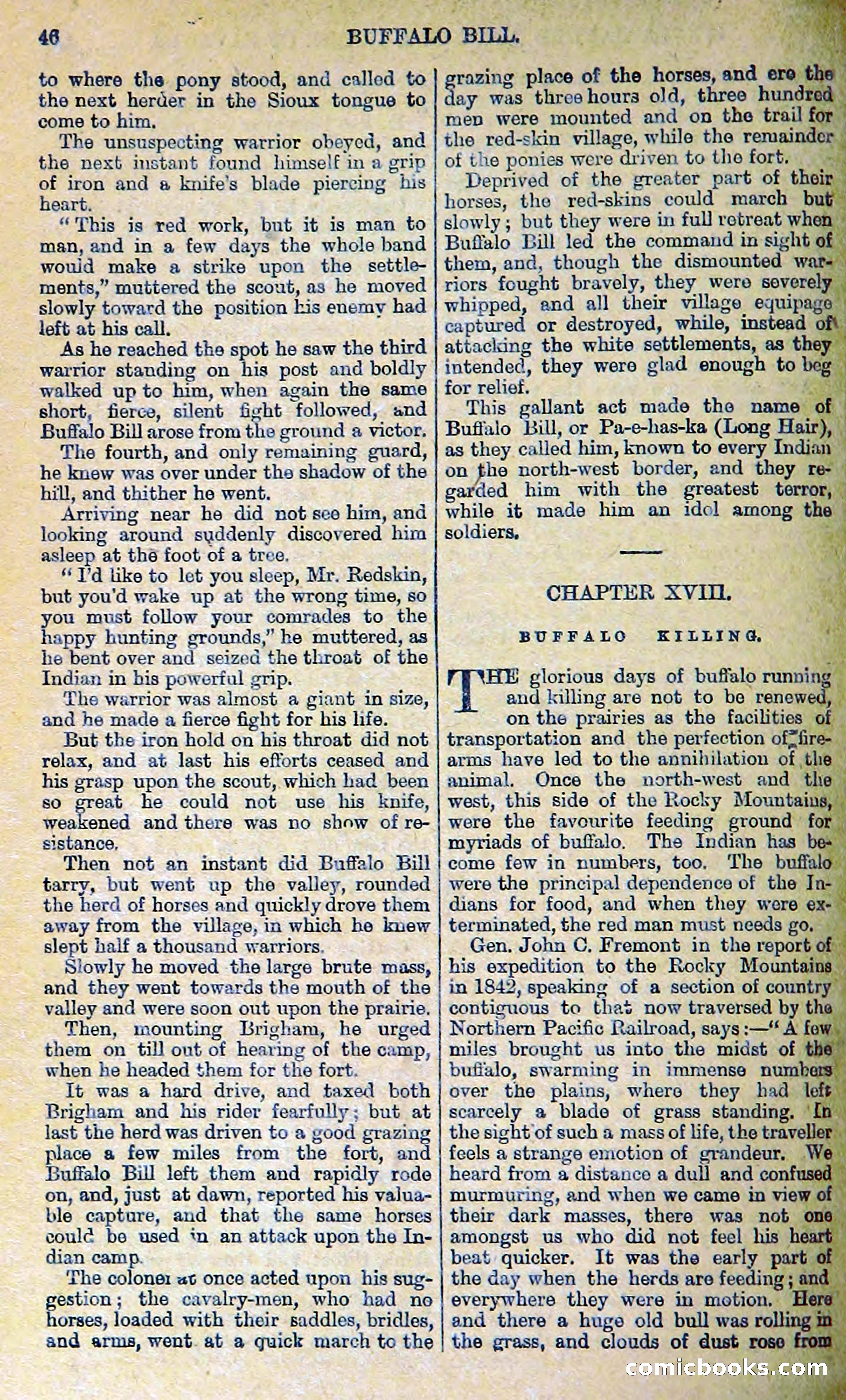
A restored page from Penny Dreadfuls, 1890. Page through the whole issue in the reader above.
📄 Transcribed text from this page (OCR, searchable)
Machine-transcribed from the original scan — historical spelling and the odd misread are preserved.
' Pe nO Enter Fa Oe ae | » 45 « se Ps v- 1% = < 2 + & . ~~ “hs 46 to where the pony stood, and the next herder in the Sioux tongue to come to him, The unsuspecting warrior obeyed, and the next instant found himself in a grip of iron and a knife’s blade piercing his heart. “This is red work, but it 1s man to man, and in a few days the whole band would make a strike upon the settle- ments,” muttered the scout, as he moved slowly toward the position his enemy had left at his call. As he reached the spot he saw the third waitior standing on his post and boldly walked up to him, when again the same short, fierce, silent fight followed, and _ Buffalo Bill arose from the ground 2 victor, The fourth, and only remaining guard, he knew was over under ths shadow of the hill, and thither he went. Arriving near he did not see him, and looking around suddenly discovered him asleep at thé foot of a tree, Vd like to let you sleep, Mr. Redskin, but you'd wake up at the wrong time, so you must follow your comrades to the happy hunting grounds,” he muttered, as he bent over and seized the throat of the Indian in bis powerful grip. The warrior was almost a giant In size, and he made a fierce fight for his hie. But the iron hold on his throat did not relax, and at last his efforts ceased and his grasp upon the scout, which had been so great he could not use his knife, weakened and there was no show of re- sistance, Then not an instant did Buffalo Bull tarry, but went up the valley, rounded the herd of horses and quickly drove them away from the village, in which he inew slept haif a thousand warriors. Slowly he moved the large brute mass, and they went towards the mouth of the valley and were soon out upon the prairie. Then, mounting Brigham, he urged them on till ont of hearing of the camp, when he headed them for the fort. It was a hard drive, and taxed both Brigham and his rider fearfully; but at last the herd was driven to a good grazing place a few miles from the fort, and Buffalo Bill left them and rapidly rode on, and, just at dawn, reported his valua- ble capture, and that the same horses coulc be used ‘n an attack upon the In- dian camp. The colone: at once acted upon his sug- gestion; the cavalry-men, who had no horses, loaded with their saddles, bridles, and arms, went. at a quick march to the BUFFALO BILL called to “ > re 4 vm ve ae + Bax Oh * a. 4 aT hk ae 2 ) ; © azing place of the horses, and ere the ay was threehours old, three hundred mep were mounted and on the trail for” the red-skin village, while the remainder of the ponies were driven to the fort. ~ Deprived of the greater part of their horses, the red-skins could march but slowly ; but they were in full retreat when Buffalo Bill led the command in sight of them, and, though the dismounted war- riors fought bravely, they were severely whipped, and all their village equipage — captured or destroyed, while, mstead oft attacking the white settlements, as they intended, they were glad enough to beg for relief. > “ae This gallant act made the name of — Buffalo Bill, or Pa-e-has-ka (Long Hair), © as they called him, known to every Indian ~ on the north-west border, and they re- garded him with the greatest terror, while it made him an idol among t soldiers, : KILLING « H¥ glorious days of buffalo running and killing are not to be renewed, on the prairies as the facilities of transportation and the perfection of-fire- arms have led to the annihilation of the animal. Once the north-west and the west, this side of the Rocky Mountains, were the favourite feeding ground for myriads of buffalo. The Indian has bes come few in numbers, too, The buffalo” were the principal dependence of the In- dians for food, and when they were ex- terminated, the red man must needs go, _ Gen. John C, Fremont in the report of his expedition to the Rocky Mountains in 1842, speaking of a section of country - contiguous to thas now traversed by the Northern Pacific Railroad, says :— A few miles brought us into the midst of the bufialo, swarming in immense numbers over the plains, where they had left scarcely a blade of grass standing, ‘fn the sight of such a mass of life, the traveller feels a strange emotion of grandeur, We heard from a distance a dull and confused murmuring, and when we came in view of their dark masses, there was nob oné amongst us who did not feel his heart beat quicker. It was the early part ol the day when the herds are feeding; and — everywhere they were in motion, Here and there a huge old bull was rolling the grass, and clouds of dust rose from Gomicbooks.cotr , Sie ect 2 BUFFALO