
Penny Dreadfuls, 1901 · page 33 of 37
The Boy Captain of the Black Swallow — page 33: what you’re looking at
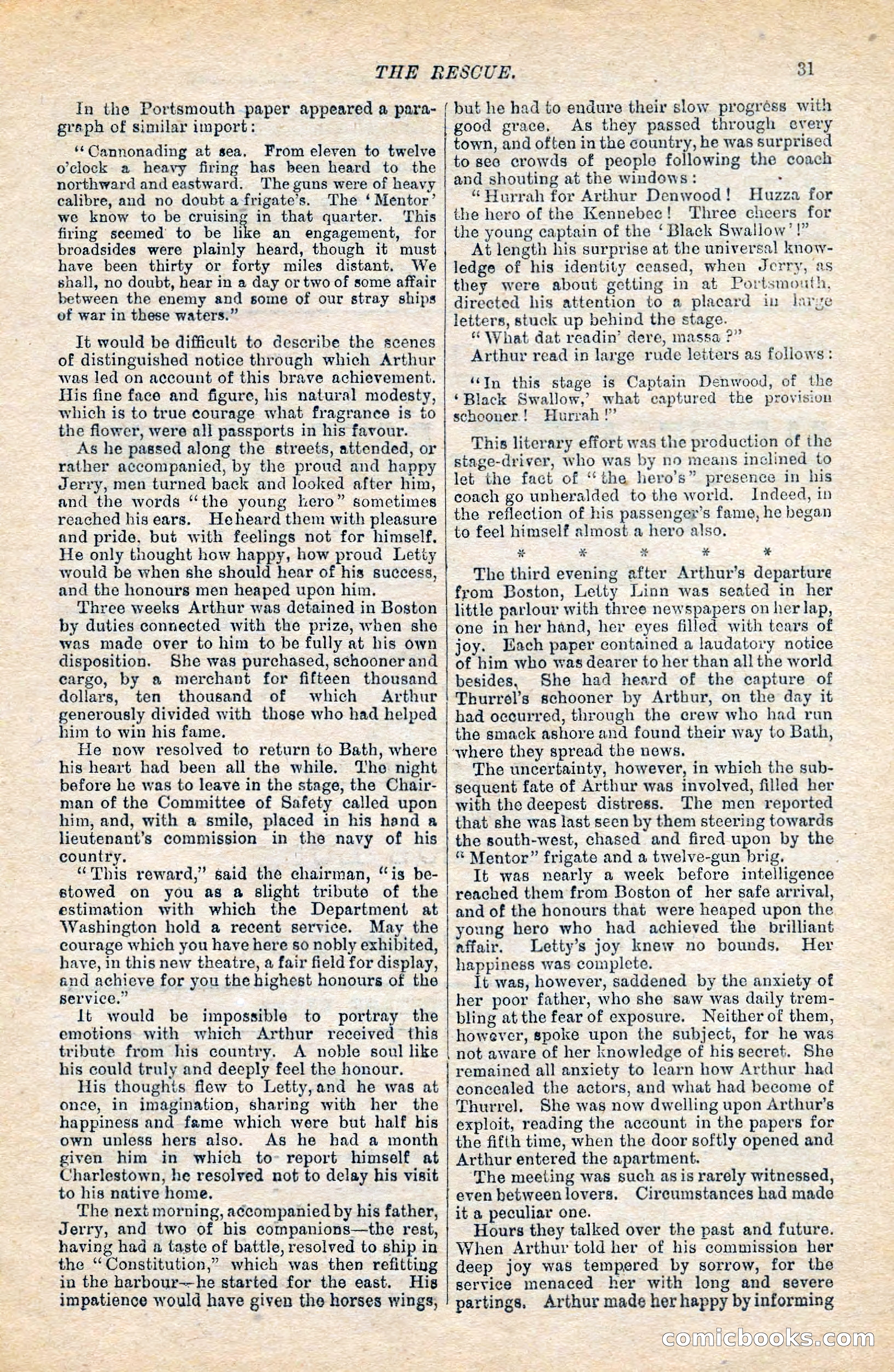
A restored page from Penny Dreadfuls, 1901. Page through the whole issue in the reader above.
📄 Transcribed text from this page (OCR, searchable)
Machine-transcribed from the original scan — historical spelling and the odd misread are preserved.
THE RESCUE, 3] In the Portsmouth paper appeared a para- { but he had to endure their slow progréss with graph of similar import: ‘¢Oannonading at sea, From eleven to twelve o'clock a heavy firmg has been heard to the northward and eastward. The guns were of heavy calibre, and no doubt afrigate’s. The ‘ Mentor’ we know to be cruising in that quarter. This firing seemed to be tke an engagement, for broadsides were plainly heard, though it must have been thirty or forty miles distant. We shall, no doubt, hear in a day or two of some affair between the enemy and some of our stray ships of war in these waters.” Jt would be difficult to describe the scenes of distinguished notice through which Arthur was led on account of this brave achievement. Klis fine face and figure, his natural modesty, which is to true courage what fragrance is to the flower, were all passports in his favour. As he passed along the streets, attended, or rather accompanied, by the proud and happy Jerry, men turned back and looked after him, and the words “the young kero” sometimes reached his ears. Heheard them with pleasure and pride, but with feelings not for himself, He only thought how happy, how proud Letty would be when she should hear of his success, and the honours men heaped upon him. Three weeks Arthur was detained in Boston by duties connected with the prize, when she was made over to him to be fully at his own disposition. She was purchased, schooner and eargo, by a merchant for fifteen thousand dollars, ten thousand of which Arthur generously divided with those who had helped him to win his fame. He now resolved to return to Bath, where his heart had been all the while. The night before he was to leave in the stage, the Chair- man of the Committee of Safety called upon him, and, with a smile, placed in his hand a lieutenant’s commission in the navy of his country. “This reward,” said the chairman, “is be- stowed on you as a slight tribute of the estimation with which the Department at Washington hold a recent service. May the courage which you have here so nobly exhibited, have, In this new theatre, a fair field for display, and achieve for you the highest honours of the service.” It would be impossible to portray the emotions with which Arthur received this tribute from his country. A noble soul like his could truly and deeply feel the honour. His thoughts flew to Letty,and he was at once, in imagination, sharing with her the happiness and fame which were but half his own unless hers also. As he had a month given him in which to- report himself at Charlestown, he resolved not to delay his visit to his native home. The next morning, accompanied by his father, Jerry, and two of his companions—the rest, having had a taste of battle, resolved to ship in the “Constitution,” which was then refitting in the harbour-—he started for the east. His impatience would have given the horses wings, OnE SS Se ee ae a en ee ee eae ae ae ee Eee ere SEO See SO CMe eS a eS LD ee ee a ara anenwarmtonentmmmmemnmereees good grace, As they passed through every town, and often in the country, he was surprised to see crowds of people following the coach and shouting at the windows: . “Hurrah for Arthur Denwood! Huzza for the hero of the Kennebec! Three cheers for the young captain of the ‘Black Swallow’ |!” At length his surprise at the universal know- ledge of his identity ceased, when Jerry, as they were about getting in at Portsmouth, directed his attention to a placard in larye letters, stuck up behind the stage. ‘What dat readin’ dere, massa ?” Arthur read in large rude letters as follows: ‘In this stage is Captain Denwood, of the ‘Black Swallow,’ what captured the provision schooner! Hurrah!” This literary effort was the production of the stage-driver, who was by no means inclined to let the fact of ‘the hero’s” presence in his coach go unheralded tothe world. Indeed, in the reflection of his passenger's fame, he began to feel himself almost a hero also. The third evening after Arthur’s departure from Boston, Letty Linn was seated in her little parlour with three newspapers on her lap, one in her hand, her eyes filled with tears of joy. Each paper contained a laudatory notice of him who was dearer to her than all the world besides, She had heard of the capture of Thurrel’s schooner by Arthur, on the day it had occurred, through the crew who had run the smack ashore and found their way to Bath, where they spread the news. The uncertainty, however, in which the sub- sequent fate of Arthur was involved, filled her with the deepest distress. The men reported that she was last seen by them steering towards the south-west, chased and fired upon by the ® Mentor” frigate and a twelve-gun brig. It was nearly a week before intelligence reached them from Boston of her safe arrival, and of the honours that were heaped upon the young hero who had achieved the brilliant affair. Letty’s joy knew no bounds, Her happiness was complete. It was, however, saddened by the anxiety of her poor father, who she saw was daily trem- bling at the fear of exposure. Neither of them, however, spoke upon the subject, for he was not aware of her knowledge of his secret. She remained all anxiety to learn how Arthur had econeealed the actors, and what had become of Thurrel, She was now dwelling upon Arthur’s exploit, reading the account in the papers for the fifth time, when the door softly opened and Arthur entered the apartment. ‘The meeting was such as is rarely witnessed, even between lovers. Circumstances had made it a peculiar one. Hours they talked over the past and future. When Arthur told her of his commission her deep joy was tempered by sorrow, for the service menaced her with long and severe partings. Arthur made her happy by informing oO Comichboo nn) S (©)