
Penny Dreadfuls, 1901 · page 3 of 37
The Boy Captain of the Black Swallow — page 3: what you’re looking at
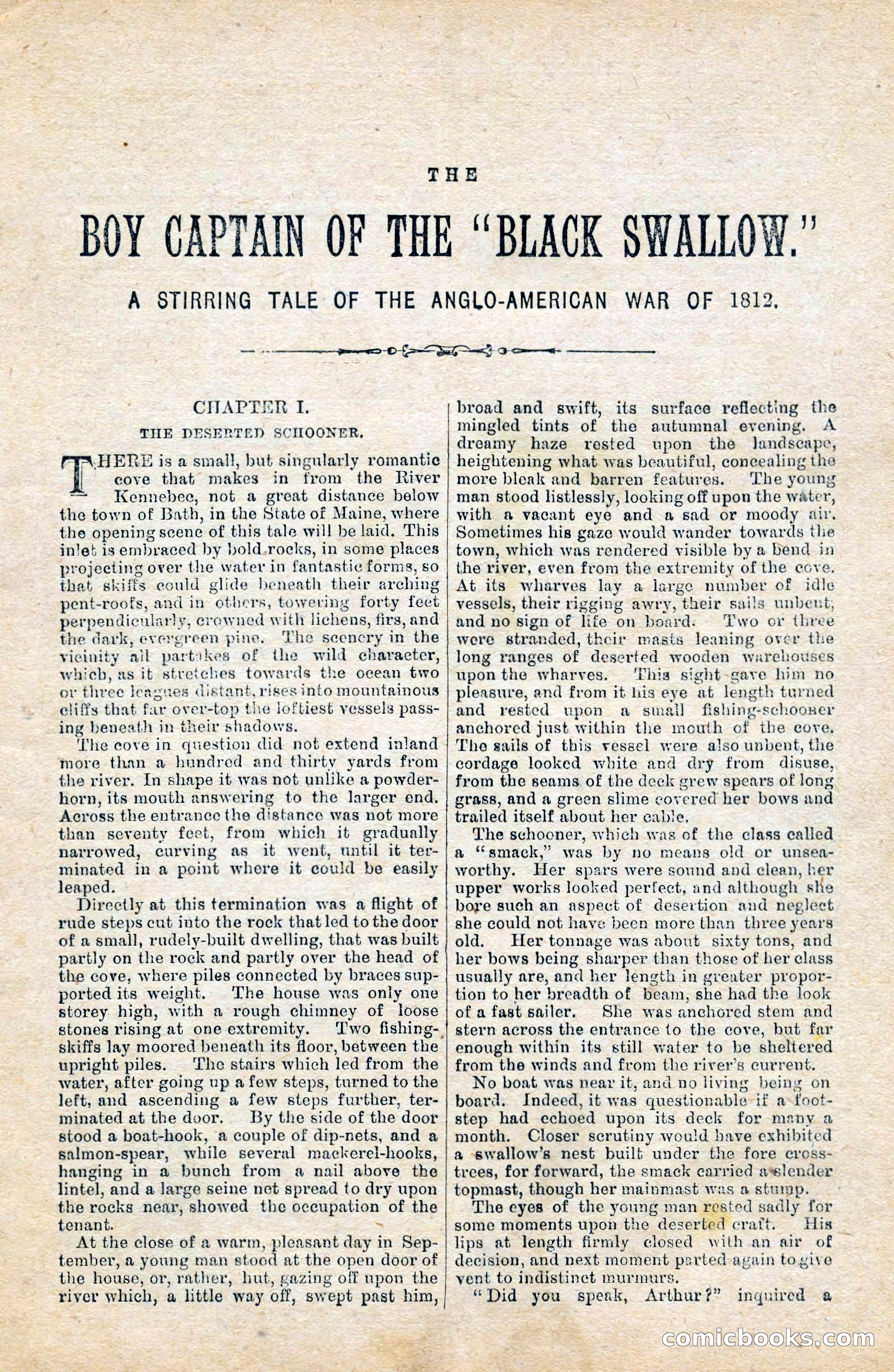
A restored page from Penny Dreadfuls, 1901. Page through the whole issue in the reader above.
📄 Transcribed text from this page (OCR, searchable)
Machine-transcribed from the original scan — historical spelling and the odd misread are preserved.
THE BOY CAPTAIN OF THE “BLACK SWALLOW.” A STIRRING TALE OF THE ANGLO-AMERICAN WAR OF 1812. CHAPTER I. THE DESERTED SCHOONER, A.HERE is a small, but singularly romantic T cove that makes in from the River Kennebee, not a great distance below the town of Bath, in the State of Maine, where the opening scene of this tale will be laid. This inlet is embraced by bold.rocks, in some places projecting over the water in fantastic forms, so that skiffs eould glide beneath their arching pent-roofs, and in others, towering forty feet perpendicularly, crowned with lichens, firs, and the dark, evergreen pine. The scenery in the vicinity all partakes of the wild character, which, xs if stretches towards the ocean two or three leagues distant, rises into mountainous eliffs that far ever-top the loftiest vessels pass- ing beneath in thei shadows. ‘The eove in question did not extend inland more than a hundred and thirty yards from the river. In shape it was not unlike a powder- horn, its mouth answering to the larger end. Across the entrance the distance was not more than seventy feet, from which it gradually narrowed, curving as it went, until it ter- minated in a point where it could be easily leaped. Directly at this termination was a flight of rude steps cut into the rock that led to the door of a small, rudely-built dwelling, that was built partly on the rock and partly over the head of the cove, where piles connected by braces sup- ported its weight. The house was only one storey high, with a rough chimney of loose stones rising at one extremity. ‘I'wo fishing-| skiffs lay moored beneath its floor, between the upright piles. The stairs which led from the water, after going up a few steps, turned to the left, and ascending a few steps further, ter- minated at the door. By the side of the door stood a boat-hook, a couple of dip-nets, and a salmon-spear, while several mackerel-hooks, hanging in a bunch from a nail above the lintel, and a large seine net spread to dry upon the rocks near, showed the occupation of the tenant. > At the close of a warm, pleasant day in Sep- tember, a young man stood at the open door of the house, or, rather, hut, gazing off upon the river which, a little way off, swept past him, a a SM broad and swift, its surface reflecting the mingled tints of the autumnal evening. A dreamy haze rested upon the landscape, heightening what was beautiful, coneealing the more bleak and barren features. The young man stood listlessly, looking off upon the water, with a vacant eye and a sad or moody air. Sometimes his gaze would wander towards tlie town, which was rendered visible by a bend in the river, even from the extremity of the cove. At its wharves lay a large number of idle vessels, their rigging awry, their sails unbent, and no sign of life on board. ‘Two or tliree were stranded, their masts leaning over the long ranges of deserted wooden warehouses upon the wharves. ‘This sight-gare him no pleasure, and from it his eye at length turned and rested upon a smail fishing-schooner anchored just within the mouth ef the cove, The sails of this vessel were also unbent, the cordage looked white and dry from disuse, from the seams of the deck grew spears of long grass, and a green slime covered her bows and trailed itself about her cable, The schooner, which was of the class called a ‘‘smack,” was by no means old or unsea- worthy. Her spars were sound and clean, her upper works looked perfect, and although she bore such an aspect of desertion and neglect she could not have been more than three years old. Her tonnage was about sixty tons, and her bows being sharper than those of her class usually are, and her length in greater propor- tion to her breadth of beam, she had the look ofa fast sailer. She was anchored stem and stern across the entrance to the cove, but far enough within its still water to be sheltered from the winds and from the river’s current. No boat was near it, and no living being on board. Indeed, it was questionable if a-foot- step had echoed upon its deck for many a month. Closer scrutiny would bave exhibited a swallow’s nest built under the fore cross- trees, for forward, the smack carried aslender topmast, though her mainmast was a stump. The eyes of the young man rested sadly for some moments upon the deserted cratt. His lips at length firmly closed with an air of decision, and next moment parted again toyvive yent to indistinct murmurs, “Did you speak, Arthur?” inguired a oO Comichboo S. (©)