
Penny Dreadfuls, 1900 · page 3 of 37
Old Shadow Shot — page 3: what you’re looking at
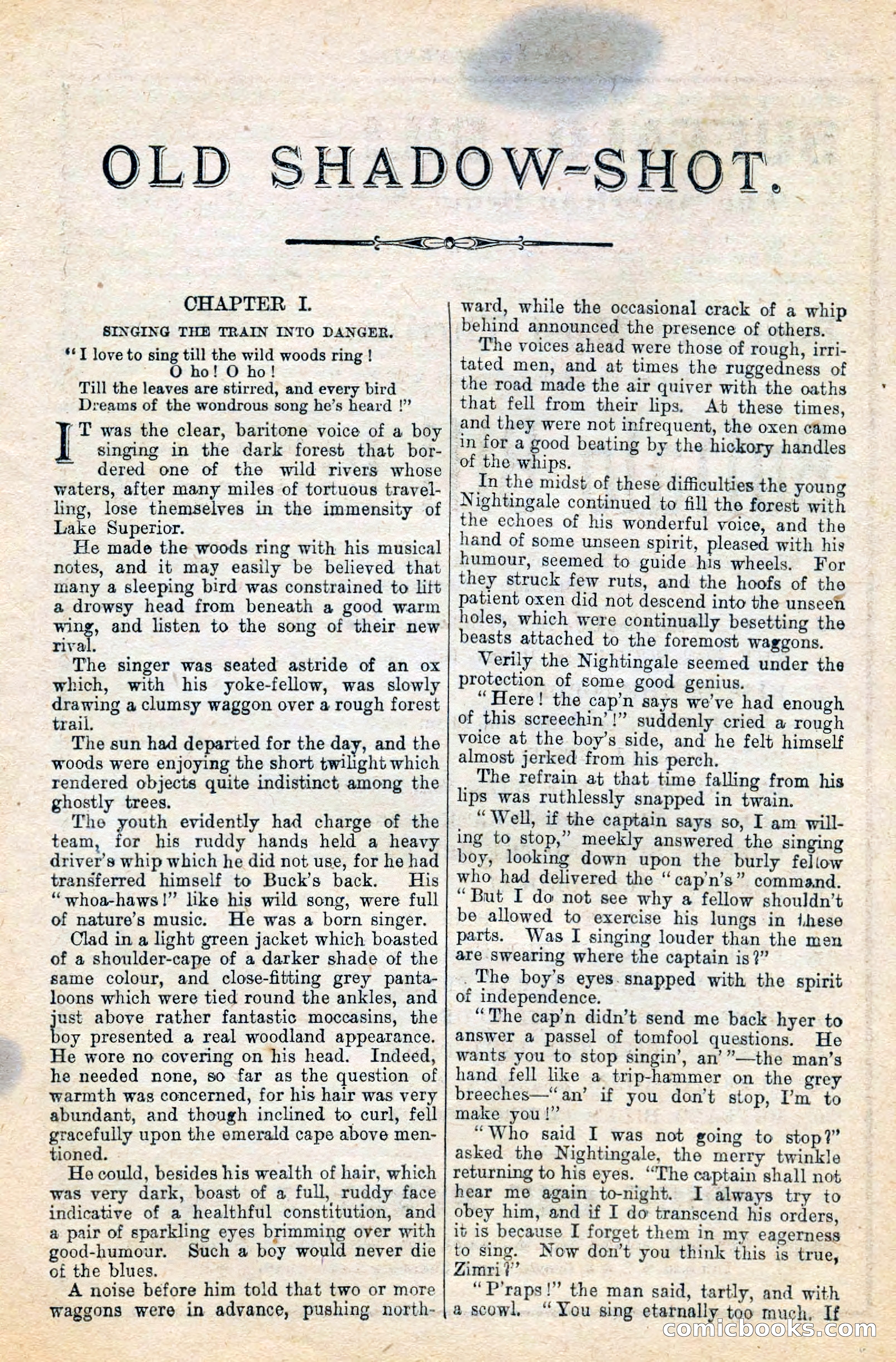
A restored page from Penny Dreadfuls, 1900. Page through the whole issue in the reader above.
📄 Transcribed text from this page (OCR, searchable)
Machine-transcribed from the original scan — historical spelling and the odd misread are preserved.
ee_rlee) CHAPTER I. SINGING THE TRAIN INTO DANGER. **T love to sing till the wild woods ring ! O ho! O ho! Till the leaves are stirred, and every bird Dreams of the wondrous song he’s heard !” T was the clear, baritone voice of a boy singing in the dark forest that bor- dered one of the wild rivers whose waters, after many miles of tortuous travel- ling, lose themselves in the immensity of Lake Superior. He made the woods ring with his musical notes, and it may easily be believed that many a sleeping bird was constrained to litt a drowsy head from beneath a good warm ia f and listen to the song of their new rival. The singer was seated astride of an ox which, with his yoke-fellow, was slowly drawing a clumsy waggon over a rough forest trail. The sun had departed for the day, and the woods were enjoying the short twilight which rendered objects quite indistinct among the ghostly trees. The youth evidently had charge of the team, for his ruddy handg held a heavy driver’s whip which he did not use, for he had transferred himself to Buck’s back. His ““whoa-haws!” like his wild song, were full of nature’s music. He was a born singer. Clad in a light green jacket which boasted of a shoulder-cape of a darker shade of the same colour, and close-fitting grey panta- loons which were tied round the ankles, and just above rather fantastic moccasins, the boy presented a real woodland appearance. He wore no covering on his head. Indeed, he needed none, so far as the question of warmth was concerned, for his hair was very abundant, and though inclined to curl, fell gracefully upon the emerald cape above men- tioned. He could, besides his wealth of hair, which was very dark, boast of a full, ruddy face indicative of a healthful constitution, and a pair of sparkling eyes ppnine oyer with good-humour. Such a boy would never die of the blues. A noise before him told that two or more waggons were in advance, pushing north- A OT. ward, while the occasional crack of a whip behind announced the presence of others. The voices ahead were those of rough, irri- tated men, and at times the ruggedness of the road made the air quiver with the oaths that fell from their lips. At these times, and they were not infrequent, the oxen came in for a good beating by the hickory handles of the whips. in the midst of these difficulties the young Nightingale continued to fill the forest with the echoes of his wonderful voice, and the hand of some unseen spirit, pleased with his humour, seemed to guide his wheels. For they struck few ruts, and the hoofs of the patient oxen did not descend into the unseeh holes, which were continually besetting the beasts attached to the foremost waggons. Verily the Nightingale seemed under the protection of some good genius. “ Here! the cap’n says we've had enough of this screechin’!” suddenly cried a rough voice at the boy’s side, and he felt himself almost jerked from his perch. _ The refrain at that time falling from his lips was ruthlessly snapped in twain. _ “Well, if the captain says so, I am will- ing to stop,” meekly answered the singing boy, looking down upon the burly fellow who had delivered the “cap’n’s” command. “But I do not see why a fellow shouldn't be allowed to exercise his lungs in ihese parts. Was I singing louder than the men are swearing where the captain is?” _The boy's eyes. snapped with the spirit of independence. “The cap’n didn’t send me back hyer to answer a passel of tomfool questions. He wants you to stop singin’, an’”—the man’s hand fell like a trip-hammer on the grey breeches—‘‘an’ if you don’t stop, I’m to make you !” “Who said I was not going to stop?” asked the Nightingale, the merry twinkle returning to his eyes. “The captain shall not hear me again to-night. I always try to obey him, and if I do transcend his orders, it is because I forget them in my eagerness to sing. Now don’t you think this is true, Zimri ¢” “P'raps!” the man said, tartly, and with a scowl, “You sing etarnally too much, If CONMUC MOO LSS (EO)