
Penny Dreadfuls, 1890 · page 170 of 233
That Girl of Johnson's — page 170: what you’re looking at
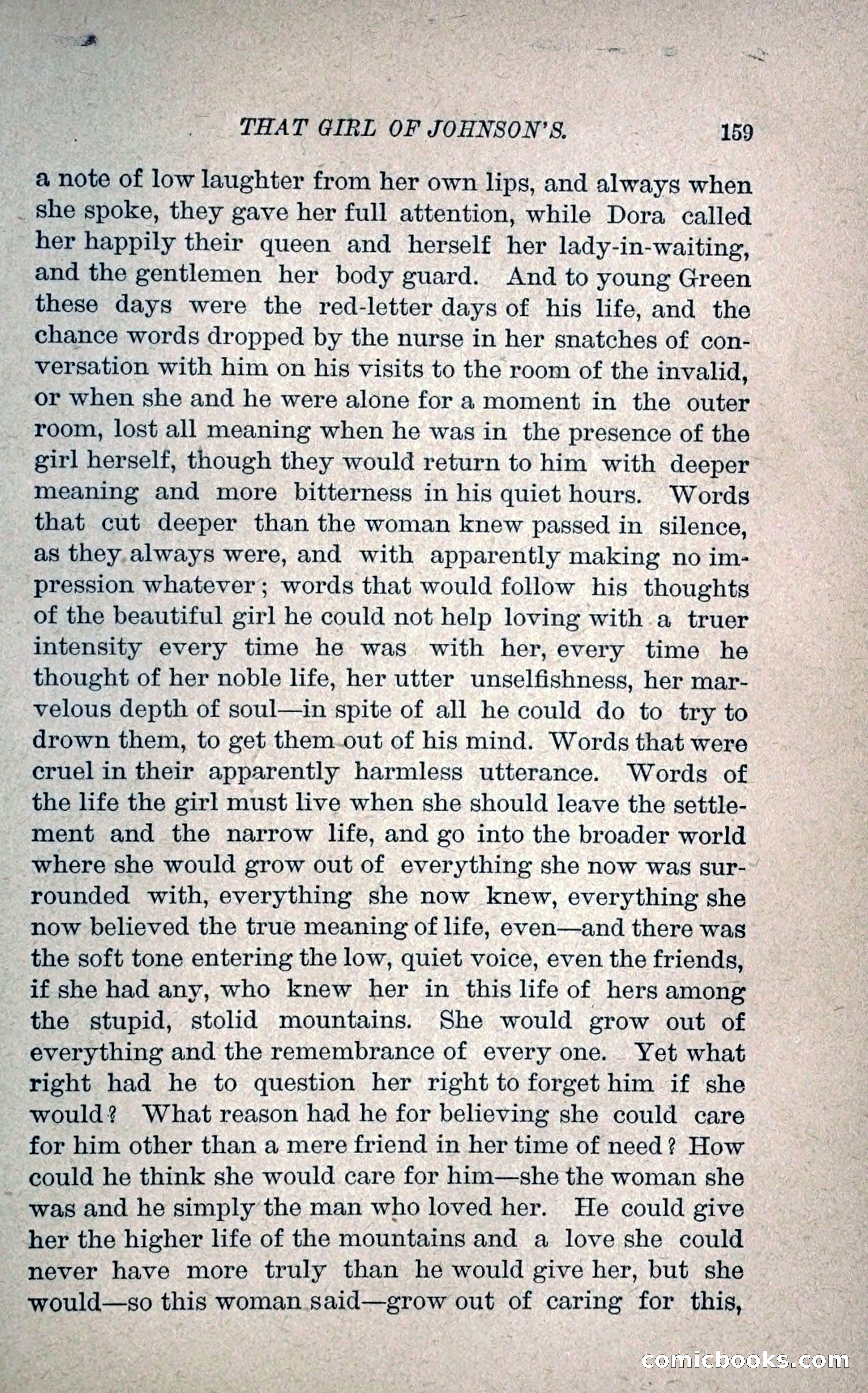
A restored page from Penny Dreadfuls, 1890. Page through the whole issue in the reader above.
📄 Transcribed text from this page (OCR, searchable)
Machine-transcribed from the original scan — historical spelling and the odd misread are preserved.
THAT GIRL OF JOHNSON’S. “8 159 a note of low laughter from her own lips, and always when _ She spoke, they gave her full attention, while Dora called her happily their queen and herself her lady-in- -waiting, and the gentlemen her body guard. And to young Green these days were the red-letter days of his life, and the chance words dropped by the nurse in her snatches of con- versation with him on his visits to the room of the invalid, or when she and he were alone for a moment in the outer room, lost all meaning when he was in the presence of the girl herself, though they would return to him with deeper meaning and more bitterness in his quiet hours. Words that cut deeper than the woman knew passed in silence, as they.always were, and with apparently making no im- pression whatever; words that would follow his thoughts of the beautiful girl he could not help loving with a truer intensity every time he was with her, every time he thought of her noble life, her utter unselfishness, her mar- velous depth of soul—in spite of all he could do to try to drown them, to get them-.out of his mind. Words that were cruel in their apparently harmless utterance. Words of the life the girl must live when she should leave the settle- ment and the narrow life, and go into the broader world where she would grow out of everything she now was sur- rounded with, everything she now knew, everything she now believed the true meaning of life, even—and there was the soft tone entering the low, quiet voice, even the friends, if she had any, who knew her in this life of hers among the stupid, stolid mountains. She would grow out of everything and the remembrance of every one. Yet what right had he to question her right to forget him if she would? What reason had he for believing she could care for him other than a mere friend in her time of need? How could he think she would care for him—she the woman she was and he simply the man who loved her. He could give her the higher life of the mountains and a love she could never have more truly than he would give her, but she would—so this woman said—grow out of caring for this, ‘S (E(0) m Gomichoo