
Penny Dreadfuls, 1850 · page 139 of 396
The String of Pearls; or, The Barber of Fleet Street — page 139: what you’re looking at
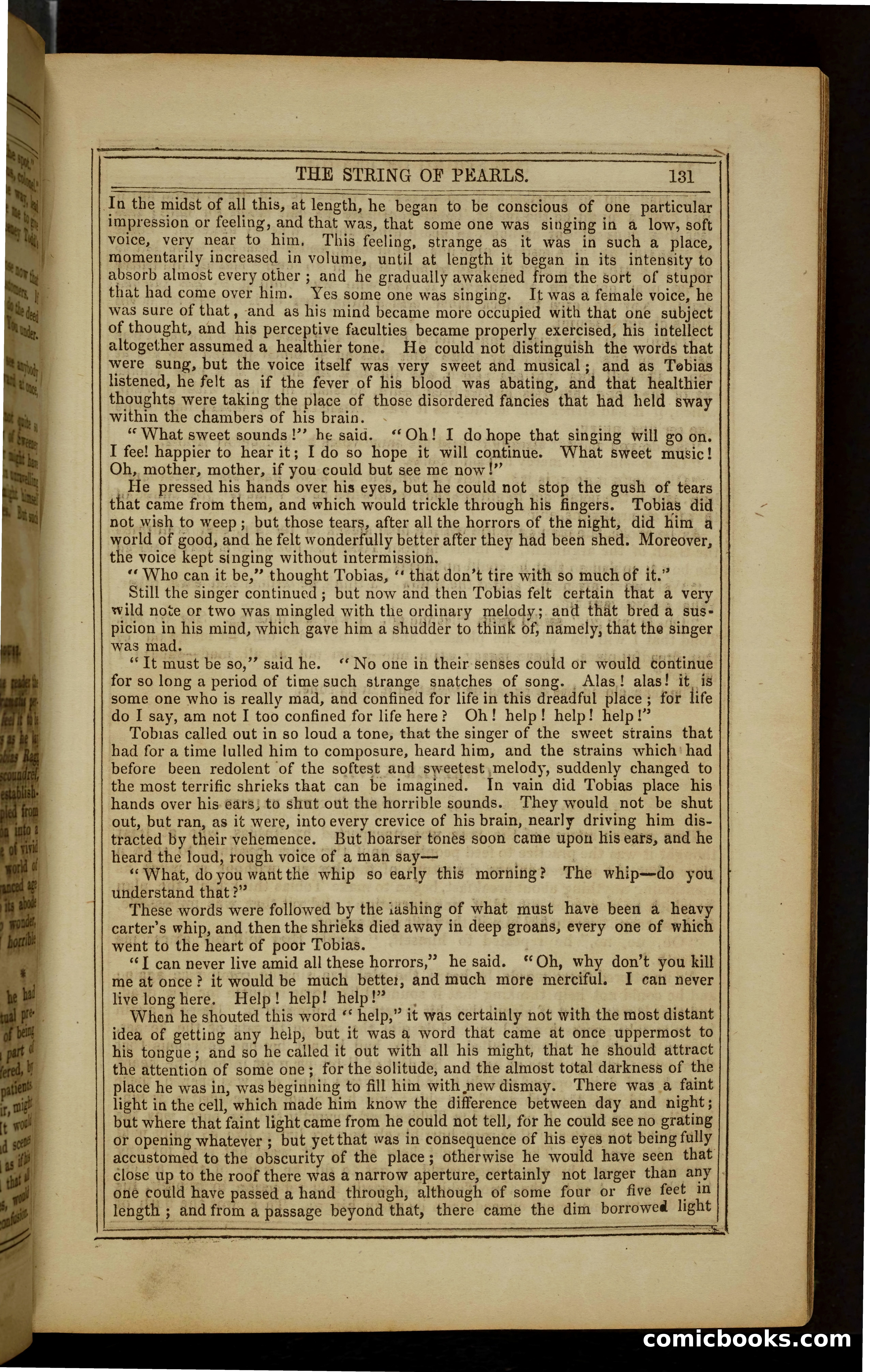
A restored page from Penny Dreadfuls, 1850. Page through the whole issue in the reader above.
📄 Transcribed text from this page (OCR, searchable)
Machine-transcribed from the original scan — historical spelling and the odd misread are preserved.
THE STRIN G OF PEARLS. In the midst of all this, at length, he began to be conscious of one particular impression or feeling, and that was, that some one was singing in a low, soft voice, very near to him, This feeling, strange as it was in such a place, momentarily increased in volume, until at length it began in its intensity to absorb almost every other ; and he gradually awakened from the sort of stupor that had come over him. Yes some one was singing. It was a female voice, he was sure of that, and as his mind became more occupied with that one subject of thought, and his perceptive faculties became properly exercised, his intellect altogether assumed a healthier tone. He could not distinguish the words that were sung, but the voice itself was very sweet and musical; and as Tebias listened, he felt as if the fever of his blood was abating, and that healthier thoughts were taking the place of those disordered fancies that had held sway within the chambers of his brain. ) “What sweet sounds!’’ he said. ‘‘Oh! I dohope that singing will go on. I fee! happier to hear it; Ido so hope it will continue. What sweet music! Oh, mother, mother, if you could but see me now!” | | He pressed his hands over his eyes, but he could not stop the gush of tears that came from them, and which would trickle through his fingers. Tobias did not wish to weep; but those tears, after all the horrors of the night, did him a world of good, and he felt wonderfully better after they had been shed. Moreover, the voice kept singing without intermission. ay ‘‘ Who can it be,” thought Tobias, ‘‘ that don’t tire with so muchof it.” __ Still the singer continued ; but now and then Tobias felt certain that a very wild note or two was mingled with the ordinary melody; and that bred a sus- picion in his mind, which gave him a shudder to think of, namely, that the singer was mad. ‘“It must be so,” suid he. ‘* No one in their-senses could or would continue for so long a period of time such strange snatches of song. . Alas! alas! it is some one who is really mad, and confined for life in this dreadful place ; for life do I say, am not I too confined for life here? Oh! help! help! help!” Tobias called out in so loud a tone, that the singer of the sweet strains that had for a time lulled him to composure, heard him, and the strains which’ had before been redolent of the softest and sweetest,melody, suddenly changed to the most terrific shrieks that can be imagined. In vain did Tobias place his hands over his ears} to shut out the horrible sounds. They would not be shut out, but ran, as it were, into every crevice of his brain, nearly driving him dis- tracted by their vehemence. But hoarser tones soon came upon his ears, and he heard the loud, rough voice of a man say— | | ‘What, do you wantthe whip so early this morning? The whip--do you understand that?” These words were followed by the iashing of what must have been a heavy carter’s whip, and then the shrieks died away in deep groans, every one of which went to the heart of poor Tobias. ‘¢T can never live amid all these horrors,’ he said. “Oh, why don’t you kill me at once? it would be much better, and much more merciful. JI can never livelong here. Help! help! help!” |. When he shouted this word “ help,” it was certainly not with the most distant idea of getting any help, but it was a word that came at once uppermost to his tongue; and so he called it out with all his might, that he should attract the attention of some one; for the solitude, and the almost total darkness of the place he was in, was beginning to fill him with newdismay. There was a faint light in the cell, which made him know the difference between day and night; but where that faint light came from he could not tell, for he could see no grating or opening whatever ; but yet that was in consequence of his eyes not being fully accustomed to the obscurity of the place; otherwise he would have seen that close up to the roof there was a narrow aperture, certainly not larger than any |. one could have passed a hand through, although of some four or five feet In length ; and from a passage beyond that, there came the dim borrowed light comicbooks.com