
Penny Dreadfuls, 1844 · page 19 of 399
The Steam-Packet: A Tale of the River and the Ocean — page 19: what you’re looking at
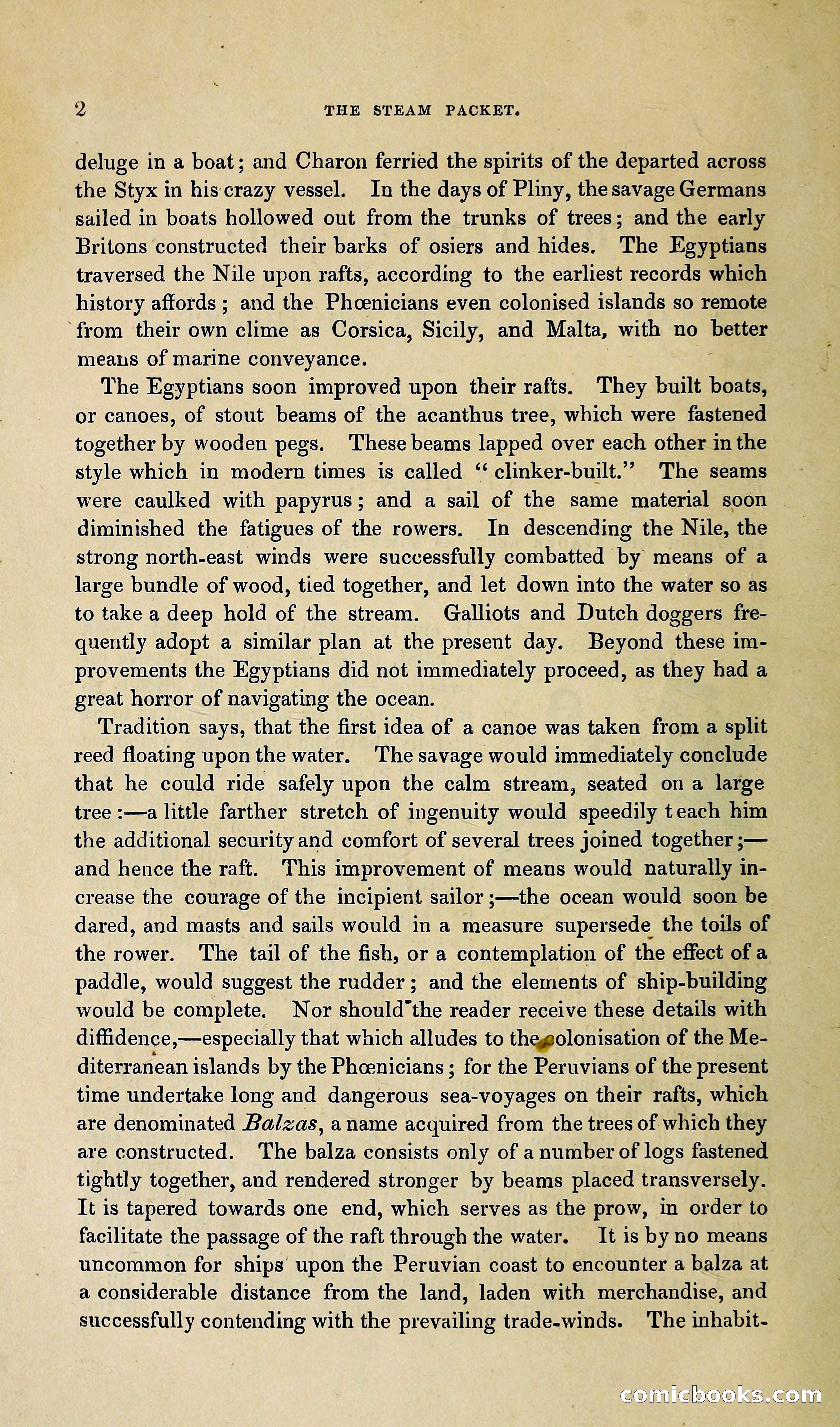
A restored page from Penny Dreadfuls, 1844. Page through the whole issue in the reader above.
📄 Transcribed text from this page (OCR, searchable)
Machine-transcribed from the original scan — historical spelling and the odd misread are preserved.
2 THE STEAM PACKET. deluge in a boat; and Charon ferried the spirits of the departed across the Styx in his crazy vessel. In the days of Pliny, thesavage Germans sailed in boats hollowed out from the trunks of trees; and the early Britons constructed their barks of osiers and hides. The Egyptians traversed the Nile upon rafts, according to the earliest records which history affords ; and the Phcenicians even colonised islands so remote ‘from their own clime as Corsica, Sicily, and Malta, with no nee means of marine conveyance. The Egyptians soon improved upon their rafts. They built boats, or canoes, of stout beams of the acanthus tree, which were fastened together by wooden pegs. These beams lapped over each other in the style which in modern times is called ‘‘ clinker-built.”” The seams were caulked with papyrus; and a sail of the same material soon diminished the fatigues of the rowers. In descending the Nile, the strong north-east winds were successfully combatted by means of a large bundle of wood, tied together, and let down into the water so as to take a deep hold of the stream. Galliots and Dutch doggers fre- quently adopt a similar plan at the present day. Beyond these im- provements the Egyptians did not immediately proceed, as they had a great horror of navigating the ocean. Tradition says, that the first idea of a canoe was taken from a split reed floating upon the water. The savage would immediately conclude that he could ride safely upon the calm stream, seated on a large tree :—a little farther stretch of ingenuity would speedily teach him the additional security and comfort of several trees joined together ;— and hence the raft. This improvement of means would naturally in- crease the courage of the incipient sailor ;—the ocean would soon be dared, and masts and sails would in a measure supersede the toils of the rower. The tail of the fish, or a contemplation of the effect of a paddle, would suggest the rudder; and the elements of ship-building would be complete. Nor should the reader receive these details with diffidence,—especially that which alludes to thegolonisation of the Me- diterranean islands by the Pheenicians ; for the Peruvians of the present time undertake long and dangerous sea-voyages on their rafts, which are denominated Balzas, aname acquired from the trees of which they are constructed. The balza consists only of a number of logs fastened tightly together, and rendered stronger by beams placed transversely. It is tapered towards one end, which serves as the prow, in order to facilitate the passage of the raft through the water. It is by no means uncommon for ships upon the Peruvian coast to encounter a balza at a considerable distance from the land, laden with merchandise, and successfully contending with the prevailing trade-winds. The inhabit- GComicbhooks (e{0)