
Penny Dreadfuls, 1853 · page 79 of 231
The Soldier's Wife — page 79: what you’re looking at
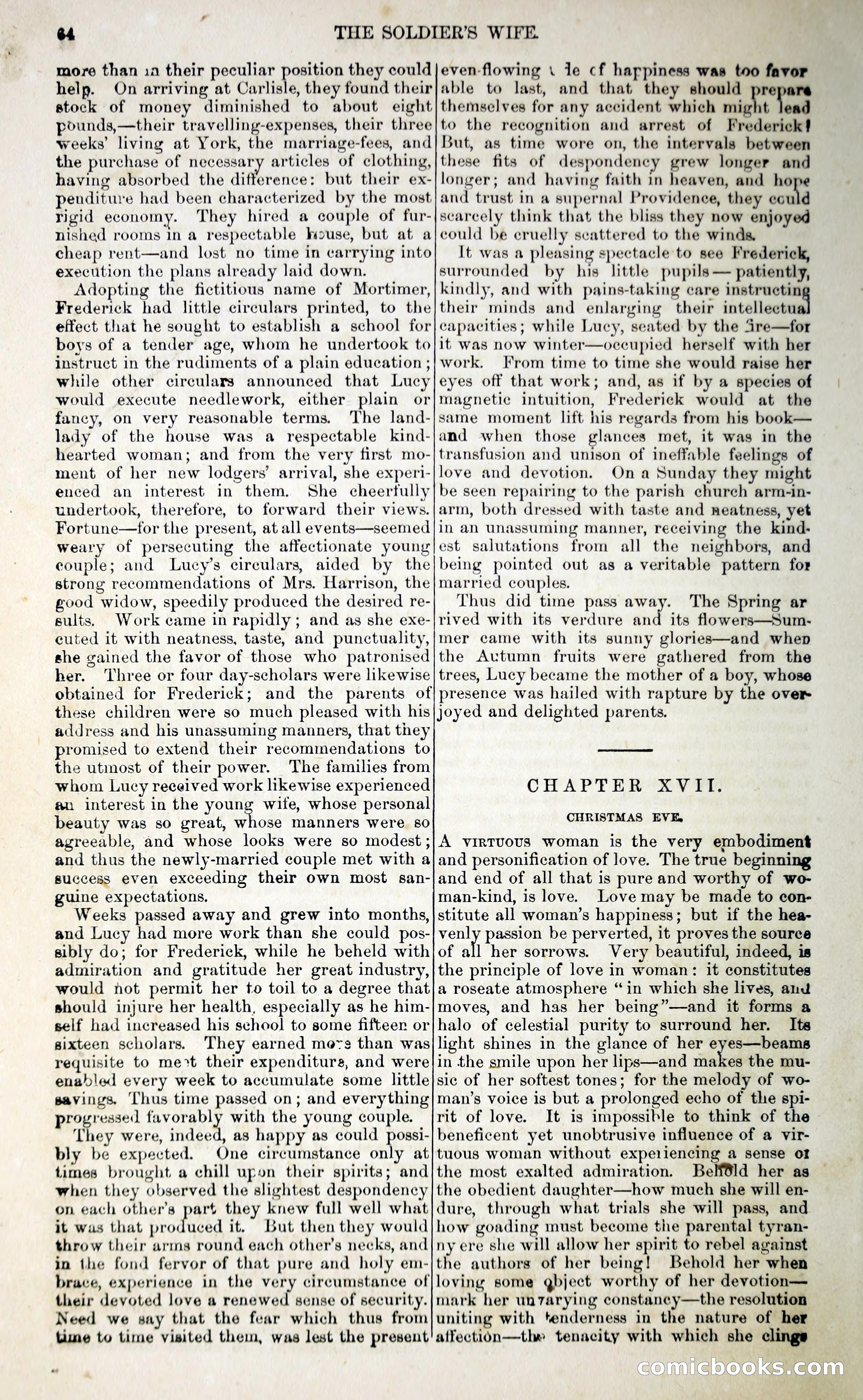
A restored page from Penny Dreadfuls, 1853. Page through the whole issue in the reader above.
📄 Transcribed text from this page (OCR, searchable)
Machine-transcribed from the original scan — historical spelling and the odd misread are preserved.
64 more than 1a their peculiar position they could help. On arriving at Carlisle, they found their atock of money diminished to about eight pounds,—their travelling-expenses, their three weeks’ living at York, the marriage-fees, and the purchase of necessary articles of clothing, having absorbed the difference: but their ex- penditure had been characterized by the most rigid economy. They hired a couple of fur- nished rooms 1n a respectable kiouse, but at a cheap rent—and lost no time in carrying into execution the plans already laid down. Adopting the fictitious name of Mortimer, Frederick had little circulars printed, to the effect that he sought to establish a school for boys of a tender age, whom he undertook to instruct in the rudiments of a plain education ; while other circulars announced that Lucy would execute needlework, either plain or fancy, on very reasonable terms. The land- lady of the house was a respectable kind- hearted woman; and from the very first mo- ment of her new lodgers’ arrival, she experi- enced an interest in them. She cheerfully undertook, therefore, to forward their views. Fortune—for the present, at all events—seemed weary of persecuting the affectionate young eouple; and Lucy’s circulars, aided by the strong recommendations of Mrs. Harrison, the good widow, speedily produced the desired re- sults. Work came in rapidly; and as she exe- euted it with neatness, taste, and punctuality, she gained the favor of those who patronised her. Three or four day-scholars were lhkewise THE SOLDIER'S WIFE. even-flowing \ le cf happiness was too favor able to last, and that they should pr themselves for any accident which might lead to the recognition and arrest of Frederick But, as time wore on, the intervals between these fits of despondency grew longer and longer; and having faith in heaven, and ho and trust in a supernal Providence, they eould scarcely think that the bliss they now enjoyed could be cruelly scattered to the winds, It was a pleasing spectacle to see Frederick, surrounded by his little pupils — patiently, kindly, and with pains-taking care instruetin their minds and enlarging their intellectua capacities; while Lucy, seated by the 4re—for it was now winter—occupied herself with her work. From time to time she would raise her eyes off that work; and, as if by a species of magnetic intuition, Frederick would at the same moment lift his regards from his book— and when those glances met, it was in the transfusion and unison of ineffable feelings of love and devotion. On a Sunday they might be seen repairing to the parish chureh arm-in- arm, both dressed with taste and neatness, yet in an unassuming manner, receiving the kind- est salutations from all the neighbors, and being pointed out as a veritable pattern for married couples. Thus did time pass away. The Spring ar rived with its verdure and its flowers—Sum- mer came with its sunny glories—and whep the Autumn fruits were gathered from the trees, Lucy became the mother of a boy, whose obtained for Frederick; and the parents of|presence was hailed with rapture by the over these children were so much pleased with his|joyed and delighted parents. address and his unassuming manners, that they promised to extend their recommendations to the utmost of their power. The families from whom Lucy received work likewise experienced an interest in the oF wite, whose personal beauty was so great, whose manners were. 80 agreeable, and whose looks were so modest ; and thus the newly-married couple met with a success even exceeding thelr own most san- guine expectations. Weeks passed away and grew into months, and Lucy had more work than she could pos- sibly do; for Frederick, while he beheld with admiration and gratitude her great industry, would not permit her to toil to a degree that should injure her health, especially as he him- self had increased his school to some fifteen or sixteen scholars. They earned me~s than was requisite to met their expenditure, and were enablad every week to accumulate some little savings, ‘Thus time passed on; and everything progressed Lahbed- with the young couple. They were, indeed, bly be expected. times brought a chill upon their spirits; and/the most exalted admiration. CHAPTER XVII. CHRISTMAS EVE A virTUOUS woman is the very embodiment and personification of love. The true beginning and end of all that is pure and worthy of wo- man-kind, is love. Love may be made to con- stitute all woman’s happiness; but if the hea- venly passion be perverted, it proves the source of all her sorrows. Very beautiful, indeed, is the principle of love in woman: it constitutes a roseate atmosphere “in which she lives, and moves, and has her being”—and it forms a halo of celestial purity to surround her. Its light shines in the glance of her Ns et 007 9 in the smile upon her lips—and makes the mu- sic of her softest tones; for the melody of wo- man’s voice is but a prolonged echo of the spi- rit of love. It is impossible to think of the as happy as could possi-|beneficent yet unobtrusive influence of a vir- One circumstance only at/tuous woman without experiencing a sense of BelfOld her as when they observed the slightest despondency|the obedient daughter—how much she will en- on each other's pare they knew full well what/dure, through what trials she will pass, and it was that produced it. But then they would|how goading must become the parental tyran- throw their arms round each other’s necks, and|ny ere she will allow her spirit to rebel against y : in the fond fervor of that pure and holy em-/the authors of her being! circumstance ofjloving some gbject worthy of her devotion— sense of security.|mark her un7varying constancy—the resolution brace, experience in the i) their devoted love a renewe Behold her when Need we say that the fear which thus from|uniting with tenderness in the nature of her time to time visited them, was lest the present! affection—the tenacity with which she clings (E(0) ,00KS AMIE co