
Penny Dreadfuls, 1853 · page 55 of 231
The Soldier's Wife — page 55: what you’re looking at
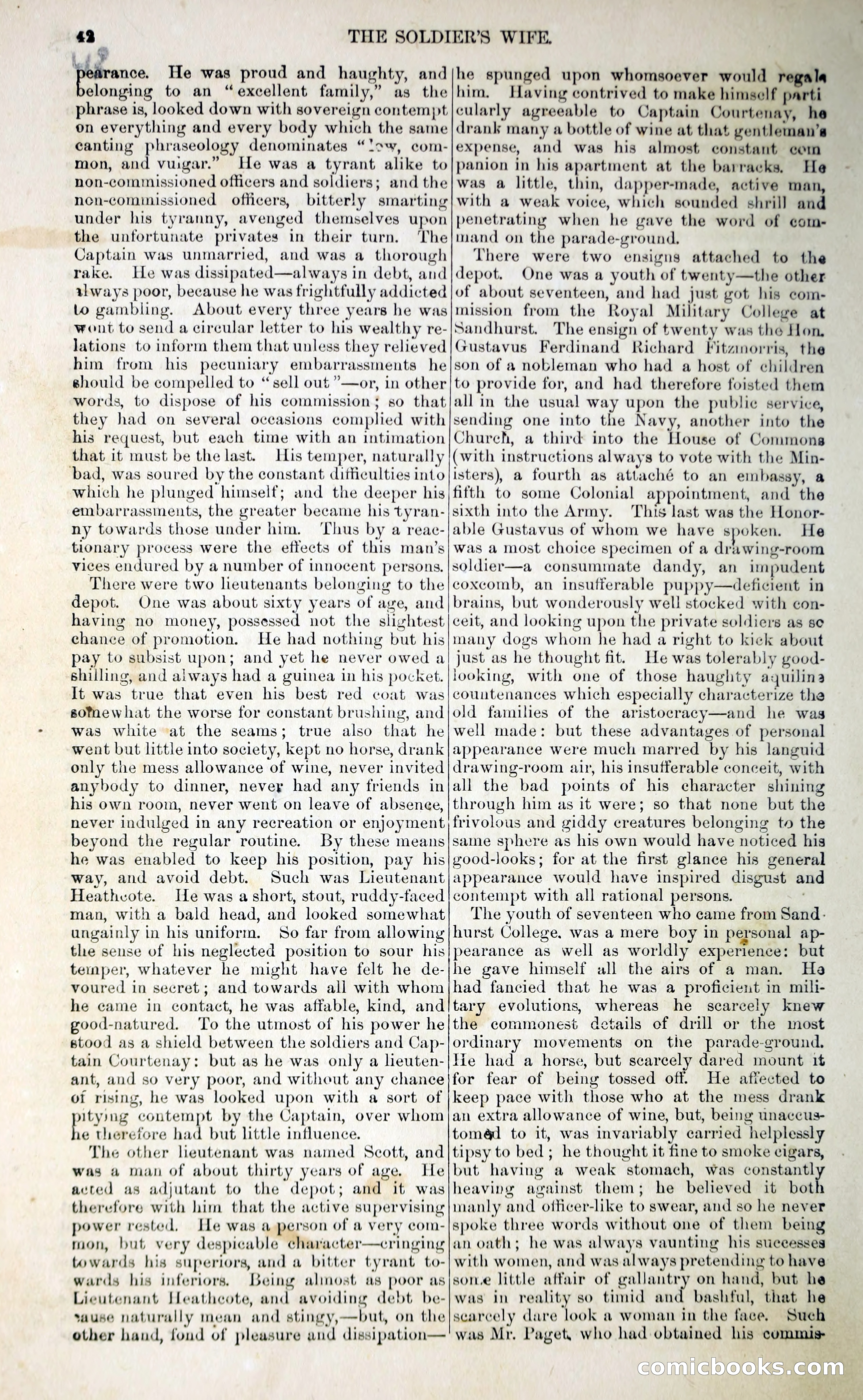
A restored page from Penny Dreadfuls, 1853. Page through the whole issue in the reader above.
📄 Transcribed text from this page (OCR, searchable)
Machine-transcribed from the original scan — historical spelling and the odd misread are preserved.
42 on LiF e elonging to an “excellent family,” as the phrase is, looked down with sovereign contempt on everything and every body which the same canting phraseology denominates “tow, com- mon, and vuigar.” He was a tyrant alike to non-commissioned officers and soldiers; and the nen-comimissioned officers, bitterly smarting under his tyranny, avenged themselves upon the unfortunate privates in their turn. The Captain was unmarried, and was a thorough rake. He was dissipated—always in debt, and always poor, because he was frightfully addicted to gambling. About every three years he was wont to send a circular letter to his wealthy re- lations to inform them that unless they relieved him from his pecuniary embarrassments he should be compelled to “sell out ”—or, in other words, to dispose of his commission; so that they had on several occasions complied with his request, but each time with an intimation that it must be the last. His temper, naturally bad, was soured by the constant difficulties into which he plunged himself; and the deeper his embarrassmeuts, the greater became his tyran- ny towards those under him. ‘Thus by a reae- tionary process were the effects of this man’s vices endured by a number of innocent persons. There were two lieutenants belonging to the depot. One was about sixty years of age, and having no money, possessed not the slightest chance of promotion. He had nothing but his pay to subsist upon; and yet he never owed a shilling, and always had a guinea in his pocket. It was true that even his best red coat was gotne what the worse for constant brushing, and Was white at the seams; true also that he went but little into society, kept no horse, drank only the mess allowance of wine, never invited anybody to dinner, never had any friends in his own room, never went on leave of absenee, never indulged in any recreation or enjoyment beyond the regular routine. By these means he was enabled to keep his position, pay his way, and avoid debt. Such was Lieutenant Heathvote. He was a short, stout, ruddy-faced man, with a bald head, and looked somewhat ungainly in his uniform. So far from allowing the sense of his neglected position to sour his temper, whatever he might have felt he de- voured in secret; and towards all with whom he came in contact, he was affable, kind, and good-natured. ‘To the utmost of his power he stood as a shield between the soldiers and Cap- tain Courtenay: but as he was only a lieuten- ant, and so very poor, and without any chance of rising, he was looked upon with a sort of ntyng contempt by the Captain, over whom Bp therefore had but little influence. The other lieutenant was named Scott, and was a man of about thirty years of age. He avted as adjutant to the depot; and it was therefore with him that the active supervising power rested, Ile was a person of a very com- mon, but very despicable character—cringing towards his superiors, and a bitter tyrant to- wards his inferiors. Being almost as poor as Lieutenant Ileathcote, and avoiding debt be- sause naturally mean and stingy,—but, on the other hand, fond of pleasure and dissipation— france. He was proud and haughty, andjhe spunged upon whomsoever would — mn — — — — THE SOLDIER’S WIFE. la him. Having contrived to make nba cularly agreeable to Captain Courtenay, he drank many a bottle of wine at that gentleman’s expense, and was his almost constant com panion in his apartment at the barracks, He was a little, thin, dapper-made, active man, with a weak voice, which sounded shrill and penetrating when he gave the word of com- mand on the parade-ground, There were two ensigns attached to the depot. One was a youth of twenty—the other of about seventeen, and had just got his com- mission from the Royal Military College at Sandhurst. The ensign of twenty was the Hon, Gustavus Ferdinand Richard Fitzinorris, the son of a nobleman who had a host of children to provide for, and had therefore foisted them all in the usual way upon the public service, sending one into the Navy, another into the Church, a third into the House of Commons (with instructions always to vote with the Min- isters), a fourth as attaché to an embassy, a fifth to some Colonial appointment, and the sixth into the Army. This last was the Honor- able Gustavus of whom we have spoken. He was a most choice specimen of a drawing-room soldier—a consummate dandy, an impudent coxcomb, an insufferable puppy—deficient in brains, but wonderously well stocked with con- ceit, and looking upon the private soldiers as se many dogs whom he had a right to kick about just as he thought fit. He was tolerably good- looking, with one of those haughty aquilina countenances which especially characterize the old families of the aristocracy—and he was well made: but these advantages of personal appearance were much marred by his languid drawing-room air, his insufferable conceit, with all the bad points of his character shining through him as it were; so that none but the frivolous and giddy creatures belonging to the same sphere as his own would have noticed his good-looks; for at the first glance his general appearance would have inspired disgust and contempt with all rational persons. , The youth of seventeen who came from Sand- hurst College, was a mere boy in personal ap- pearance as well as worldly experience: but he gave himself all the airs of a man. Ha had fancied that he was a proficient in mili- tary evolutions, whereas he scarcely knew the commonest details of drill or the most ordinary movements on the parade-ground. lie had a horse, but scarcely dared mount it for fear of being tossed off. He affected to keep pace with those who at the mess drank an extra allowance of wine, but, being unaccus- tomad to it, was invariably carried helplessly tipsy to bed; he thought it fine to smoke cigars, but having a weak stomach, was constantl heaving against them; he believed it both manly and officer-like to swear, and so he never spoke three words without one of them being an oath; he was always vaunting his suceesses with women, and was always pretending to have some little affair of gallantry on hand, but he was in reality so timid and bashful, that he scarcely dare look a woman in the face. Such was Mr. Paget, who had obtained his commis m <S) c 0) ,00KS.CcO