
Penny Dreadfuls, 1853 · page 30 of 231
The Soldier's Wife — page 30: what you’re looking at
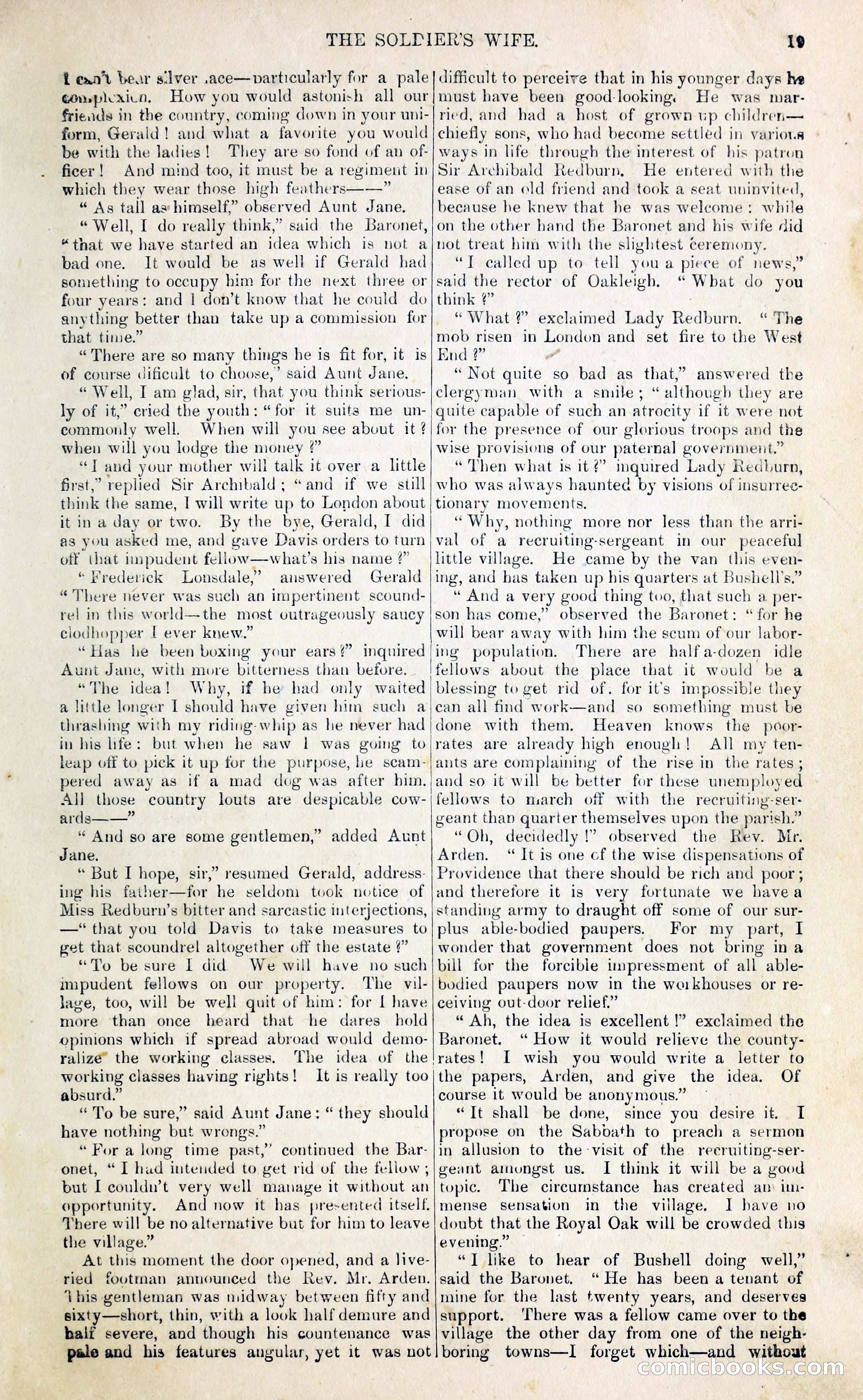
A restored page from Penny Dreadfuls, 1853. Page through the whole issue in the reader above.
📄 Transcribed text from this page (OCR, searchable)
Machine-transcribed from the original scan — historical spelling and the odd misread are preserved.
THE SOLIIER’S WIFE. 19 { ean’ bear siiver .ace—varticularly for a pale difficult to perceive that in his younger days he GOmple XlUN, How you would astonish all our/must have been good-looking He was mar- friends in the country, coming down in your uni-}ried, and had a host of grown up children— form, Gerald! and what a favorite you would be with the ladies! They are so fond of an of- ficer! And mind too, it must be a regiment in which they wear those high feathers——” “ As tall aw himself,” observed Aunt Jane. “Well, I do really think,” said the Baronet, “that we have started an idea which is not a bad one. It would be as well if Gerald had something to occupy him for the next three or four years: and | don’t know that he could do anything better than take up a commission for that time.” “'There are so many things he is fit for, it is of course dificult to choose,’ said Aunt Jane, “Well, I am glad, sir, that you think serious- ly of it,” cried the youth : “for it suits me un- commonly well. When will you see about it $ when will you lodge the money ?” “TY and your mother will talk it over a little first,” replied Sir Archibald; “and if we still think the same, I will write up to London about it ina day or two. By the bye, Gerald, I did as you asked me, and vave Davis orders to turn os, (hat impudent fellow—what’s his name 2” Frederick Lonsdale,’ answered Gerald a - a. never was such an impertinent scound- rel in this world—the most outrageously saucy clodhopper [ ever knew.” “Has he been boxing your ears ?” Aunt Jane, with more bitterness than before. “The ieee Why, little longer I should have given him such a hiaehing with my riding: whip as he never had in his life: inquired /ing population. if be had only waited | but when he saw 1 was going tolrates are already high enough | chiefly sons, who had become settled in variour Ways In hes through the interest of his parry Sir Archibald Beau He entered with the ease of an old friend and took a seat uninvited, because he knew that he was welcome: while on the other hand the Baronet and his wife aid vot treat him with the slightest ¢ ceremony. “T called up to tell you a piece of news,” said the rector of Oakleigh. “ What do you think @? : “What ? exclaimed Lady Redburn. “ The mob risen in London and set fire to the West End 2?” : | “ Not quite so bad as that,’ answered the clergyman with a smile; “ although they are quite capable of such an atrocity if it were not for the presence of our glorious troops and the Wise provisions of our paternal government.” “Then what is it?’ mguired Lady RedbLurn, who was always haunted by visions of insurree- tionary movements. “Why, nothing more nor less than the arri- val of a recruiting-sergeant in our peaceful little village. He came by the van this even- ing, and has taken up his quarters at Bushell’s.” “ And a very good thing too, that such a. per- son has come,” observed the Baronet: “for he will bear away with him the scum of our labor- There are halfa-dozen idle fellows about the place that 1t would be a blessing to get rid of. for it’s impossible they can all find work—and so something must be done with them. Heaven knows ibe poor- All my ten- leap off to pick it up for the purpose, he scam-|ants are complaining of the rise in the rates ; pered away as if a mad dog was after him.;and so it will be better for these unemp loyed All those country louts are despicable cow-| fellows Ards——" “ And so are some gentlemen,” Jane. “ But I hope, sir,” added Aunt to march off with the recruiting-ser- geant than quarter themselves upon the parish.” “Oh, decidedly !” observed the Rev. Mr. Arden. “It is one cf the wise dispensations of resumed Gerald, address- | Providence that there should be rich and POOr ; ing his father—for he seldom took notice of |and therefore it is very fortunate we havea Miss Redburn’s bitter and sarcastic interjections, |standing army to draught off some of our sur- —‘ that you told Davis to take measures to get that scoundrel altogether off the estate ” “To be sure I did plus able-bodied paupers. For my part, I wonder that government does not bring ina We will have no such|bill for the forcible inpressment of all able- impudent fellows on our property. The vil-|bodied paupers now in the woikhouses or re- lave, too, will be well quit of him: more than onee heard that he dares hold opinions which if spread abroad would demo- Bakonet idea of the!lrates! It is really too|the papers, ralizé’ the working classes. The working classes having rights ! absurd.” “To be sure,” said Aunt Jane: “ they should have nothing but wrongs.” “For a long time past,’ continued the Bar- onet, “I hud intended to get rid of the fellow ; ” but [ couldn’t very well manage it without an] topic. opportunity. And now it has presented itself.|mense sensation in the village. for | have| ceiving out-door relief.” “Ah, the idea is excellent !” exclaimed the “ How it would relieve the county- I wish you would write a letter to Arden, and give the idea. Of course it would be avuony mous.” “It shall be done, since you desire it. I ropose on the Sabbath to preach a sermon in allusion to the-visit of the reeruiting-ser- geant amongst us. I think it will be a good The circumstance has created an im- I have no There will be no alternative but for him to leave|doubt that the Royal Oak will be crowded this the village.” At this moment the door opened, and a live- ried footman announced the Rev. Mr. Arden. evening.” “T like to hear of Bushell doing well,” said the Baronet. “He has been a tenant of ‘his gentleman was midway between fifty and|mine for the last twenty years, and deserves sixty—short, thin, with a look half demure and |support. There was a fellow came over to the half severe, and though his countenance was/village the other day from one of the neigh- pale and his features angular, yet it was notiboring towns—lIl forget which—and without GOMIGE OOKS (E()