
Penny Dreadfuls, 1853 · page 28 of 231
The Soldier's Wife — page 28: what you’re looking at
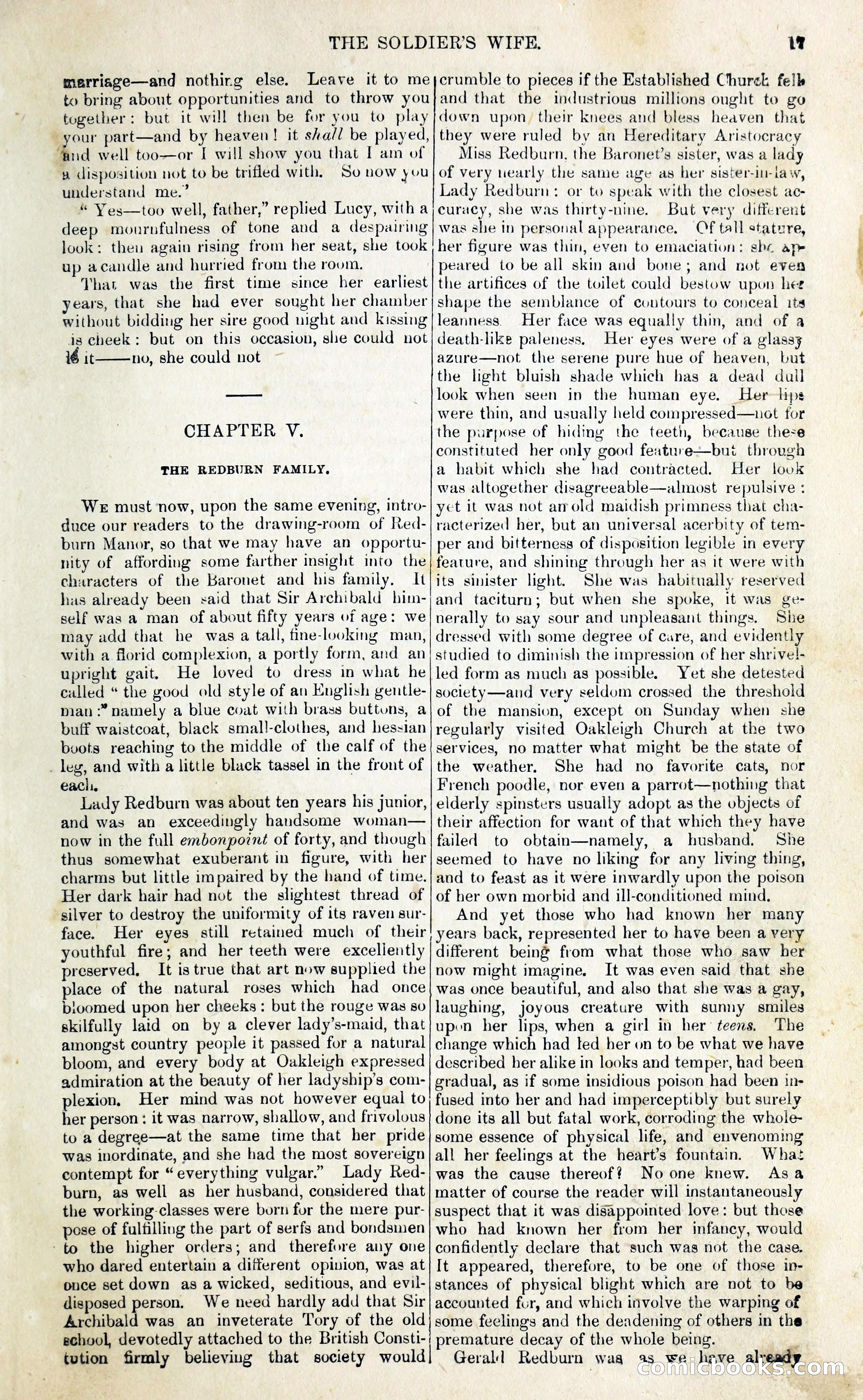
A restored page from Penny Dreadfuls, 1853. Page through the whole issue in the reader above.
📄 Transcribed text from this page (OCR, searchable)
Machine-transcribed from the original scan — historical spelling and the odd misread are preserved.
THE SOLDIER'S WIFE, 7 merriage—and nothirg else. Leave it to me;crumble to pieces if the Established Church felb to bring about opportunities and to throw you together: but it will then be for you to play your part—and by heaven! it shall be played, ‘nid well too—or I will show you that I am of a disposition not to be trifled with, So now you understand me.’ « Yes—too well, father,” replied Lucy, with a deep mournfulness of tone and a despairing look: then again rising from her seat, she took up acandle and hurried from the room. That was the first time since her earliest years, that she had ever sought her chamber without bidding her sire good night and kissing is ebheek: but on this occasion, she could not 6 it no, she could not eee CHAPTER V. THE REDBURN FAMILY. WE must now, upon the same evening, intro- duce our readers to the drawing-room of Red- burn Manor, so that we may have an opportu- nity of affording some farther insight into the characters of the Baronet and his family. It has already been said that Sir Archibald him- self was a man of about fifty years of age: we may add that he was a tall, fine-looking man, with a florid complexion, a portly form, and an upright gait. He loved to dress in what he culled “ the good old style of an English gentle- man :* namely a blue coat with brass buttons, a buff waistcoat, black small-clothes, and hessian boots reaching to the middle of the calf of the _ leg, and with a little black tassel in the front of each, Lady Redburn was about ten years his junior, and was an exceedingly handsome woman— now in the full embonpornt of forty, and though thus somewhat exuberant in figure, with her charms but little impaired by the hand of time. Her dark hair had not the slightest thread of silver to destroy the uniformity of its raven sur- face. Her eyes still retained much of their) youthful fire; and her teeth were excellently preserved, It is true that art now supplied the place of the natural roses which had once bloomed upon her cheeks: but the rouge was so skilfully laid on by a clever lady’s-maid, that amongst country people it passed for a natural bloom, and every body at Oakleigh expressed admiration at the beauty of her ladyship’s com- plexion. Her mind was not however equal to her person: it was narrow, shallow, and frivolous to a degree—at the same time that her pride was inordinate, and she had the most sovereign contempt for “everything vulgar.” Lady Red- burn, as well as her husband, considered that the working-classes were born fur the mere pur- pose of fulfilling the part of serfs and bondsmen -to the higher orders; and therefore any one who dared entertain a different opinion, was at once set down as a wicked, seditious, and evil- disposed person, We need hardly add that Sir Archibald was an inveterate Tory of the old school, devotedly attached to the British Consti- tution firmly believiug that society would| and that the industrious millions ought to go down upon. their knees and bless heaven that they were ruled by an Hereditary Aristocracy Miss Redburn, the Baronet’s sister, was a lady of very nearly the same age as her sister-in-law, Lady Redburn: or to speak with the closest ac- curacy, she was thirty-nine. But very different was she in personal appearance. Of tall stature, her figure was thin, even to emaciation: she ap peared to be all skin and bone; and not even the artifices of the toilet could bestow upon hee shape the semblance of coutours to conceal its leanness. Her face was equally thin, and of a death-like paleness. Her eyes were of a glassy azure—not the serene pure hue of heaven, but the light bluish shade which has a dead dull look when seen in the human eye. Her lips were thin, and usually held compressed—not for the purpose of hidmg the teeth, because these constituted her only good feature—but throvgh a habit which she had contracted. Her look was altogether disagreeable—almost repulsive : yet it was not arold maidish primness that cha- racterized her, but an universal acerbity of tem- per and bitterness of disposition legible in every feature, and shining through her as it were with its sinister light. She was habitually reserved and taciturn; but when she spoke, it was ge- nerally to say sour and unpleasant things. She dressed with some degree of care, and evidently studied to diminish the impression of her shrivel- led form as much as possible. Yet she detested socilety—and very seldom crossed the threshold of the mansion, except on Sunday when she regularly visited Oakleigh Church at the two services, no matter what might be the state of the weather. She had no favorite cats, nor French poodle, nor even a parrot—nothing that elderly spinsters usually adopt as the objects of their affection for want of that which they have failed to obtain—namely, a husband. She seemed to have no liking for any living thing, and to feast as it were inwardly upon the poison of her own morbid and ill-conditioned mind, And yet those who had known her many years back, represented her to have been a very different being from what those who saw her now might imagine, It was even said that she was once beautiful, and also that she was a gay, laughing, joyous creature with sunny smiles upon her lips, when a girl in her teens, The change which had ted her on to be what we have described her alike in looks and temper, had been gradual, as if some insidious poison had been in- fused into her and had imperceptibly but surely done its all but fatal work, corroding the whole- some essence of physical life, and envenoming all her feelings at the heart’s fountain. Wha was the cause thereof? Noone knew. Asa matter of course the reader will instantaneously suspect that it was disappointed love: but those who had known her from her infancy, would confidently declare that such was not the case. It appeared, therefore, to be one of those in- stances of physical blight which are not to be accounted fur, and which involve the warping of some feelings and the deadening of others in the premature decay of the whole being. Gerald Redburn waa ase hee already.