
Penny Dreadfuls, 1853 · page 24 of 231
The Soldier's Wife — page 24: what you’re looking at
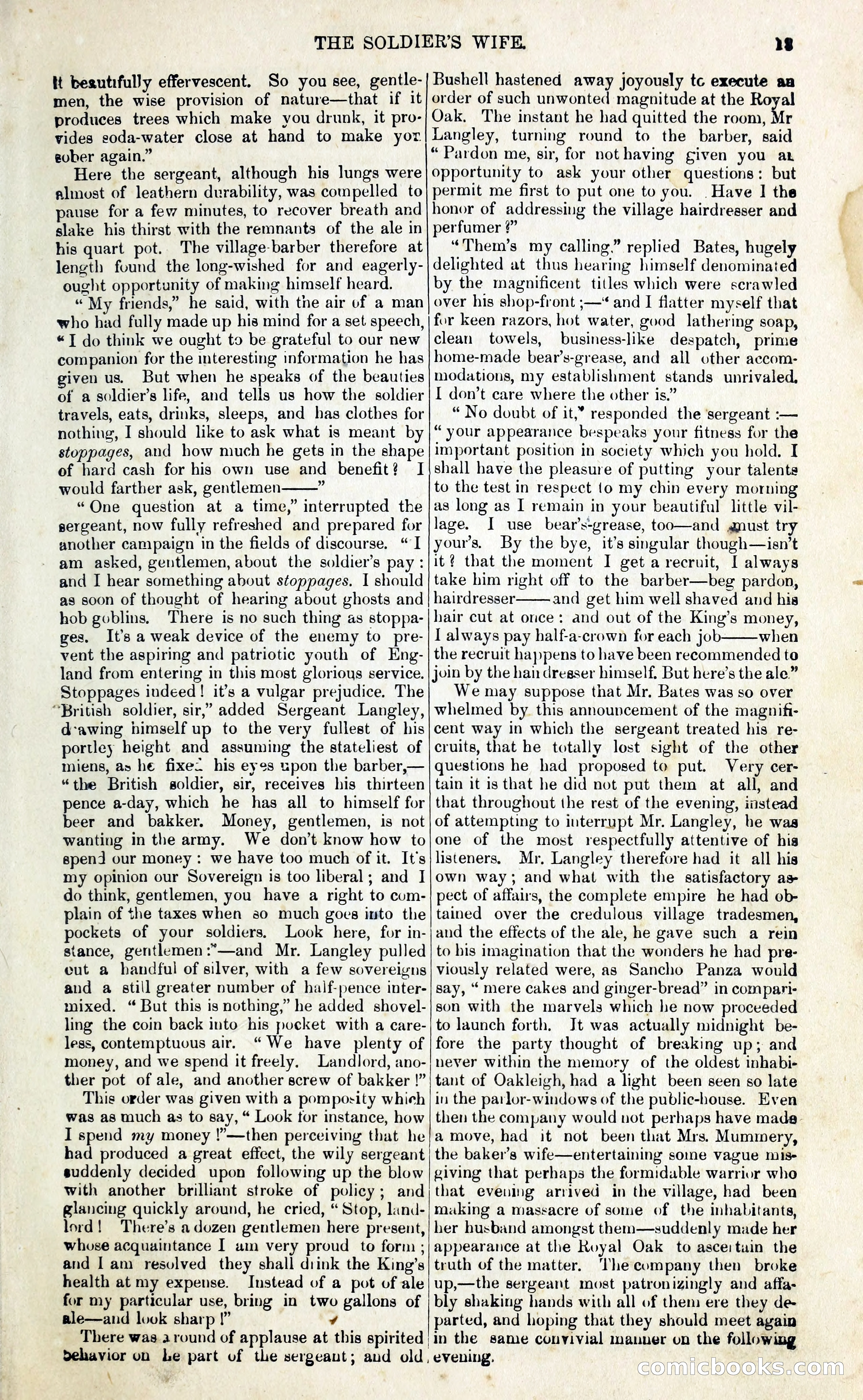
A restored page from Penny Dreadfuls, 1853. Page through the whole issue in the reader above.
📄 Transcribed text from this page (OCR, searchable)
Machine-transcribed from the original scan — historical spelling and the odd misread are preserved.
THE SOLDIER'S WIFE. 18 tt beautifully effervescent. So you see, gentle-| Bushell hastened away joyously tc execute aa men, the wise provision of nature—that if it produces trees which make you drunk, it pro- vides soda-water close at hand to make yor eober again.” Here the sergeant, although his lungs were almost of leathern durability, was compelled to pause for a few minutes, to recover breath and slake his thirst with the remnants of the ale in his quart pot. The village-barber therefore at length found the long-wished for and eagerly- ought opportunity of making himself heard. “My friends,” he said, with the air of a man who had fully made up his mind for a set speech, “T do think we ought to be grateful to our new companion for the interesting information he has given us. But when he speaks of the beauties of a soldier’s life, and tells us how the soldier travels, eats, drinks, sleeps, and has clothes for nothing, I should like to ask what is meant by stoppages, and how much he gets in the shape of hard cash for his own use and benefit? I would farther ask, gentlemen y “One question at a time,” interrupted the sergeant, now fully refreshed and prepared for another campaign in the fields of discourse. “I am asked, gentlemen, about the soldier’s pay: and I hear something about stoppages. I should as soon of thought of hearing about ghosts and hob goblins. There is no such thing as stoppa- ges, It’s a weak device of the enemy to pre- vent the aspiring and patriotic youth of Eng- land from entering in this most glorious service. Stoppages indeed! it’s a vulgar prejudice. The “British soldier, sir,’ added Sergeant Langley, d-awing himself up to the very fullest of his portiey height and assuming the stateliest of miens, as he fixes his eyes upon the barber,— “the British soldier, sir, receives his thirteen pence a-day, which he has all to himself for beer and bakker. Money, gentlemen, is not wanting inthe army. We don’t know how to spend our money: we have too much of it. It’s my opinion our Sovereign is too liberal; and I do think, gentlemen, you have a right to cum- plain of the taxes when 30 much goes into the pockets of your soldiers. Look here, for in- stance, gentlemen:"—and Mr. Langley pulled cut a handful of silver, with a few sovereigns and a still greater number of half-pence inter- mixed. “ But this is nothing,” he added shovel- ling the coin back into his pocket with a care- less, contemptuous air. “ We have plenty of money, and we spend it freely. Landlord, ano- ther pot of ale, and another screw of bakker !” This order was given with a pomposity whieh was as much as to say, “ Look tor instance, how I spend my money !’—then perceiving that he had produced a great effect, the wily sergeant suddenly decided upon following up the blow with another brilliant stroke of policy; and glancing quickly around, he cried, “ Stop, land- lord! There’s adozen gentlemen here present, whuse acquaintance I um very proud to form ; and Iam resulved they shall diink the King’s health at my expense. Instead of a pot of ale for my particular use, bring in two gallons of ale—and look sharp |” order of such unwonted magnitude at the Royal Oak. The instant he had quitted the room, Mr Langley, turning round to the barber, said “Pardon me, sir, for nothaving given you ar opportunity to ask your other questions: but permit me first to put one to you. Have I the honor of addressing the village hairdresser and perfumer ?” “Them’s my calling.” replied Bates, hugely delighted at thus hearing himself denominated by the magnificent titles which were scrawled over his shop-front ;—* and I flatter myself that for keen razors, hot water, good lathering soap, clean towels, business-like despatch, prime home-made bear’s-grease, and all other accom- modations, my establishment stands unrivaled, I don’t care where the other is.” “ No doubt of it,” responded the ‘sergeant :— “your appearance bespeaks your fitness for the important position in society which you hold. I shall have the pleasure of putting your talents to the test in respect {o my chin every morning as long as I remain in your beautiful little vil- lage. I use bear’s-grease, too—and gnust try yours. By the bye, it’s singular though—isn’t it? that the moment I get a recruit, I always take him right off to the barber—beg pardon, hairdresser and get him well shaved and his hair cut at once: and out of the King’s money, I always pay half-a-crown for each job when the recruit happens to have been recommended to join by the han dresser himself. But here’s the ale” We may suppose that Mr. Bates was so over whelmed by this announcement of the magnifi- cent way In which the sergeant treated his re- cruits, that he totally lost sight of the other questions he had proposed to put. Very cer- tain it is that he did not put them at all, and that throughout the rest of the evening, instead of attempting to interrupt Mr. Langley, he was one of the most respectfully attentive of his listeners. Mr. Langley therefore had it all his own way; and what with the satisfactory as pect of affairs, the complete empire he had ob- tained over the credulous village tradesmen, and the effects of the ale, he gave such a rein to his imagination that the wonders he had pre- viously related were, as Sancho Panza would say, “ mere cakes and ginger-bread” in compari- son with the marvels which he now proceeded to launch forth. Jt was actually midnight be- fore the party thought of breaking up; and never within the memory of the oldest inhabi- tant of Oakleigh, had a light been seen so late in the parlor-windows of the public-house. Even then the company would not perhaps have mada a move, had it not been that Mrs. Mummery, the baker’s wife—entertaining some vague mis- giving that perhaps the formidable warrior who that evening arrived in the village, had been making a massacre of some of the inhabitants, her husband amongst them—suddenly made her appearance at the Ruyal Oak to asceituin the truth of the matter, The company then broke up,—the sergeant most patronizingly and affa- bly shaking hands with all of them ere they de- parted, and hoping that they should meet again There was. around of applause at this spirited in the same convivial manner on the following vehavior on Le part of the sergeant; and old, evening. \ i GOMmiGboo S (E(O)