
Penny Dreadfuls, 1853 · page 216 of 231
The Soldier's Wife — page 216: what you’re looking at
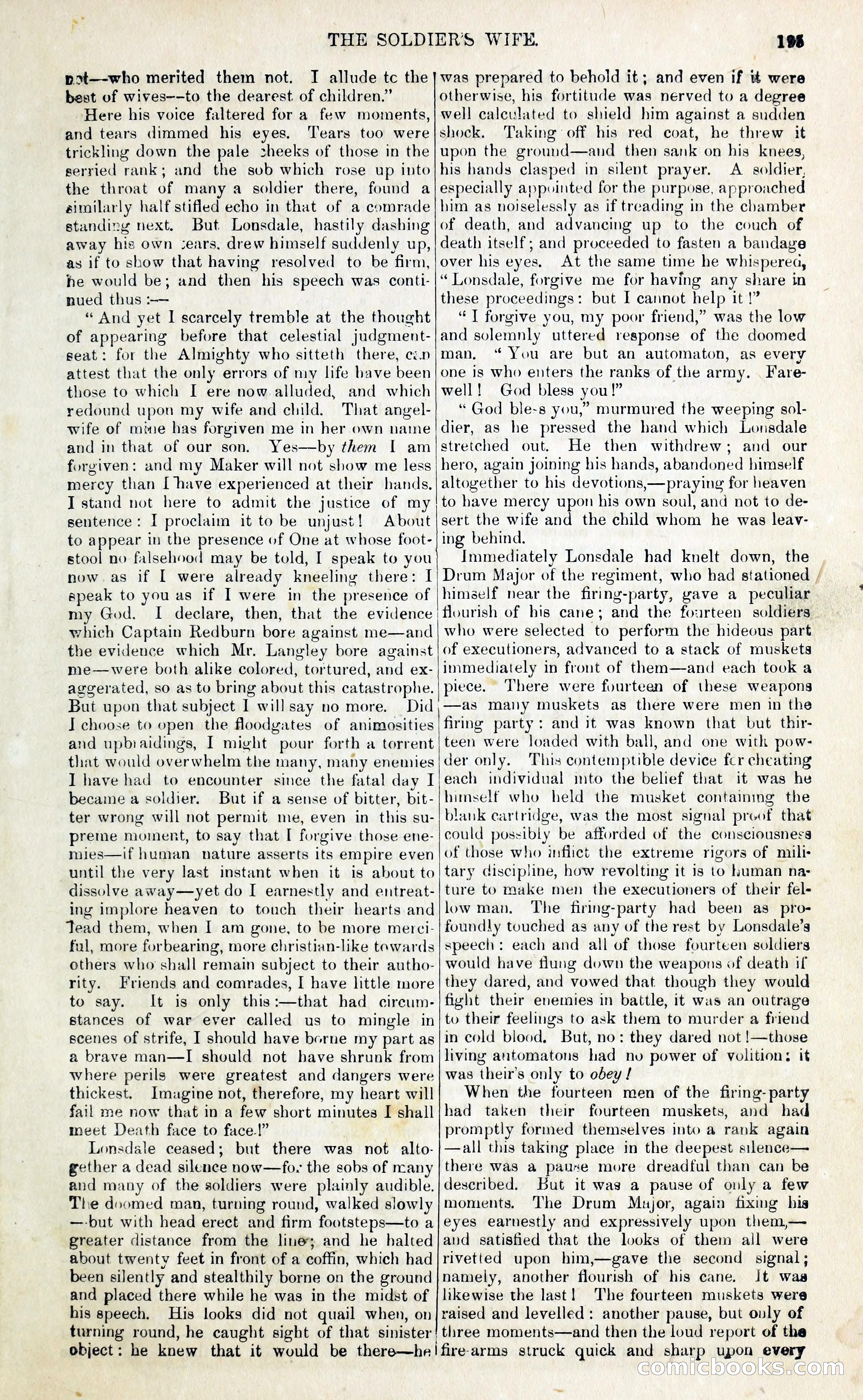
A restored page from Penny Dreadfuls, 1853. Page through the whole issue in the reader above.
📄 Transcribed text from this page (OCR, searchable)
Machine-transcribed from the original scan — historical spelling and the odd misread are preserved.
THE SOLDIERS WIFE, px%t—-who merited them not. best of wives—-to the dearest. of children.” Here his voice faltered for a few moments, and tears dimmed his eyes. ‘Tears too were trickling down the pale cheeks of those in the serried rank; and the sob which rose up into the throat of many a soldier there, found a similarly half stifled echo in that of a comrade standing next. But Lonsdale, hastily dashing away his own ;ears, drew himself suddenly up, as if to show that having resolved to be firm, he would be; and then his speech was conti- nued thus :—— “ And yet I scarcely tremble at the thought of appearing before that celestial judgment- seat: for the Almighty who sitteth there, cin attest that the only errors of my life bave been those to which I ere now alluded, and which redound upon my wife and child. That angel- wife of mme has forgiven me in her own name and in that of our son. Yes—by them | am forgiven: and my Maker will not show me less mercy than [ have experienced at their hands, I stand not here to admit the justice of my sentence: I proclaim it to be unjust! About to appear in the presence of One at whose foot- stool no falsehood may be told, I speak to you now as if [ were already kneeling there: I speak to you as if I were in the presence of my God. I declare, then, that the evidence which Captain Redburn bore against me—and the evidence which Mr. Langley bore against me—were both alike colored, tortured, and ex- aggerated, so as to bring about this catastrophe. But upon that subject I will say no more. Did J choose to open the floodgates of animosities and upbiaidings, I might pour forth a torrent that would overwhelm the many, many enemies I have had to encounter since the fatal day I became a soldier. But if a sense of bitter, bit- ter wrong will not permit me, even in this su- preme moment, to say that I forgive those ene- mies—if human nature asserts its empire even until the very last instant when it is about to dissolve away—yet do I earnestly and entreat- ing implore heaven to touch their hearts and Tead them, when I am gone, to be more merci- ful, more forbeari ing, more christian-like tawards others who shall remain subject to their autho- rity. Friends and comrades, I have little more to say. It is only this:—that had circum- stances of war ever called us to mingle in scenes of strife, | should have borne my part as a brave man—lI should not have shrunk from where perils were greatest and dangers were thickest, Imuagine not, therefore, my heart will fail me now that in a few short minutes I shall meet Death face to face!” Lonsdale ceased; but there was not alto- gether a dead silence now—fo. the sobs of many and many of the soldiers were plainly audible. The doomed man, turning round, walked slowly —-but with head erect and firm footsteps—to a greater distance from the lines and he halted about twenty feet in front of a coffin, which had been silently and stealthily borne on the ground and placed there while he was in the midst of his speech. His looks did not quail when, on 198 I allude tc the} was prepared to behold it; and even if tt were otherwise, his fortitude was nerved to a degree well calculated to shield him against a sudden shock. Taking off his red coat, he threw it upon the ground—and then sank on his knees, his hands clasped in silent prayer. <A. soldier, especially appointed for the purpose, approached him as noiselessly as if treading in the chamber of death, and advancing up to the couch of death itself : and proceeded to fasten a bandage over his eyes, At the same time he whisperea, “Lonsdale, forgive me for having any share in these proceedings : but I cannot help it !” “T forgive you, my poor friend,” was the low and solemnly uttered response of the doomed man, “ You are but an automaton, as every one is who enters the ranks of the army. Fare- well! God bless you!” “God ble-s you,” murmured the weeping sol- dier, as he pressed the hand which Lonsdale stretched out. He then withdrew; and our hero, again joining his hands, abandoned himself altogether to his devotions,—praying for heaven to have mercy upon his own soul, and not to de- sert the wife and the child whom he was leav- ing behind. Immediately Lonsdale had knelt down, the Drum Major of the regiment, who had stationed himself near the firing-party, gave a peculiar ‘flourish of bis cane; and the fourteen soldiers who were selected to perform the hideous part of executioners, advanced to a stack of muskets immediately in front of them—and each took a piece. There were fourteen of these weapons —as many muskets as there were men in the firing party: and jt was known that but thir- teen were loaded with ball, and one with pow- der only. This contemptible device fcr cheating each individual mto the belief that it was he himself who held the musket containing the blank cartridge, was the most signal proof that could possibly be afforded of the consciousness of those who inflict the extreme rigors of muli- tary discipline, how revolting it 1s to human na- ture to make men the executioners of their fel- low man, The firing-party had been as_ pro- foundly touched as any of the rest by Lonsdale’s speech: each and all of those fourteen soldiers would have flung down the weapons of death if they dared, and vowed that though they would fivht their enemies in battle, it was an outrage to their feelings to ask them to murder a friend in cold blood, But, no: they dared not !—those living antomatons had no power of volition; it was their's only to obey / When the fourteen men of the firing- party had taken their fourteen muskets, and had promptly formed themselves into a rank again —all this taking place in the deepest silence— there was a pause more dreadful than can be described. But it was a pause of only a few moments. The Drum Mujor, again fixing his eyes earnestly and expressively upon them,— and satisfied that the looks of them all were rivetted upon him,—gave the second signal; namely, another flourish of his cane. Jt was hkewise the last! The fourteen muskets were raised and levelled: another pause, but ouly of turning round, he caught sight of that sinister! three moments—and then the loud report of the object : he knew that it would be there—he/fire-arms struck quick and shar p upon every a mn (C GO (OV) KS4 EO)