
Penny Dreadfuls, 1853 · page 214 of 231
The Soldier's Wife — page 214: what you’re looking at
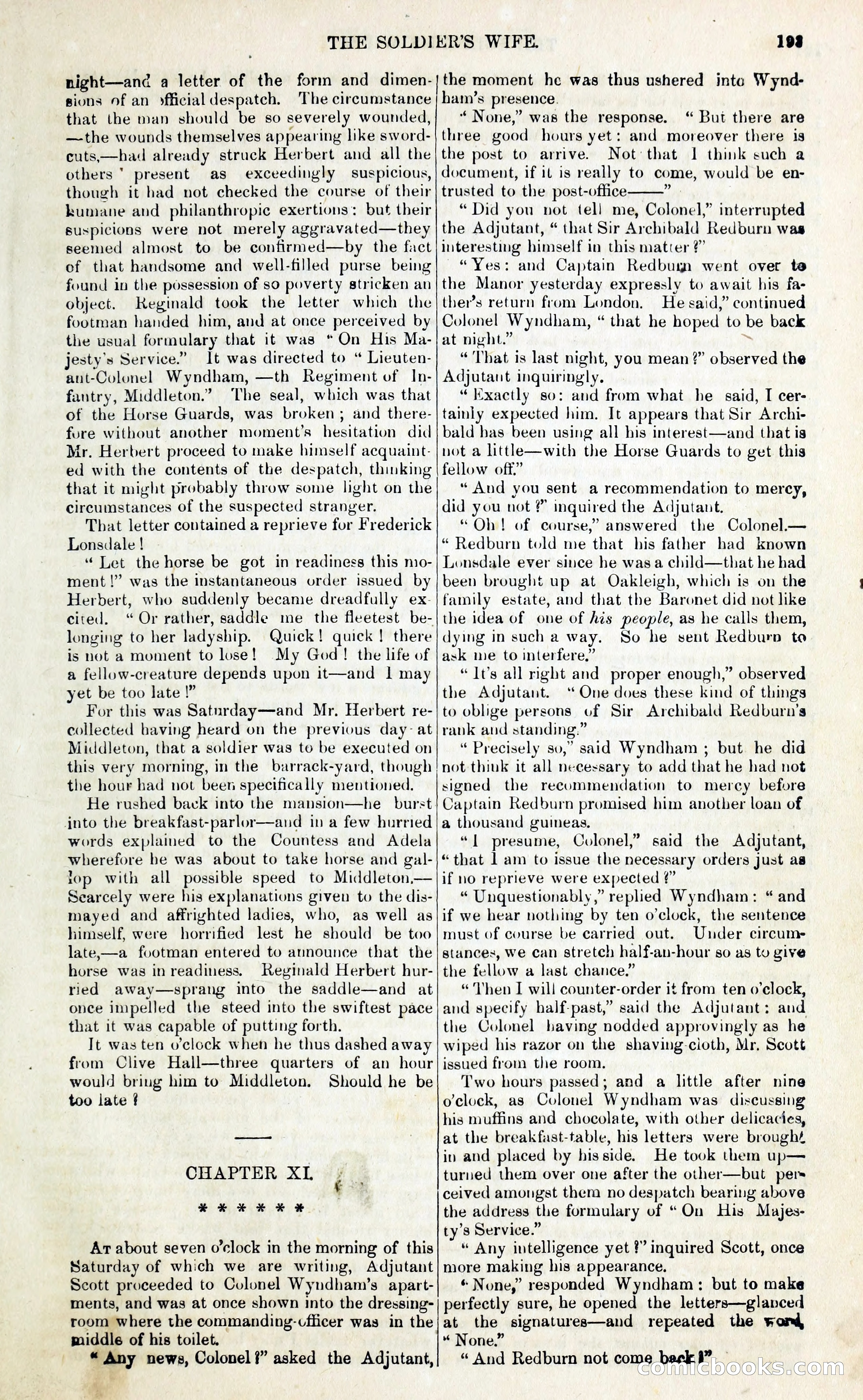
A restored page from Penny Dreadfuls, 1853. Page through the whole issue in the reader above.
📄 Transcribed text from this page (OCR, searchable)
Machine-transcribed from the original scan — historical spelling and the odd misread are preserved.
THE SOLDIER'S WIFE. night—and a letter of the form and dimen- sions of an official despatch. The circumstance that the man should be so severely wounded, —the wounds themselves appearing like sword- cuts,—had already struck Herbert and all the others * present as exceedingly suspicious, though it had not checked the course of their kumane and philanthropic exertions: but their suspicions were not merely aggravated—they seemed almost to be confirmed—by the fact of that handsome and well-filled purse being found in the possession of so poverty stricken an object. Reginald took the letter which the footman handed him, and at once perceived by the usual formulary that it was * On His Ma- jesty’s Service.” It was directed to “ Lieuten- ant-Colonel Wyndham, —th Regiment of In- fantry, Middleton.” The seal, which was that of the Horse Guards, was broken; and there- fore without another moment’s hesitation did Mr. Herbert proceed to make himself acquaint- ed with the contents of the despatch, thinking that it might probably throw some light on the circumstances of the suspected stranger. That letter contained a reprieve for Frederick Lonsdale ! “ Let the horse be got in readiness this mo- ment!” was the instantaneous order issued by Herbert, who suddenly became dreadfully ex- cited. “Or rather, saddle me the fleetest be- longing to her ladyship. Quick! quick ! there is not a moment to lose! My God! the life of a fellow-creature depends upon it—and | may yet be too late !” For this was Saturday—and Mr. Herbert re- collected having heard on the previous day-at Middleton, that a soldier was to be executed on this very morning, in the barrack-yard, though the hour had not been specifically mentioned. He rushed back into the mansion—he_ burst into the breakfast-parlor—and in a few hurried words explained to the Countess and Adela wherefore he was about to take horse and gal- lop with all possible speed to Middleton, — Searcely were his explanations given to the dis- mayed and affrighted ladies, who, as well as himself, were horrified lest he should be too late,—a footman entered to announce that the horse was in readiness. Reyinald Herbert hur- ried away—sprang into the saddle—and at once impelled the steed into the swiftest pace that it was capable of putting forth. It was ten o’clock when he thus dashed away from Clive Hall—three quarters of an hour would bring him to Middleton. Should he be too late ¢ ee CHAPTER XL %¥%* + * * Ar about seven o'clock in the morning of this Saturday of which we are writing, Adjutant Scott proceeded to Colonel Wyndham’s apart- ments, and was at once shown into the dressing- room where the commanding-cficer was in the middle of his toilet. “ Any news, Colonel?” asked the Adjutant, 193 the moment he was thus ushered into Wynd- ham’s presence. “ None,” was the response. “ But there are three good hours yet: and moreover there is the post to arrive. Not that 1 think such a document, if it is really to come, would be en- trusted to the post-office id “Did you not tell me, Colonel,” interrupted the Adjutant, “ that Sir Archibald Redburn was interesting himself in this matter ?” “Yes: and Captain Redbugn went over te the Manor yesterday expressly to await his fa- thers return from London. He said,’ continued Colonel Wyndham, “ that he hoped to be back at night.” y “That is last night, you mean?” observed the Adjutant inguiringly, “exactly so: and from what he said, I cer- tainly expected him. It appears that Sir Archi- bald has been using all his interest—and that is not a litthe—with the Horse Guards to get this fellow off” “And you sent a recommendation to mercy, did you not ? inquired the Adjutant. “Oh! of course,” answered the Colonel.— “Redburn told me that his father had known Lonsdale ever since he was a child—that he had been brought up at Oakleigh, which is on the family estate, and that the Baronet did not like the idea of one of his people, as he calls them, dying in such a way. So he sent Redburo to ask me to interfere,” “It’s all right and proper enough,” observed the Adjutant. ‘“ One does these kind of things to oblige persons of Sir Archibald Redburn’s rank and standing.” “Precisely so,” said Wyndham ; but he did not think it all necessary to add that he had not signed the recommendation to merey before Captain Redburn promised him another loan of a thousand guineas. “| presume, Colonel,” said the Adjutant, “that 1 am to issue the necessary orders just ag if no reprieve were expected ¢” “ Unquestionably,” replied Wyndham: “ and if we hear nothing by ten o’clock, the sentence must of course be carried out. Under circum stances, we can stretch half-an-hour so as tu give the fellow a last chance.” “hen I will counter-order it from ten o’clock, and specify half-past,” said the Adjutant: and the Colonel having nodded approvingly as he wiped his razor on the shaving-cioth, Mr. Scott issued from the room. Two hours passed; and a little after nine o'clock, as Colonel Wyndham was discussing his muffins and chocolate, with other delicacies, at the breakfast-table, his letters were broughé in and placed by hisside. He took them up— turned them over one after the other—but pers ceived amongst them no despatch bearing above the address the formulary of “On His Majes- ty’s Service.” “ Any intelligence yet ?” inquired Scott, once more making his appearance. * None,” responded Wyndham: but to make perfectly sure, he opened the letters—glanced at the signatures—and repeated the word, “ None.” “ And Redburn not come bark § boo <Sii CO)