
Penny Dreadfuls, 1853 · page 201 of 231
The Soldier's Wife — page 201: what you’re looking at
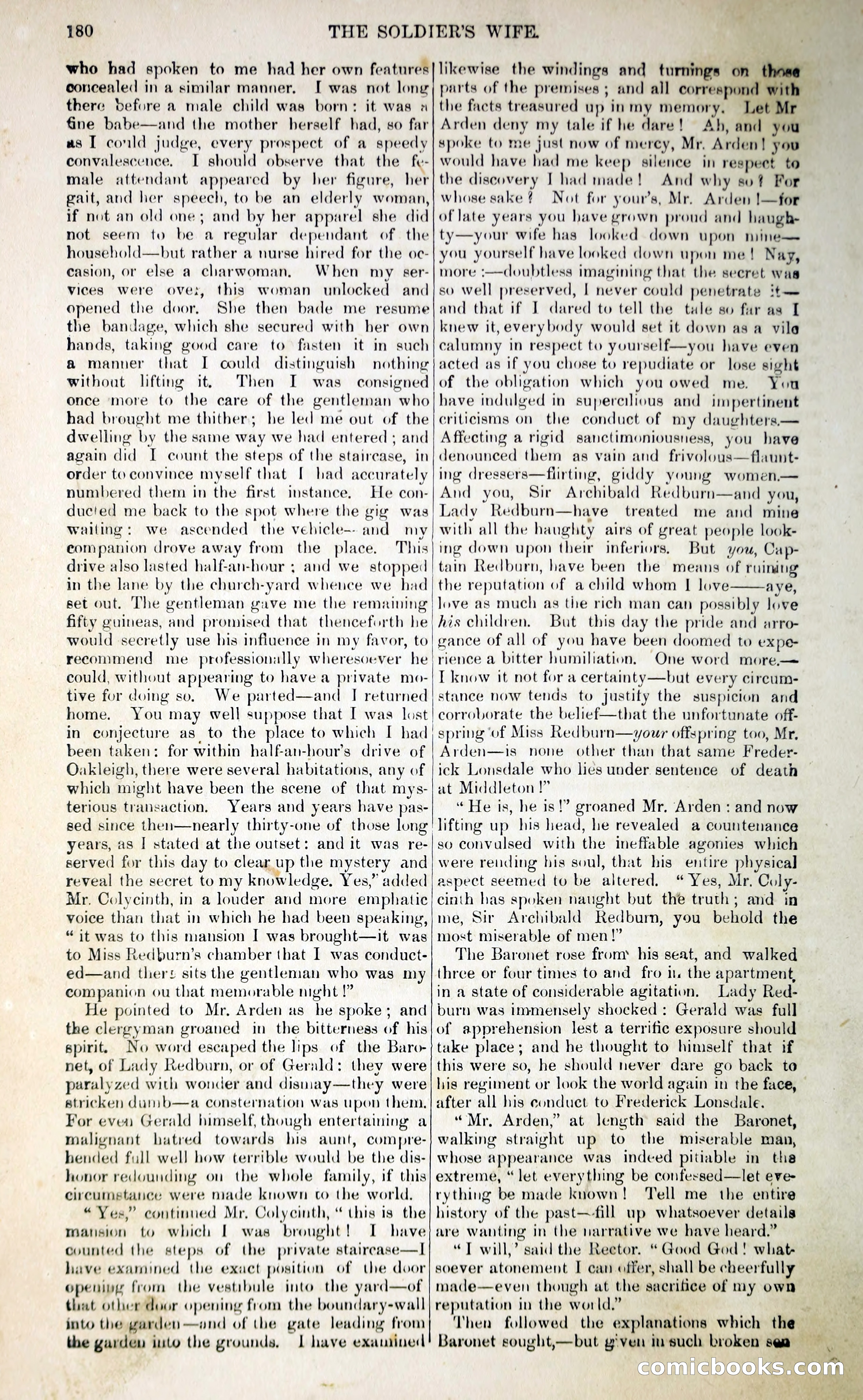
A restored page from Penny Dreadfuls, 1853. Page through the whole issue in the reader above.
📄 Transcribed text from this page (OCR, searchable)
Machine-transcribed from the original scan — historical spelling and the odd misread are preserved.
180 who had spoken to me had her own features concealed in a similar manner. [ was not long there before a male child was born: it was a fine babe—and the mother herself had, so far as I could judge, every prospect of a speedy convalescence, I should observe that the fe- male attendant appeared by her figure, her gait, and her speech, to be an elderly woman, if not an old one; and by her apparel she did not seem to be a regular dependant of the household—but rather a nurse hired for the oc- casion, or else a charwoman, When my ser- vices were over, this woman unlocked and opened the door, She then bade me resume the bandage, which she secured with her own hands, taking good care to fasten it in such a manner that I oould distinguish nothing without lifting it, Then I was consigned once more to the care of the gentleman who had brought me thither; he led me out of the dwelling by the same way we had entered ; and again did I count the steps of the staircase, in order to convince myself that [ had accurately numbered them in the first instance, He con- ducted me back to the spot where the gig was wailing: we ascended the vehicle-- and my companion drove away from the place. This drive also lasted half-an-hour ; and we stopped in the lane by the churech-yard whence we had set out. The gentleman gave me the remaining fifty guineas, and promised that thenceforth he would secretly use his influence in my favor, to recommend me professionally wheresoever he could, without appearing to have a private mo- tive for doing so, We parted—and I returned home. You may well suppose that I was lost in eonjecture as_ to the place to which I had been taken: for within half-an-hour’s drive of Oakleigh, there were several habitations, any of which might have been the scene of that mys- terious transaction, Years and years have pas- Se Le SN a | sed since then—nearly thirty-one of those long: years, as | stated at the outset: and it was re- served for this day to clear up the mystery and reveal the secret to my knowledge. Yes,” added Mr. Colyeinth, in a louder and more emphatic voice than that in which he had been speaking, “it was to this mansion I was brought—it was to Miss Redburn’s chamber that I was conduct- ed—and thers sits the gentleman who was my companion ou that memorable night !” He pointed to Mr. Arden as he spoke; and the clergyman groaned in the bitterness of his spirit. No word escaped the lips of the Baro- net, of Lady Redburn, or of Gerald: they were paralyzed with wonder and disiizay—they were stricken dunisb—a consternation was upon them. For eves: Gerald himself, though entertaining a malignant hatred towards his aunt, compre- hended full well how terrible would be the dis- honor redounding ou the whole family, if this circumstance were made known co the world, “Yes,” continued Mr, Colyeinth, “ this is the mansion to which | was brought! I have counted the steps of the private staircase—I have examined the exaet position of the door opening from the vestibule into the yard—of that other door opening from the boundary-wall into the garden —ond of the gate leading from THE SOLDIER'S WIFE. likewise the windings and turnings on t parts of the premises ; and all correspond — the facts treasured up in my memory. Let M Arden deny my tale if he dare! spoke to me just now of merey, Mr. Arden! you would have had me keep silence in respeet to the discovery I had made! And why su? For whose sake? Not for your’s, Mr. Arden |—for of late years you have grown proud and haugh- ty—your wife has looked down upon mine— you yourself have looked down upon me! Nag, more :—doubtless imagining that the seeret was so well preserved, | never could penetrate it— and that if I dared to tell the tule so far as T knew it,everybody would set it down as a vile calumny in respect to yourself—you have even acted as if you chose to repudiate or lose sight of the obligation which you owed me. You have indulged in supercilious and impertinent criticisms on the conduct of my daughters — Affecting a rigid sanctimoniousness, you have denouneed them as vain and frivolous—flaunt- ing dressers—fiirting, giddy young women— And you, Sir Archibald Redburn—and you, Lady Redburn—have treated me and mine with all the haughty airs of great people look- ing down upon their inferiors. But you, Cap- tain Redburn, have been the means of ruimng the reputation of achild whom | love aye, love as much as the rich man can possibly love his children. But this day the pride and arro- gance of all of you have been doomed to expe- rience a bitter humiliation. One word more.— [I know it not for a certainty—but every circum- stance now tends to justify the suspicion and corroborate the belief—that the unfortunate off- spring ‘of Miss Redburn—your offspring too, Mr, Arden—is none other than that same Freder- ick Lonsdale who lies under sentence of death at Middleton !” “He is, he is!” groaned Mr. Arden: and now lifting up his head, he revealed a countenance so convulsed with the ineffable agonies which were rending his soul, that his entire physical aspect seemed to be altered. “ Yes, Mr, Coly- cinth has spoken naught but the truth; and in me, Sir Archibald Redburn, you behold the most miserable of men!” The Baronet rose from his seat, and walked three or four times to and fro in the apartment, in a state of considerable agitation. Lady Red- burn was immensely shocked: Gerald was full of apprehension lest a terrific exposure should take place; and he thought to himself that if this were so, he should never dare go back to Ah, and you his regiinent or look the world again in the face, | after all his eonduet to Frederick Lonsdale. “Mr, Arden,” at Jenyth said the Baronet, walking straight up to the miserable man, whose appearance was indeed pitiable in’ the extreme, “let everything be confessed—let eve- rything be made known! Tell me the entire history of the past—fill up whatsoever details are wanting in the narrative we have heard.” “T will,’ said the Reetor. “Good God! what soever atonement I can offer, shall be cheerfully made—even though at the sacrifice of my own reputation in the world.” Then followed the explanations which the es ft: + bitte the garden into the grounds, I have examined! Baronet sought,—but g'ven in such broken sea ta ae Gomilcboo ‘Ss