
Penny Dreadfuls, 1853 · page 197 of 231
The Soldier's Wife — page 197: what you’re looking at
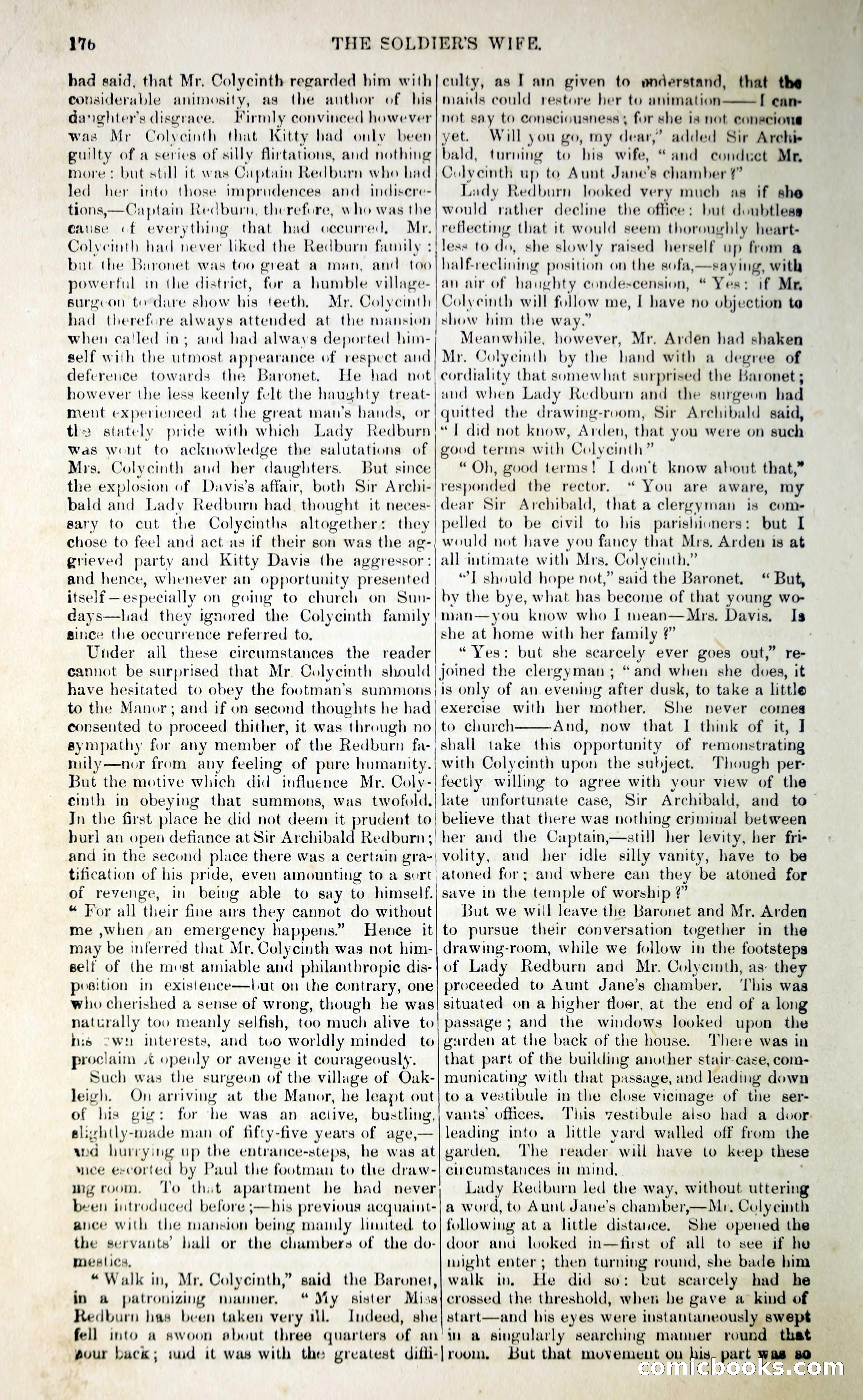
A restored page from Penny Dreadfuls, 1853. Page through the whole issue in the reader above.
📄 Transcribed text from this page (OCR, searchable)
Machine-transcribed from the original scan — historical spelling and the odd misread are preserved.
176 THE SOLDIERS WIFE, had said, that Mr. Colycinth regarded him with|culty, as I am given to onderstand, that the considerable animosity, as the author of his danghter’s disgrace. Firmly convinced however was Mr Colyeinth that Kitty had only been guilty of a series of silly flirtations, and nothing more: but stil if was Captain Redburn who bad led her into those imprudences and indisere- tions,—Captain Redburn, therefore, who was the ause of everything that had ocecurred, Mr. Colyemth had never liked the Redburn family ; but the Baronet was too great a man, and too powerful in the district, for a humble village- surgcon to dare show his teeth, Mr. Colyeimth had therefore always attended at the mansion when called in; and had always deported him- self with the utmost appearance of respect and deference towards the Baronet. He had not however the less keenly felt the haughty treat- ment experienced at the great man’s hands, or the stately pride with which Lady Redburn was wout to acknowledge the salutations of Mrs. Colycinth and her ‘daughters. But since the explosion of Davis’s affair, both Sir Arehi-|t bald and Lady Redburn had thought it neces- sary to cut the Colyeinths altogether: they chose to feel and act as if their son was the age! grieved party and Kitty Davis the aggressor: and hence, whenever an opportunity presented itself — especially on going to chureh on Sun- days—had they ignored the Colyeinth family giice the occurrence referred to, Under all these circumstances the reader cannot be surprised that Mr. Colyeith should have hesitated to obey the footman’s summons to the Manor; and if on second thoughts he had consented to proceed thither, it was through no sympathy for any member of the Redburn fa- mily—nor from any feeling of pure humanity. But the motive which did influence Mr, Coly- einth in obeying that summons, was tw Jn the first place he did not deem it prudent to hurl an open defiance at Sir Archibald Redburn ; and in the second place there was a certain gra- tification of his pride, even amounting to a sort of revenge, in being able to say to himself. “ For all their fine airs they cannot do without me ,when an emergency happens.” Hence it may be inferred that Mr. Colycinth was not him- pelf of the most amiable and philanthropie dis- position in exis(ence—bLut on the contrary, one who cherished a sense of wrong, though he was naturally too meanly selfish, too much alive to his °2wn interests, and too worldly minded to proclaim .¢ opeuly or avenge it courageously, Such was the surgeon of the village of Oak- leigh. On arriving at the Manor, he leapt out of his gig: for he was an active, bustling, elightly-made man of fifty-five years of age,— wd hurrying up the entrance-steps, he was at mice excorted by Paul the footman to the draw- mgroom. To thit apartment he bad never been introduced before ;—his previous acquaint- ance with the mansion being mainly limited to the servants’ hall or the chambers of the do- meslics, “Walk in, Mr, Colyeinth,” said the Baronet, in a patronizing manner, “ My sister Mins Redburn has been taken very ul Indeed, she fell into a swoon about three quarters of an pour back ; joined the clergyman ; ‘is only of an evening after dusk, to take a little jud it was with the greatest difli-| room, maids could restore her to animation——[ ean not say to conseiousness ; for she is not econacions yet. Will you go, my dear,’ added Sir Arehie bald, turning to his wife, “and conduet Mr, Culyeinth up to Aunt Jane’s chamber ¢” Lady Redburn looked very much as if she would rather decline the offiee: but doubtless reflecting that it would seem thoroughly heart- less to da, she slowly raised herself up from a halferee lining position on the sofa,—saying, with an air of haughty condeseension, “ Yes: if Mr, Colyeinth wall follow me, | have no objection te show him the way.” Meanwhile, however, Mr. Ardén had shaken Mr. Colyeinth by the hand with a degree of cordiality that somewhat surprised the Baronet ; and when Lady Redburn and the surgeon had quitted the drawing-room, Sir Arehibald said, “1 did not know, Arden, that you were on such good terms with Colyeinth” “Oh, good terms! I don't know about that,” responded the rector. “ You are aware, my dear Sir Archibald, that a clergyman is come pelled to be civil to his parishioners: but I would not have you faney that Mrs, Arden is at all intimate with Mrs. Colyeinth.” “T should hope not,” said the Baronet. “ But, by the bye, what has become of that young wo- man—you know who I mean—Mrs. Davis, she at home with her family ? “Yes: but she scarcely ever goes out,” “and when she ily it exercise with her mother. She never comes to church And, now that I think of it, J shall take this opportunity of remonstrating with Colyeinth upon the subject. Though per- fectly willing to agree with your view of the ate unfortunate case, Sir Archibald, believe that there was nothing criminal between her and the Captain,—still her levity, her fri- volity, and her idle silly vanity, have to be atoned for; and where can they be atoned for save in the temple of worship ?” But we will leave the Baronet and Mr. Arden to pursue their conversation together in the drawing-room, while we follow in the footsteps of Lady Redburn and Mr. Colycinth, as: they proceeded to Aunt Jane’s chamber. ‘This was situated on a higher floor, at the end of a long passage ; and the windows looked upon the garden at the back of the house. There was in that part of the building another staircase, com- municating with that passage, and leading down to a vestibule in the close vicinage of the ser- vants’ offices, leading into a little varden, The reader circumstances In mind, Lady Redburn led the way, without uttering a word, to Aunt Jane’s chamber,—M», Colyeinth following at a little distance. She opened the door and luoked in—first of all to see if he might enter; then turning round, she bade him walk in, He did so: but scarcely had he crossed the threshold, when be gave a kind of start—and his eyes were instantaneously swept in a singularly searching manuer round that vard walled off from the will have to keep these Is and to This vestibule also had a door. But that movement on his- part daner ecom choo >-CcO