
Penny Dreadfuls, 1853 · page 189 of 231
The Soldier's Wife — page 189: what you’re looking at
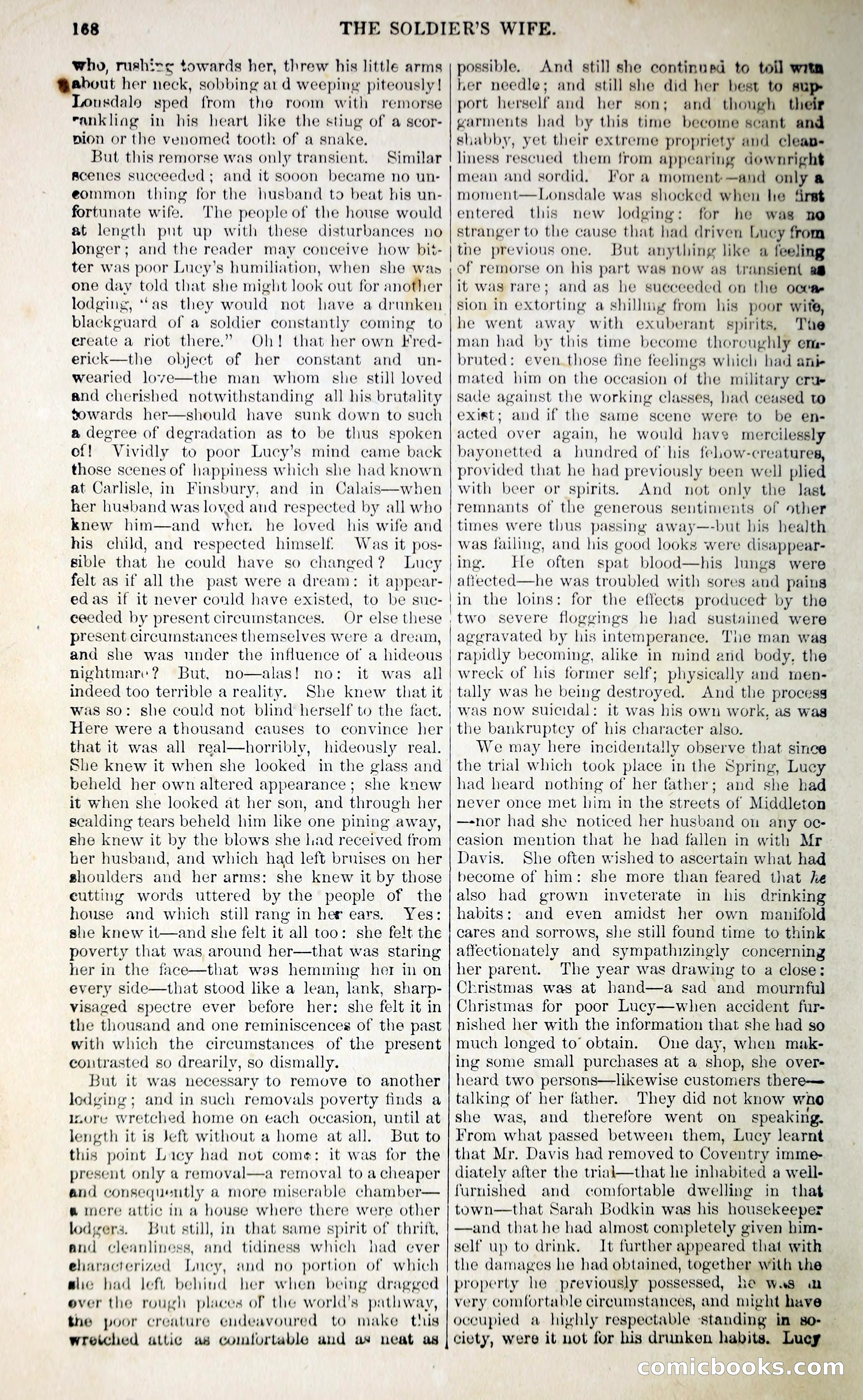
A restored page from Penny Dreadfuls, 1853. Page through the whole issue in the reader above.
📄 Transcribed text from this page (OCR, searchable)
Machine-transcribed from the original scan — historical spelling and the odd misread are preserved.
168 who, rushize towards her, threw his little arms ®adout her neck, sobbing a1 d weeping piteously! Lonsdale sped from the room with remorse rankliag in his heart like the stiug of a scor- pion or the venomed tooth of a snake. But this remorse was only transient. Similar Acenes sueceeded; and it sooon became no un- eommon thing for the husband to beat his un- fortunate wife. The people of the house would at length put up with these disturbances no longer; and the reader may conceive how bit- ter was poor Luey’s humiliation, when she was one day told that she might look out for another lodging, ‘as they would not have a drunken blackguard of a soldier constantly coming to ereate a riot there.” Oh! that her own Fred- erick—the object of her constant and = un- wearied love—the man whom she still loved and cherished notwithstanding all his brutality towards her—should have sunk down to such a degree of degradation as to be thus spoken of! “Vividly to poor Lucy’s mind came back those scenes of happiness which she had known at Carlisle, in Finsbury, and in Calais—when her husband was loved and respected by all who knew him—and wher he loved his wife and his child, and respected himself Was it pos- sible that he could have so changed? Lucy felt as if all the past were a dream: it appear- edas if it never could have existed, to be sue- eeeded by present circumstances. Or else these | present circumstances themselves were a dream and she was under the influence of a hideous nightmare? But, no—alas! no: it was all indeed too terrible a reality. She knew that it was so: she could not blind herself to the fact Here were a thousand causes to convince her that it was all real—horribly, hideously real She knew it when she looked in the glass and beheld her own altered appearance; she knew it when she looked at her son, and through her scalding tears beheld him like one pining away, she knew it by the blows she lad received from her husband, and which had left bruises on her shoulders and her arms: she knew it by those eutting words uttered by the people of the house and which still rang in her ears. Yes she knew it—and she felt it all too: she felt the poverty that was around her—that was staring her in the face—that wes hemming her in on every side—that stood like a lean, lank, sharp- visaged spectre ever before her: she felt it in the thousand and one reminiscences of the past with which the circumstances of the present eoutrasted so drearily, so dismally. But it was necessary to remove to another lodving ; and in such removals poverty finds wore wretched home on each occasion, until at length it is Jeft without a home at all. But to this point Lacy had not come: it was for the present only a removal—a removal to a cheaper and consequently a more miserable chamber @ mere attic in a house where there were othe lodgers. But still, in that same spirit of thrift and cleanliness, and tidiness which had eve eharacterized Luey, and no portion of which slic had left behind her when being dragged ever the rough places of the world’s pathway, the poor creature endeavoured to make this wretched attic as comlortable and as neat as THE SOLDIER’S WIFE. es possible. And still she continued to toil her needle; and still she did her best to port herself and her son; and though theit garments had by this time become scant and shabby, yet their extreme propriety and cleap- liness rescued them from appearing downright mean and sordid. For a moment-—and only a moment—Lonsdale was shocked when he first entered this new lodging: for he wag ne stranger to the cause that had driven Lucy from the previous one. But anything like a feeling of remorse on his part was now as transient ag It was rare; and as he sueceeded on the ocet sion in extorting a shilhiy from his poor wife, he went away with exuberant spirits, The man had by this time become thoroughly ene bruted: even.those fine feelings which had ani- mated him on the occasion of the military erue sade against the working classes, had ceased to exist; and if the same scene were to be en- acted over again, he would have mercilessly bayonetted a hundred of his feliow-creatures, provided that he had previously been well plied with beer or spirits. And not only the last remnants of the generous sentiments of other times were thus passing away—-but his health was failing, and his good looks were disappear- ing. He often spat blood—his lungs were aftected—he was troubled with sores and pains in the loins: for the effects produced by the .two severe floggings he had sustained were aggravated by his intemperance. The man wag rapidly becoming, alike in mind and body, the wreck of his former self; physically and men- tally was he being destroyed. And the process ras now suicidal: it was his own work, as was the bankruptey of his character also. We may here incidentally observe that since the trial which took place in the Spring, Luey had heard nothing of her father; and she had never once met him in the streets of Middleton —-nor had she noticed her husband on any oe- r - easion mention that he had fallen in with Mr Davis. She often wished to ascertain what had become of him: she more than feared that he also had grown inveterate in his drinking habits: and even amidst her own manifold cares and sorrows, she still found time to think affectionately and sympathizingly concerning her parent. The year was drawing to a close; Christmas was at hand—a sad and mournful Christmas for poor Lucy—when accident fur- nished her with the information that she had so much longed to’ obtain. One day, when mak- ing some small purchases at a shop, she overs heard two persons—likewise customers there— talking of her father. They did not know who she was, and therefore went on speaking. From what passed between them, Lucy learnt that Mr. Davis had removed to Coventry imme- diately after the trial—that he inhabited a well- furnished and comfortable dwelling in that town—that Sarah Bodkin was his housekeeper —and that he had almost completely given him- self up to drink. It further appeared that with the damages he had obtained, together with the property he previously possessed, he Was am very comfortable circumstances, and might have occupied a highly respectable standing im so- cloty, were it not for bis drunken habits, Lucy | Gomiecbooks (E ym (eo)