
Penny Dreadfuls, 1853 · page 170 of 231
The Soldier's Wife — page 170: what you’re looking at
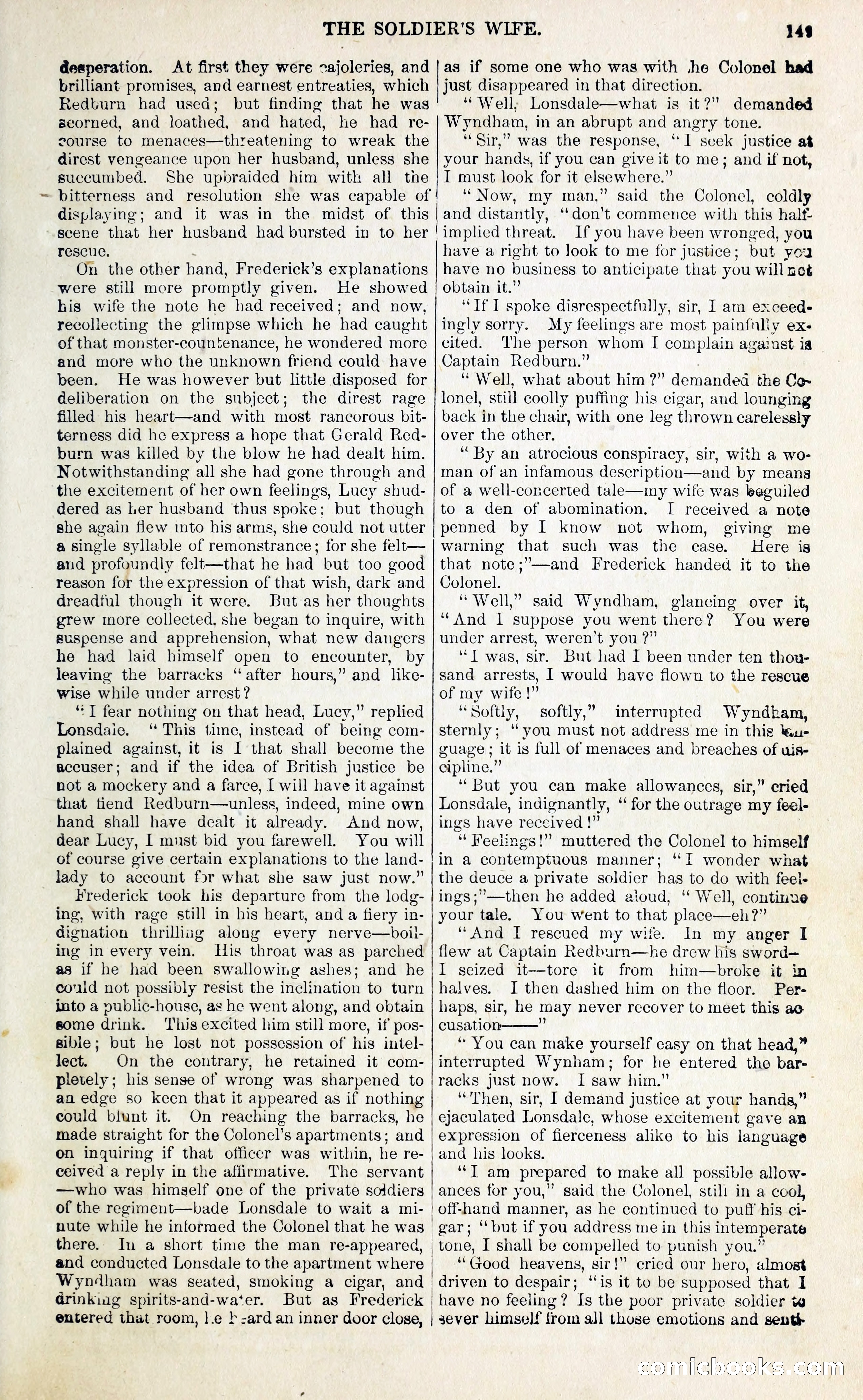
A restored page from Penny Dreadfuls, 1853. Page through the whole issue in the reader above.
📄 Transcribed text from this page (OCR, searchable)
Machine-transcribed from the original scan — historical spelling and the odd misread are preserved.
THE SOLDIER'S WIFE. derperation. 149 At first they were ajoleries, and |as if some one who was with jhe Colonel had brilliant promises, and earnest entreaties, which | just disappeared in that direction. Redturn had used; but finding that he was acorned, and loathed, and hated, he had re- course to menaces—threatening to wreak the direst vengeance upon her husband, unless she succumbed. She upbraided him with all the bitterness and resolution she was capable of displaying; and it was in the midst of this scene that her husband had bursted in to her rescue. On the other hand, Frederick’s explanations were still more promptly given. He showed his wife the note he had received; and now, recollecting the glimpse which he had caught of that monster-countenance, he wondered more and more who the unknown friend could have been. He was however but little disposed for deliberation on the subject; the direst rage filled his heart—and with most rancorous bit- terness did he express a hope that Gerald Red- burn was killed by the blow he had dealt him. Notwithstanding all she had gone through and the excitement of her own feelings, Lucy shud- dered as Ler husband thus spoke: but though she again flew into his arms, she could not utter a single syllable of remonstrance; for she felt— and profoundly felt—that he had but too good reason for the expression of that wish, dark and dreadtul though it were. But-as her thoughts grew more collected, she began to inquire, with suspense and apprehension, what new dangers he had laid himself open to encounter, by leaving the barracks ‘after hours,” and like- wise while under arrest? “I fear nothing on that head, Lucy,” replied Lonsdaie. “This time, instead of being com- plained against, it is I that shall become the accuser; and if the idea of British justice be not a mockery and a farce, [I will have it against that fiend Redburn—unless, indeed, mine own hand shall have dealt it already. And now, dear Lucy, I must bid you farewell. You will of course give certain explanations to the land- lady to account for what she saw just now.” Frederick took his departure from the lodg- ing, with rage still in his heart, and a fiery in- dignation thrilling along every nerve—boil- ing in every vein. His throat was as parched as if he had been swallowing ashes; and he could not possibly resist the inclination to turn into a vublic-house, as he went along, and obtain some drink. This excited him still more, if pos- sible; but he lost not possession of his intel- lect. On the contrary, he retained it com- pletely; his sense of wrong was sharpened to an edge so keen that it appeared as if nothing could blunt it. On reaching the barracks, he made straight for the Colonel’s apartments; and on inquiring if that officer was within, he re- ceived a reply in the affirmative. The servant —who was himself one of the private soldiers of the regiment—bade Lonsdale to wait a mi- mute while he informed the Colonel that he was there. In a short time the man re-appeared, and conducted Lonsdale to the apartment where Wyndham was seated, smoking a cigar, and Grinking spirits-and-wa‘er. But as Frederick entered that room, |.e fb -ard an inner door close, —— —.—n—— ee ee “Well; Lonsdale—what is it?” demanded Wyndham, in an abrupt and angry tone. ‘“Sir,” was the response, ‘I svek justice at your hands, if you can give it to me; and if not, I must look for it elsewhere.” ‘“Now, my man,” said the Colonel, coldly and distantly, “don’t commence with this half implied threat. If you have been wronged, you have a right to look to me for justice; but you have no business to anticipate that you willnet obtain it.” ‘Tf I spoke disrespectfully, sir, ] am exceed- ingly sorry. My feelings are most painfully ex- cited. The person whom I complain agatnst is Captain Redburn.” “Well, what about him ?” demanded the Co lonel, still coolly puffing his cigar, aud lounging back in the chair, with one leg thrown carelessly over the other. ‘By an atrocious conspiracy, sir, with a wo- man of an infamous description—and by means of a well-concerted tale—my wife was beguiled to a den of abomination. I received a note penned by I know not whom, giving me warning that such was the case. Here is that note;’”—and Frederick handed it to the Colonel. “Well,” said Wyndham, glancing over it, ‘“And I suppose you went there? You were under arrest, weren’t you ?” ‘““T was, sir. But had I been under ten thou- sand arrests, I would have flown to the rescue of my wife !” ‘Softly, softly,” interrupted Wyndham, sternly; “you must not address me in this kau guage; it is full of menaces and breaches of uis- cipline.” ‘But you can make allowances, sir,” cried Lonsdale, indignantly, “ for the outrage my feel- ings have received !” Feeli nes!” muttered the Colonel to himself in a contemptuous manner; “I wonder what the deuce a private soldier bas to do with feel- ings ;”—then he added atoud, ‘‘ Well, continue your tale. You went to that place—eh?” “And I rescued my wite. In my anger I flew at Captain Redburn—he drew his sword= I seized it—tore it from him—broke it in halves. I then dashed him on the floor. Per- haps, sir, he may never recover to meet this ac cusation——”’ ‘“ You can make yourself easy on that head,” interrupted Wynham; for he entered the bar- racks just now. I saw him.” ‘Then, sir, I demand justice at your hands,” ejaculated Lonsdale, whose excitement gave an expression of fierceness alike to his language and his looks. ‘“IT am prepared to make all possible allow- ances for you,” said the Colonel, stilt in a cool, off-hand manner, as he continued to puff his ci- gar; ‘‘but if you address me in this intemperate tone, I shall be compelled to punish you.” ‘“Good heavens, sir!” cried our hero, almost driven to despair; ‘‘is it to be supposed that I have no feeling? Is the poor private soldier # sever himself from all those emotions and sent MICLOOOKS.: O (EO) EO)