
Penny Dreadfuls, 1853 · page 160 of 231
The Soldier's Wife — page 160: what you’re looking at
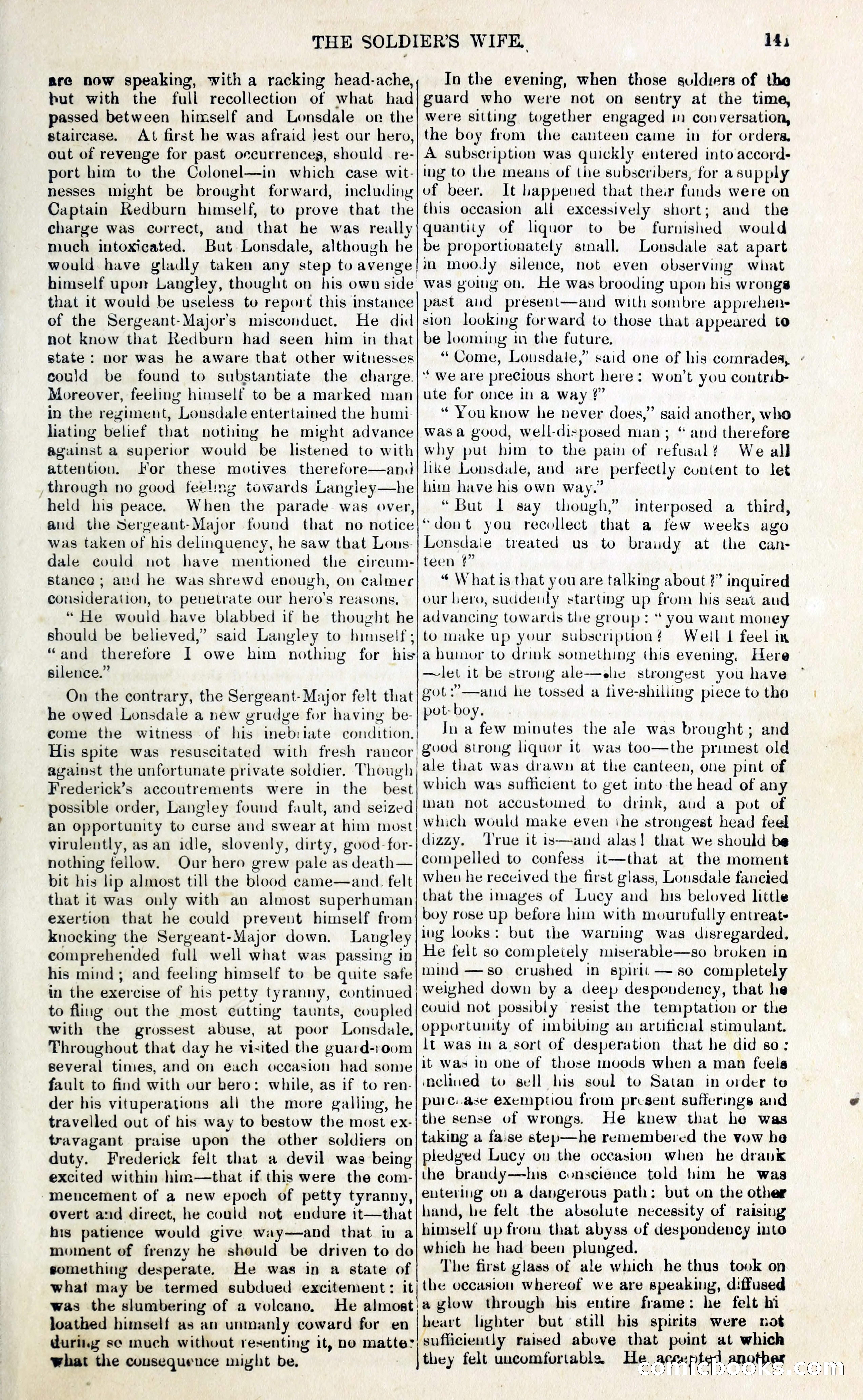
A restored page from Penny Dreadfuls, 1853. Page through the whole issue in the reader above.
📄 Transcribed text from this page (OCR, searchable)
Machine-transcribed from the original scan — historical spelling and the odd misread are preserved.
~ THE SOLDIER'S WIFE. are now speaking, with a racking head-ache, but with the full recollection of what had passed between himself and Lonsdale on the staircase. At first he was afraid lest our hero, out of revenge for past occurrences, should _re- port him to the Colonel—in which case wit- nesses might be brought forward, including Captain Redburn himself, to prove that the charge was correct, and that he was really much intoxicated. But Lonsdale, although he would have gladly taken any step to avenge himself upon Langley, thought on his own side that it would be useless to report this instance of the Sergeant-Major’s misconduct. He did not know that Redburn had seen him in that state: nor was he aware that other witnesses could be found to substantiate the charge. Moreover, feeling himself to be a marked man in the regiment, Lonsdale entertained the humi liating belief that nothing he might advance against a superior would be listened to with attention. or these motives therefore—and through no goud feeling towards Langley—he held his peace. When the parade was over, and the Sergeant-Major found that no notice was taken of his delinquency, he saw that Lons dale could not have mentioned the circum- stance ; avd he was shrewd enough, on calmer consideration, to penetrate our hero’s reasons. “He would have blabbed if be thought he should be believed,” said Langley to himself; “and therefore I owe him nothing for his silence.” On the contrary, the Sergeant- Major felt that he owed Lonsdale a new grudge for having be- come the witness of his inebilate condition. His spite was resuscitated with fresh rancor against the unfortunate private soldier. Though Frederick’s accoutrements were in the best possible order, Langley found fault, and seized an opportunity to curse and swear at him most virulently, as an idle, slovenly, dirty, good-for- nothing fellow. Our hero grew pale as death— bit his lip almost till the blood came—and. felt that it was only with an almost superhuman exertion that he could prevent himself from knocking the Sergeant-Major down. Langley comprehended full well what was passing in his mind; and feeling himself to be quite safe in the exercise of his petty tyranny, continued to fling out the most cutting taunts, coupled with the grossest abuse, at poor Lonsdale. Throughout that day he visited the guard-100om several times, and on each occasion had some fault to find with our hero: while, as if to ren- der his vituperations all the more galling, he travelled out of his way to bestow the most ex- travagant praise upon the other soldiers on duty. Frederick felt that a devil was being excited within him—that if this were the com- -mmencement of a new epoch of petty tyranny, overt and direct, he could not endure it—that his patience would give way—and that in a moment of frenzy he should be driven to do something desperate. He was in a state of what may be termed subdued excitement: it was the slumbering of a volcano, He almost loathed himself as an unmanly coward for en during sc much without resenting it, n0 matter what the cousequence might be. : 14; In the evening, when those suldiers of the guard who were not on sentry at the time, were sitting together engaged in conversation, the boy from the canteen came in for orders, A subseription was quickly entered into accord. ing to the means of the subscribers, for a supply uf beer. It happened that their funds were on this occasion all excessively short; and the quantity of liquor to be furnished would be proportionately small. Lonsdale sat apart mn moody silence, not even observing what was going on. He was brooding upon his wrongs past and present—and with sumbre apprehene sion looking forward to those that appeared te be looming in the future. “Come, Lousdale,” said one of his comrades, - “ we are precious short here: won’t you contrib- ute for once in a way ?” “ You kuow he never does,” said another, who wasa good, well-dizposed man; “ aud therefore why put him to the pain of refusal¢ We all like Lonsdale, and are perfectly content to let him have his own way.” “But I say though,” interposed a third, “dont you recollect that a few weeks ago Lonsdaie treated us to braudy at the can- teen ¢” “ What is that you are talking about ?” inquired our hero, suddeuly starting up from his seat and advancing towards the group: “ you want mouey to make up your subscription? Well | feel in a humor to drink something this evening, Here —let it be strong ale—ele strongest you have got:’—and he tossed a five-shilling piece to the pot- boy. Jn a few minutes the ale was brought ; and good strong liquor it was too—the primest old ale that was drawn at the canteen, one pint of which was sufficient to get into the head of any inan not accustomed to drink, aud a pot of which would make even the strongest head feel dizzy. True it is—and alas! that we should be compelled to confess it—that at the moment wheu he received the first glass, Lonsdale fancied that the images of Lucy and _ his beloved little boy rose up before him with mourufully entreate ing looks: but the warning was disregarded. He felt so completely miserable—so broken in mind —so crushed in spirit — so completely welyhed down by a deep despondency, that he couid not possibly resist the temptation or the opportunity of imbibing au artificial stimulant. lt was in a sort of desperation that he did so: it Was In one of those moods when a man feels melined to sell his soul to Satan in order to purc..ase exemptiou from present sufferings and the sense of wrongs. He kuew that he was taking a faise step—he remembered the vow he pledged Lucy on the occasion when he drank the brandy—his conscience told him he was enteriig on a dangerous path; but on the other hand, he felt the absolute necessity of raising himself up from that abyss of despondency into which he had been plunged. The first glass of ale which he thus took on the occasion whereof we are speaking, diffused aglow through his entire frame: he felt bi heart lighter but still his spirits were not sufficiently raised above that pvint at which they felt uucumfortable, He accepted another (C(0)