
Penny Dreadfuls, 1853 · page 16 of 231
The Soldier's Wife — page 16: what you’re looking at
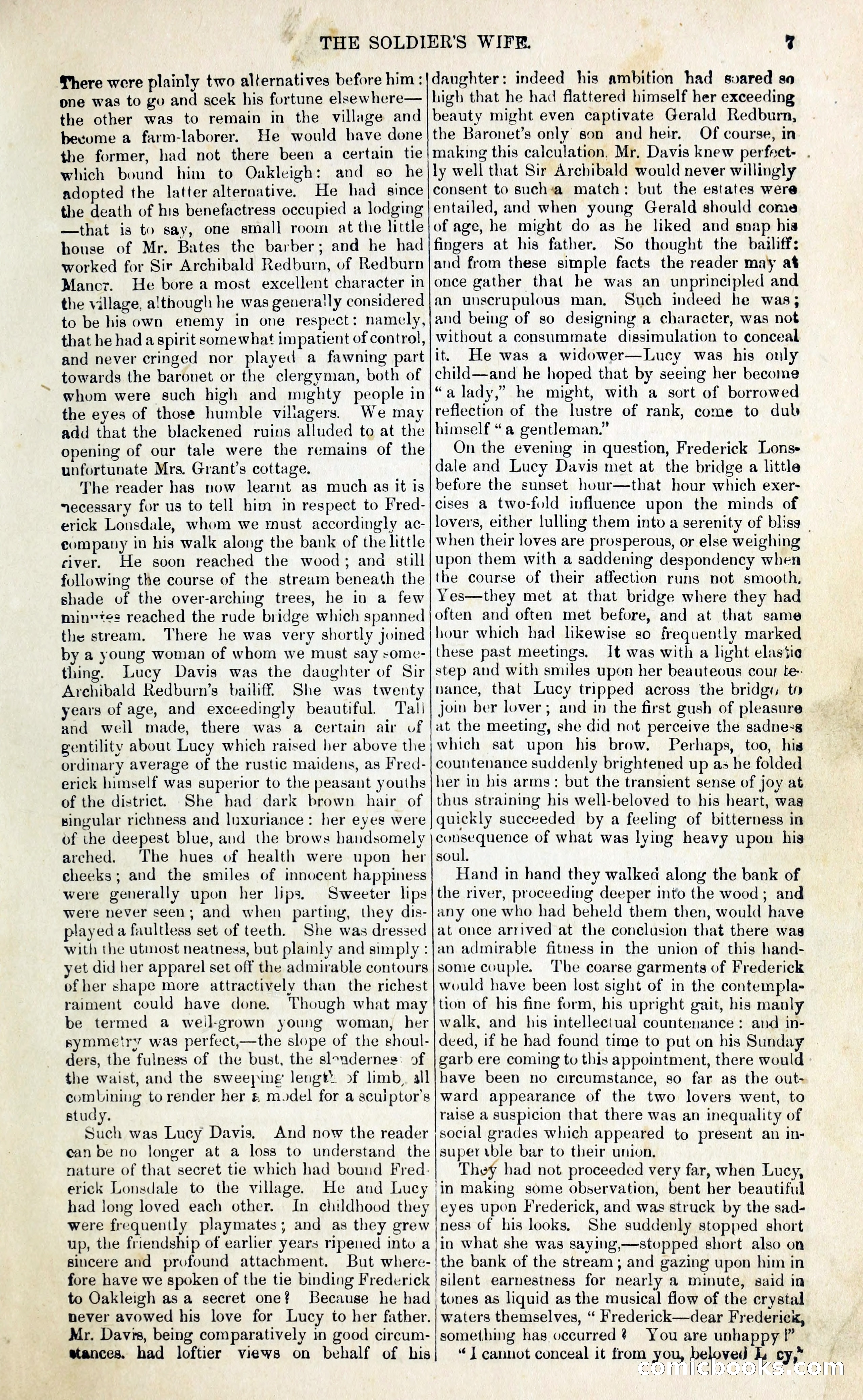
A restored page from Penny Dreadfuls, 1853. Page through the whole issue in the reader above.
📄 Transcribed text from this page (OCR, searchable)
Machine-transcribed from the original scan — historical spelling and the odd misread are preserved.
THE SOLDIER'S WIFE. % There were plainly two alternatives before him: daughter: indeed his ambition had svared so one was to go and scek his fortune elsewhere— the other was to remain in the village and become a farm-laborer. He would have done the former, had not there been a certain tie which bound him to Oakleigh: and so he adopted the latter alternative. He had since the death of his benefactress occupied a lodging —that is to say, one small room at the little house of Mr. Bates the barber; and he had worked for Sir Archibald Redburn, of Redburn Mancr. He bore a most excellent character in the village, although he was generally considered to be his own enemy in one respect: namely, that he had a spirit somewhat impatient of control, and never cringed nor played a fawning part towards the baronet or the clergyman, both of whom were such high and mighty people in the eyes of those humble villagers. We may add that the blackened ruins alluded to at the opening of our tale were the remains of the unfortunate Mrs. Grant’s cottage. The reader has now learnt as much as it is necessary for us to tell him in respect to Fred- erick Lonsdale, whom we must accordingly ac- eompany in his walk along the bank of the little civer. He soon reached the wood; anda still following the course of the stream beneath the shade of the over-arching trees, he in a few min"<es reached the rude bridge which spanned the stream. There he was very shortly Joined by a young woman of whom we must say rome- thing. Lucy Davis was the daughter of Sir Archibald Redburn’s bailiff She was twenty years of age, and exceedingly beautiful. Tall and weil made, there was a certain air of gentility about Lucy which raised her above the ordinary average of the rustic maidens, as Fred- erick himself was superior to the peasant youths of the district. She had dark brown hair of singular richness and luxuriance: her eyes were of the deepest blue, aud the brows handsomely arched. The hues of health were upon her cheeks; and the smiles of innocent happiness were generally upon her lips. Sweeter lips were never seen; and when parting, they dis- played a faultless set of teeth. She was dressed with the utmost neatness, but plainly and simply : yet did her apparel set off the admirable contours of her shape more attractively than the richest raiment could have done. Though what may be termed a well-grown young woman, her symme'ry was perfect,—the slope of the shoul- ders, the fulness of the bust, the slondernes: of the waist, and the sweeping lengt®. of limb. all combining to render her & model for a scuiptor’s study. Such was Lucy Davis. And now the reader canbe no longer at a loss to understand the nature of that secret tie which had bound Fred- erick Lonsdale to the village. He and Lucy had long loved each other. In childhood they were frequently playmates; and as they grew up, the friendship of earlier years ripened into a sincere and profound attachment. But where- fore have we spoken of the tie binding Frederick to Oakleigh asa secret one? Because he had never avowed his love for Lucy to her father. Mr. Davis, being comparatively in good circum- wances. had loftier views on behalf of his high that he had flattered himself her exceeding beauty might even captivate Gerald Redburn, the Baronet’s only son and heir. Of course, in making this calculation, Mr. Davis knew perfect- . ly well that Sir Archibald would never willingly consent to suchva match: but the estates were entailed, and when young Gerald should come of age, he might do as he liked and snap his fingers at his father. So thought the bailiff: and from these simple facts the reader may at once gather that he was an unprincipled and an unscrupulous man. Such indeed he was; and being of so designing a character, was not without a consummate dissimulation to conceal it. He was a widower—Lucy was his only child—and he hoped that by seeing her become “a lady,” he might, with a sort of borrowed reflection of the lustre of rank, come to dub himself “a gentleman.” On the evening in question, Frederick Lons- dale and Lucy Davis met at the bridge a little before the sunset hour—that hour which exer- cises a two-fold influence upon the minds of lovers, either lulling them into a serenity of blisg _ when their loves are prosperous, or else weighing upon them with a saddening despondency when the course of their affection runs not smooth, Yes—they met at that bridge where they had often and often met before, and at that same hour which had lkewise so frequently marked these past meetings. It was with a light elastie step and with smiles upon her beauteous cour te: nance, that Lucy tripped across the bridgy, to join ber lover; and in the first gush of pleasure at the meeting, she did not perceive the sadne-s which sat upon his brow. Perhaps, too, his countenance suddenly brightened up as he folded her in his arms; but the transient sense of joy at thus straining his well-beloved to his heart, was quickly succeeded by a feeling of bitterness in Serena of what was lying heavy upon his soul. Hand in hand they walked along the bank of the river, proceeding deeper into the wood; and any one who had beheld them then, would have at once arrived at the conclusion that there was an admirable fitness in the union of this hand- some couple. The coarse garments of Frederick would have been lost sight of in the contempla- tion of his fine form, his upright gait, his manly walk, and his intellectual countenance : and in- deed, if he had found time to put on his Sunday garb ere coming tu this appointment, there would have been no circumstance, so far as the out- ward appearance of the two lovers went, to raise a suspicion that there was an inequality of social grades which appeared to present an in- super ible bar to their union. They had not proceeded very far, when Lucy, in making some observation, bent her beautiful eyes upon Frederick, and was struck by the sad- ness of his looks, She suddenly stopped short in what she was saying,—stopped short also on the bank of the stream; and gazing upon him in silent earnestness for nearly a minute, said in tones as liquid as the musical flow of the crystal waters themselves, “ Frederick—dear Frederick, something has occurred’ You are unhappy!” “I cannot conceal it from you, beloved hi cy,” CoMmicbaokss Ec)