
Penny Dreadfuls, 1853 · page 143 of 231
The Soldier's Wife — page 143: what you’re looking at
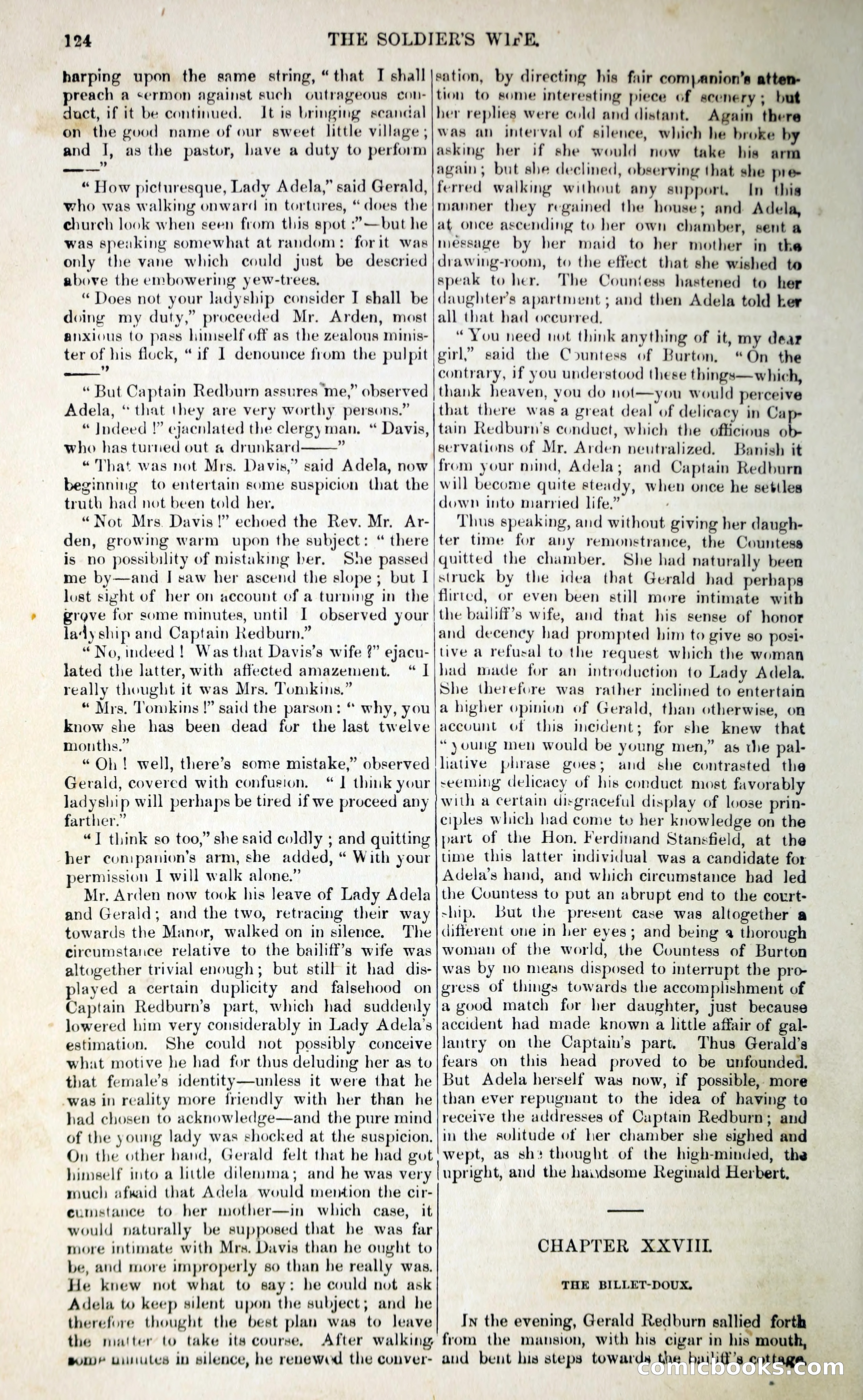
A restored page from Penny Dreadfuls, 1853. Page through the whole issue in the reader above.
📄 Transcribed text from this page (OCR, searchable)
Machine-transcribed from the original scan — historical spelling and the odd misread are preserved.
124 harping upon the same string, “that I shall preach a sermon against such outrageous con- duct, if it be continued. It is bringing seandal on the good name of our sweet little village ; and I, as the pastor, have a duty to perform ” “ How picturesque, Lady Adela,” said Gerald, who was walking onward in tortures, “ does the church look when seen from this spot :’—but he was speaking somewhat at random: forit was only the vane which could just be descried above the embowering yew-trees, “ Does not your ladyship consider I shall be doing my duty,” proceeded Mr. Arden, most anxious to pass himself off as the zealous minis- ter of his flock, “if I denounce from the pulpit ”? “But Captain Redburn assures me,” observed Adela, “ that they are very worthy persons.” “ Indeed !” ejacnlated the clergyman. “ Davis, who has turned out a drunkard ‘i “That was not Mrs. Davis,” said Adela, now beginning to entertain some suspicion that the truth had not been told her. “Not Mrs. Davis!” echoed the Rev. Mr. Ar- den, growing warm upon the subject: “ there is no possibility of mistaking ber. She passed me by—and I saw her ascend the slope; but I lust sight of her on account cf a turning in the grove for some minutes, until I observed your lady ship and Captain Redburn.” “No, indeed ! Was that Davis’s wife ?” ejacu- lated the latter, with affected amazement. “ I really thought it was Mrs. Tomkins.” “ Mrs. Tomkins !” said the parson: “ why, you know she has been dead for the last twelve months.” “Oh! well, there’s some mistake,” observed Gerald, covered with confusion. “ 1 think your Jadyship will perhaps be tired if we proceed any farther.” “] think so too,” she said coldly ; and quitting her conipanion’s arm, she added, “ With your permission I will walk alone.” Mr. Arden now took his leave of Lady Adela and Gerald; and the two, retracing their way towards the Manor, walked on in silence. The circumstance relative to the bailiff’s wife was altogether trivial enough; but still it had dis- played a certain duplicity and falsehood on Captain Redburn’s part, which had suddenly lowered him very considerably in Lady Adela’s estimation. She could not possibly conceive whut motive he had for thus deluding her as to that female’s identity—unless it were that he -was in reality more friendly with her than he had chosen to acknowledge—and the pure mind of the young lady was shocked at the suspicion. On the other hand, Gerald felt that he had got himself into a little dilemma; and he was very much afxaid that Adela would mention the cir- cumstanee to her mother—in which case, it would naturally be supposed that he was far more intimate with Mrs, Davis than he ought to be, and more improperly so than he really was. He knew not what to say: he could not ask Adela to keep silent upon the subject; and he therefore thought the best plan was to leave the matter to take its course, som? uilsiules in silence, he renewed the conver- and bent his steps towards the baits enthaga, — After walking, from the mansion, with his cigar in his mouth, THE SOLDIER'S W1rE, sation, by directing his fair companion’s atten- tion to some interesting piece of scenery; but her replies were cold and distant. Again there was an interval of silence, which he broke by asking her if she would now take his arm again, but she declined, observing that she pre- ferred walking without any support. In this manner they regained the house; and Adela, at once ascending to her own chamber, sent a message by her maid to her mother in the drawing-room, to the effect that she wished te speak to her. The Countess hastened to her daughter's apartment ; and then Adela told ker all that had oceurred, “You need not think anything of it, my dear girl,” said the Countess of Burton, “On the contrary, if you understood these things—which, thank heaven, you do not—you would perceive that there was a great deal of delicacy in Cap- tain Redburn’s conduct, which the officious ob- servations of Mr. Arden neutralized. Banish it from your mind, Adela; and Captain Redburn will become quite steady, when once he setiles down into married life.” : Thus speaking, and without giving her daugh- ter time for any remonstrance, the Countess quitted the chamber. She had naturally been struck by the idea that Gerald had perhaps ‘flirted, or even been still more intimate with the bailiff’s wife, and that his sense of honor and decency had prompted him to give so posi- live a refusal to the request which the woman had made for an introduction to Lady Adela. She therefore was rather inclined to entertain a higher opinion of Gerald, than otherwise, on account Of this incident; for she knew that “young men would be young men,” as the pal- liative phrase goes; and she contrasted the seeming delicacy of his conduct most favorably with a certain disgraceful display of loose prin- ciples which had come te her knowledge on the part of the Hon. Ferdinand Stansfield, at the time this latter individual was a candidate for Adela’s hand, and which circumstance had Jed the Countess to put an abrupt end to the court- -hip. But the present case was altogether a different one in her eyes; and being a thorough woman of the world, the Countess of Burton was by no means disposed to interrupt the pro- gress of things towards the accomplishment of a good match for her daughter, just because accident had made known a little affair of gal- lantry on the Captain’s part. Thus Gerald’s fears on this head proved to be unfounded. But Adela herself was now, if possible, more than ever repugnant to the idea of having te receive the addresses of Captain Redburn; and in the solitude of her chamber she sighed and wept, as sh? thought of the high-minded, the l upright, and the haixdsome Reginald Herbert, CHAPTER XXVIII. THE BILLET-DOUX, In the evening, Gerald Redburn sallied forth P