
Penny Dreadfuls, 1889 · page 17 of 218
A Servant of Satan: Romantic Career of Prado the Assassin — page 17: what you’re looking at
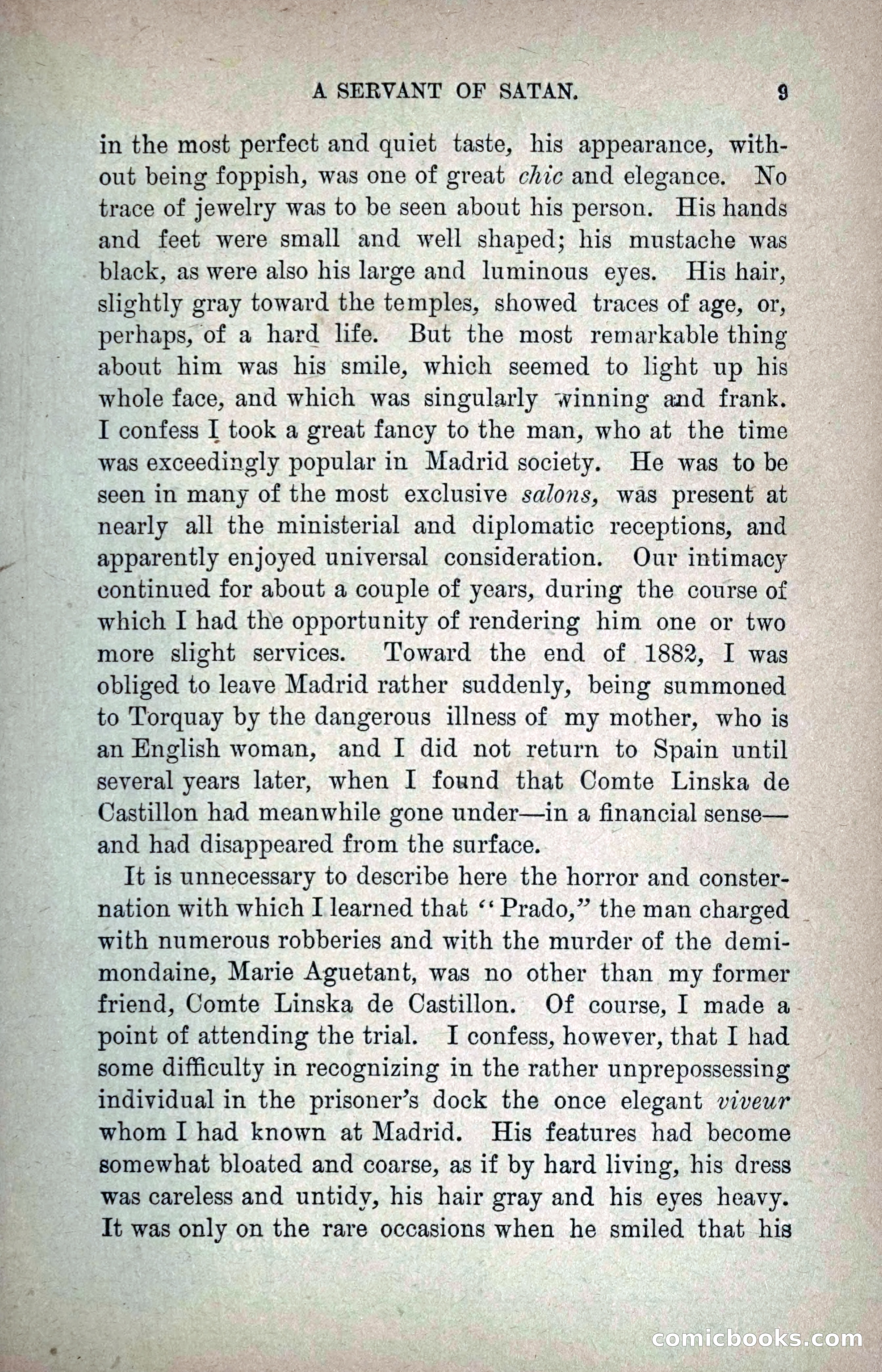
A restored page from Penny Dreadfuls, 1889. Page through the whole issue in the reader above.
📄 Transcribed text from this page (OCR, searchable)
Machine-transcribed from the original scan — historical spelling and the odd misread are preserved.
A SERVANT OF SATAN. 9° in the most perfect and quiet taste, his appearance, with- out being foppish, was one of great chic and elegance. No trace of jewelry was to be seen about his person. His hands and feet were small and well shaped; his mustache was _ black, as were also his large and luminous eyes. His hair, slightly gray toward the temples, showed traces of age, or, perhaps, of a hard life. But the most remarkable thing © about him was his smile, which seemed to light up his whole face, and which was singularly winning and frank. I confess I took a great fancy to the man, who at the time was exceedingly popular in Madrid society. He was to be seen in many of the most exclusive salons, was present at nearly all the ministerial and diplomatic receptions, and apparently enjoyed universal consideration. Our intimacy continued for about a couple of years, during the course of which [ had the opportunity of rendering him one or two more slight services. Toward the end of 1882, I was obliged to leave Madrid rather suddenly, being summoned to ‘Torquay by the dangerous illness of my mother, who is an Hnglish woman, and I did not return to Spain until several years later, when I found that Comte Linska de Castillon had meanwhile gone under—in a financial sense— and had disappeared from the surface. It is unnecessary to describe here the horror and conster- nation with which I learned that ‘‘ Prado,” the man charged _ with numerous robberies and with the murder of the demi- mondaine, Marie Aguetant, was no other than my former friend, Comte Linska de Castillon. Of course, I made a- point of attending the trial. I confess, however, that I had some difficulty in recognizing in the rather unprepossessing individual in the prisoner’s dock the once elegant vivewr whom | had known at Madrid. His features had become somewhat bloated and coarse, as if by hard living, his dress _ was careless and untidy, his hair gray and his eyes heavy. It was only on the rare occasions when he smiled that his Eomichbooks.com