
Penny Dreadfuls, 1889 · page 217 of 218
The Prairie Detective: Secret Service Series No. 24 — page 217: what you’re looking at
A restored page from Penny Dreadfuls, 1889. Page through the whole issue in the reader above.
📄 Transcribed text from this page (OCR, searchable)
Machine-transcribed from the original scan — historical spelling and the odd misread are preserved.
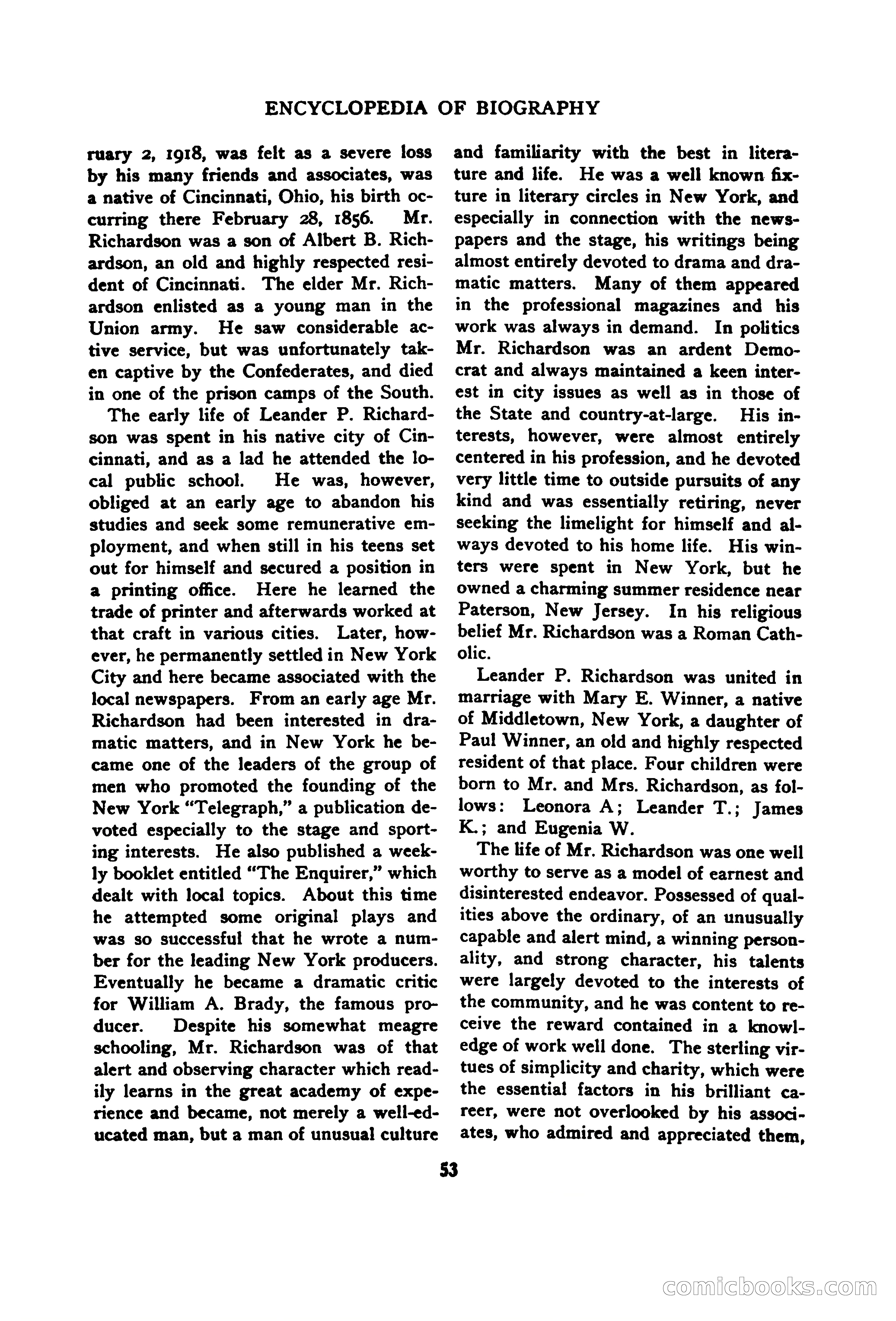
ENCYCLOPEDIA OF BIOGRAPHY ruary 2, 1918, was felt as a severe loss by his many friends and associates, was a native of Cincinnati, Ohio, his birth oc- curring there February 28, 1856. Mr. Richardson was a son of Albert B. Rich- ardson, an old and highly respected resi- dent of Cincinnati. The elder Mr. Rich- ardson enlisted as a young man in the Union army. He saw considerable ac- tive service, but was unfortunately tak- en captive by the Confederates, and died in one of the prison camps of the South. The early life of Leander P. Richard- son was spent in his native city of Cin- cinnati, and as a lad he attended the lo- cal public school. He was, however, obliged at an early age to abandon his studies and seek some remunerative em- ployment, and when still in his teens set out for himself and secured a position in a printing office. Here he learned the trade of printer and afterwards worked at that craft in various cities. Later, how- ever, he permanently settled in New York City and here became associated with the local newspapers. From an early age Mr. Richardson had been interested in dra- matic matters, and in New York he be- came one of the leaders of the group of men who promoted the founding of the New York “Telegraph,” a publication de- voted especially to the stage and sport- ing interests. He also published a week- ly booklet entitled “The Enquirer,” which dealt with local topics. About this time he attempted some original plays and was so successful that he wrote a num- ber for the leading New York producers. Eventually he became a dramatic critic for William A. Brady, the famous pro- ducer. Despite his somewhat meagre schooling, Mr. Richardson was of that alert and observing character which read- ily learns in the great academy of expe- rience and became, not merely a well-ed- ucated man, but a man of unusual culture and familiarity with the best in litera- ture and life. He was a well known fix- ture in literary circles in New York, and especially in connection with the news- papers and the stage, his writings being almost entirely devoted to drama and dra- matic matters. Many of them appeared in the professional magazines and his work was always in demand. In politics Mr. Richardson was an ardent Demo- crat and always maintained a keen inter- est in city issues as well as in those of the State and country-at-large. His in- terests, however, were almost entirely centered in his profession, and he devoted very little time to outside pursuits of any kind and was essentially retiring, never seeking the limelight for himself and al- ways devoted to his home life. His win- ters were spent in New York, but he owned a charming summer residence near Paterson, New Jersey. In his religious belief Mr. Richardson was a Roman Cath- olic. Leander P. Richardson was united in marriage with Mary E. Winner, a native of Middletown, New York, a daughter of Paul Winner, an old and highly respected resident of that place. Four children were born to Mr. and Mrs. Richardson, as fol- lows: Leonora A; Leander T.; James K.; and Eugenia W. The life of Mr. Richardson was one well worthy to serve as a model of earnest and disinterested endeavor. Possessed of qual- ities above the ordinary, of an unusually capable and alert mind, a winning person- ality, and strong character, his talents were largely devoted to the interests of the community, and he was content to re- ceive the reward contained in a knowl- edge of work well done. The sterling vir- tues of simplicity and charity, which were the essential factors in his brilliant ca- reer, were not overlooked by his associ- ates, who admired and appreciated them, MIICLOOOlK