
Penny Dreadfuls, 1853 · page 87 of 151
The Seamstress; or, The White Slave of England — page 87: what you’re looking at
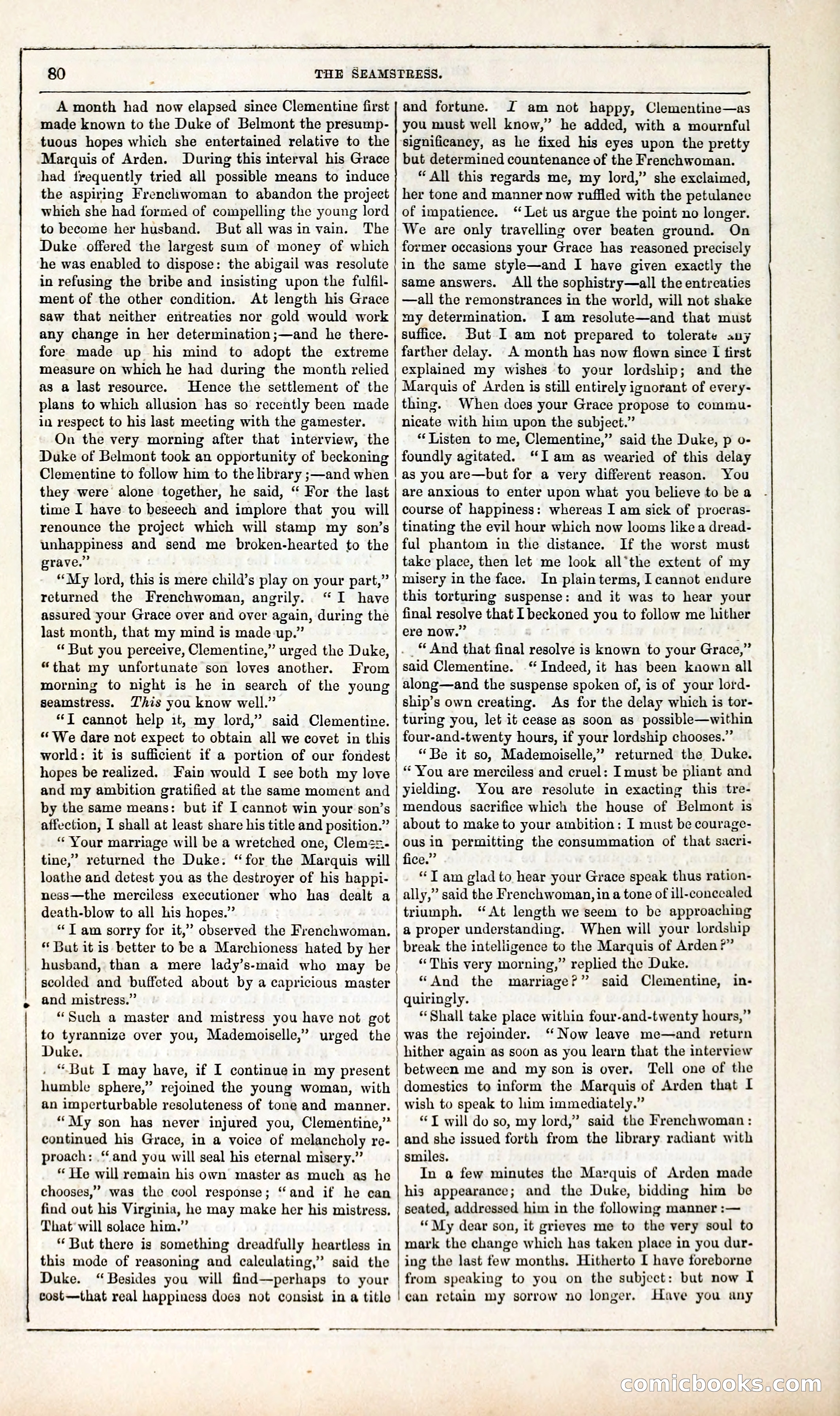
A restored page from Penny Dreadfuls, 1853. Page through the whole issue in the reader above.
📄 Transcribed text from this page (OCR, searchable)
Machine-transcribed from the original scan — historical spelling and the odd misread are preserved.
80 THE SEAMSTRESS. A month had now elapsed since Clementine first made known to the Duke of Belmont the presump- tuous hopes which she entertained relative to the Marquis of Arden. During this interval his Grace had {frequently tried all possible means to induce the aspiring Frenchwoman to abandon the project which she had formed of compelling the young lord to become her husband. But all was in vain. The Duke offered the largest sum of money of which he was enabled to dispose: the abigail was resolute in refusing the bribe and insisting upon the fulfil- ment of the other condition. At length his Grace saw that neither entreaties nor gold would work any change in her determination ;—and he there- fore made up his mind to adopt the extreme measure on which he had during the month relied as a last resource. Hence the settlement of the plans to which allusion has so recently been made in respect to his last meeting with the gamester. On the very morning after that interview, the Duke of Belmont took an opportunity of beckoning Clementine to follow him to the library ;—and when they were alone together, he said, ‘‘ For the last time I have to beseech and implore that you will renounce the project which will stamp my son’s unhappiness and send me broken-hearted to the grave.” ‘My lord, this is mere child’s play on your part,” returned the Frenchwoman, angrily. “I have assured your Grace over and over again, during the last month, that my mind is made-up.” “ But you perceive, Clementine,” urged the Duke, “that my unfortunate son loves another. From morning to night is he in search of the young seamstress. This you know well.” “T cannot help it, my lord,” said Clementine. ‘We dare not expect to obtain all we covet in this world: it is sufficient if a portion of our fondest hopes be realized. Fain would I see both my love and my ambition gratified at the same moment and by the same means: but if I cannot win your son’s affection, I shall at least share his title and position.” “ Your marriage will be a wretched one, Clem2:.- tine,” returned the Duke. “for the Marquis will loathe and detest you as the destroyer of his happi- ness—the merciless executioner who has dealt a death-blow to all his hopes.” “T am sorry for it,” observed the Frenchwoman. * But it is better to be a Marchioness hated by her husband, than a mere lady’s-maid who may be scolded and buffeted about by a capricious master and mistress.” “Such a master and mistress you have not got to tyrannize over you, Mademoiselle,” urged the Duke. and fortune. JZ am not happy, Clementine—as you must well know,” he added, with a mournful significancy, as he fixed his eyes upon the pretty but determined countenance of the Frenchwoman. “All this regards me, my lord,” she exclaimed, her tone and manner now ruffled with the petulanee of impatience. ‘ Let us argue the point no longer. We are only travelling over beaten ground. On former occasions your Grace has reasoned precisely in the same style—and I have given exactly the same answers. All the sophistry—all the entreaties —all the remonstrances in the world, will not shake my determination. Iam resolute—and that must suffice. But I am not prepared to tolerate any farther delay. A month has now flown since I first explained my wishes to your lordship; and the Marquis of Arden is still entirely ignorant of every- thing. When does your Grace propose to commu- nicate with him upon the subject.” “Listen to me, Clementine,” said the Duke, p o- foundly agitated. “Iam as wearied of this delay as you are—but for a very different reason. You are anxious to enter upon what you believe to be a course of happiness: whereas I am sick of procras- tinating the evil hour which now looms like a dread- ful phantom in the distance. If the worst must take place, then let me look all*the extent of my misery in the face. In plain terms, I cannot endure this torturing suspense: and it was to hear your final resolve that I beckoned you to follow me hither ere now.” : ._ “ And that final resolve is known to your Grace,” said Clementine. ‘“ Indeed, it has been kaown all along—and the suspense spoken of, is of your lord- ship’s own creating. As for the delay which is tor- turing you, let it cease as soon as possible—within four-and-twenty hours, if your lordship chooses.” “Be it so, Mademoiselle,’ returned the Duke. “You are merciless and cruel: I must be pliant and yielding. You are resolute in exacting this tre- mendous sacrifice which the house of Belmont is about to make to your ambition: I must be courage- ous in permitting the consummation of that sacri- fice.” “T am glad to hear your Grace speak thus ration- ally,” said the Frenchwoman, in a tone of ill-conccaled triumph. “At length we seem to be approaching a proper understanding. When will your lordship break the intelligence to the Marquis of Arden?” “This very morning,” replied the Duke. “And the marriage?” said Clementine, in- quiringly. “Shall take place within four-and-twenty hours,” was the rejoinder. ‘Now leave me—and return | hither again as sovn as you learn that the interview . “But I may have, if I continue in my present | between me and my son is over. Tell one of the humble sphere,” rejoined the young woman, with | domestics to inform the Marquis of Arden that 1 an imperturbable resoluteness of tone and manner. “My son has never injured you, Clementine,” continued his Grace, in a voice of melancholy re- proach: “and you will seal his eternal misery.” “ He will remain his own master as much as he chooses,” was the cool response; “and if he can find out his Virginia, he may make her his mistress. That will solace him.” * But there is something dreadfully heartless in this mode of reasoning and calculating,” said the Duke. “Besides you will find—perhaps to your cost—that real happiness does not consist in a title I wish to speak to lim immediately.” *T will do so, my lord,” said the Frenchwoman : and she issued forth from the library radiant with smiles. In a few minutes the Marquis of Arden made his appearance; and the Duke, bidding him be seated, addressed him in the following manner :— ‘My dear son, it grieves me to the very soul to mark the change which has taken place in you dur- ing the last few months. Hitherto I have foreborne from speaking to you on the subject: but now I 'can retain my sorrow no longer. Haye you any GOMIEHoOoOks