
Penny Dreadfuls, 1853 · page 75 of 151
The Seamstress; or, The White Slave of England — page 75: what you’re looking at
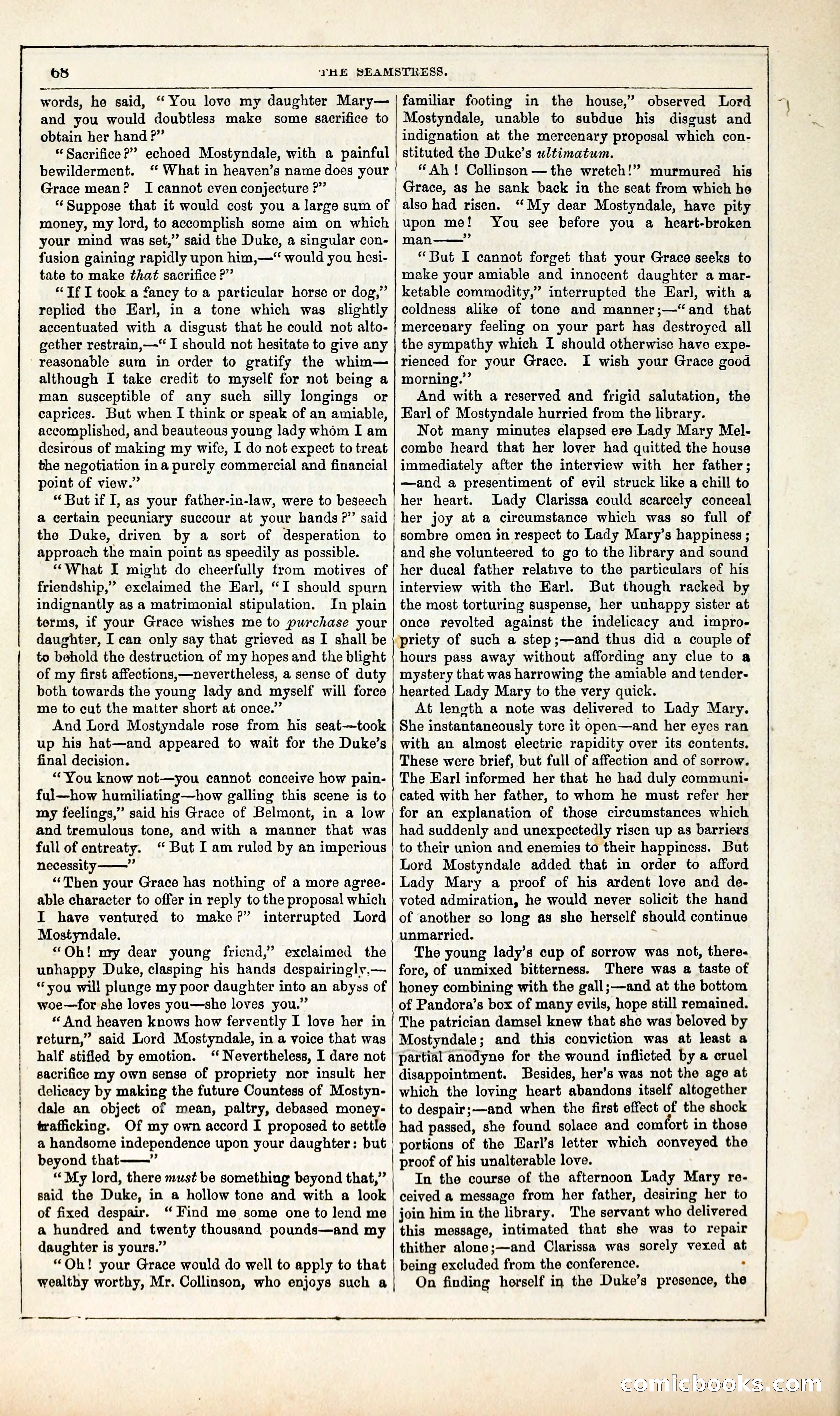
A restored page from Penny Dreadfuls, 1853. Page through the whole issue in the reader above.
📄 Transcribed text from this page (OCR, searchable)
Machine-transcribed from the original scan — historical spelling and the odd misread are preserved.
65 YHE SEAMSTRESS. words, he said, ‘“‘ You love my daughter Mary— and you would doubtless make some sacrifice to obtain her hand P” “Sacrifice?” echoed Mostyndale, with a painful bewilderment. ‘‘ What in heaven’s name does your Grace mean? I cannot even conjecture P” ‘Suppose that it would cost you a large sum of money, my lord, to accomplish some aim on which your mind was set,” said the Duke, a singular con- fusion gaining rapidly upon him,—“ would you hesi- tate to make that sacrifice ?” “Tf I took a fancy to a particular horse or dog,” replied the Earl, in a tone which was slightly accentuated with a disgust that he could not alto- gether restrain,—* I should not hesitate to give any reasonable sum in order to gratify the whim— although I take credit to myself for not being a man susceptible of any such silly longings or caprices. But when I think or speak of an amiable, accomplished, and beauteous young lady whom I am desirous of making my wife, I do not expect to treat the negotiation in a purely commercial and financial point of view.” “But if I, as your father-in-law, were to beseech a certain pecuniary succour at your hands?” said the Duke, driven by a sort of desperation to approach the main point as speedily as possible. “What I might do cheerfully from motives of friendship,” exclaimed the Earl, “I should spurn indignantly as a matrimonial stipulation. In plain terms, if your Grace wishes me to purchase your daughter, I can only say that grieved as I shall be to behold the destruction of my hopes and the blight of my first affections,—nevertheless, a sense of duty both towards the young lady and myself will force me to cut the matter short at once.” And Lord Mostyndale rose from his seat—took up his hat—and appeared to wait for the Duke’s final decision. “You know not—you cannot conceive how pain- ful—how humiliating—how galling this scene is to my feelings,” said his Grace of Belmont, in a low and tremulous tone, and with a manner that was full of entreaty. ‘“ But I am ruled by an imperious necessity x “Then your Grace has nothing of a more agree- able character to offer in reply to the proposal which I have ventured to make?” interrupted Lord Mostyndale. “Oh! mry dear young fricnd,”’ exclaimed the uphappy Duke, clasping his hands despairingly,— “you will plunge my poor daughter into an abyss of woe—for she loves you—she loves you.” ‘¢ And heaven knows how fervently I love her in return,” said Lord Mostyndale, in a voice that was half stifled by emotion. ‘ Nevertheless, I dare not sacrifice my own sense of propriety nor insult her delicacy by making the future Countess of Mostyn- dale an object of mean, paltry, debased money- trafficking. Of my own accord I proposed to settle a handsome independence upon your daughter: but beyond that-——” ‘My lord, there must be something beyond that,” said the Duke, in a hollow tone and with a look of fixed despair. ‘“ Find me some one to lend me a hundred and twenty thousand pounds—and my daughter is yours.” “Oh! your Grace would do well to apply to that wealthy worthy, Mr. Collinson, who enjoys such a LLL LLL LLL LLL LLL LLL LLL LLL LLL LL LLL LLL LL LE LLL LL CT, familiar footing in the house,” observed Lord Mostyndale, unable to subdue his disgust and indignation at the mercenary proposal which con- stituted the Duke’s ultimatum. * Ah! Collinson —the wretch!” murmured his Grace, as he sank back in the seat from which he also had risen. “My dear Mostyndale, have pity upon me! You see before you a heart-broken man——” “But I cannot forget that your Grace seeks to meke your amiable and innocent daughter a mar- ketable commodity,” interrupted the Earl, with a coldness alike of tone and manner;—“ and that mercenary feeling on your part has destroyed all the sympathy which I should otherwise have expe- rienced for your Grace. 1 wish your Grace good morning.”’ And with a reserved and frigid salutation, the Earl of Mostyndale hurried from the library. Not many minutes elapsed ere Lady Mary Mel- combe heard that her lover had quitted the house immediately after the interview with her father; —and a presentiment of evil struck like a chill to her heart. Lady Clarissa could scarcely conceal her joy at a circumstance which was so full of sombre omen in respect to Lady Mary’s happiness ; and she volunteered to go to the library and sound her ducal father relative to the particulars of his interview with the Earl. But though racked by the most torturing suspense, her unhappy sister at once revolted against the indelicacy and impro- ‘priety of such a step;—and thus did a couple of hours pass away without affording any clue to a mystery that was harrowing the amiable and tender- hearted Lady Mary to the very quick. At length a note was delivered to Lady Mary. She instantaneously tore it open—and her eyes ran with an almost electric rapidity over its contents. These were brief, but full of affection and of sorrow. The Earl informed her that he had duly communi- cated with her father, to whom he must refer her for an explanation of those circumstances which had suddenly and unexpectedly risen up as barriers to their union and enemies to their happiness. But Lord Mostyndale added that in order to afford Lady Mary a proof of his ardent love and de- voted admiration, he would never solicit the hand of another so long as she herself should continue unmarried. The young lady’s cup of sorrow was not, there- fore, of unmixed bitterness. There was a taste of honey combining with the gall;—and at the bottom of Pandora’s box of many evils, hope still remained. The patrician damsel knew that she was beloved by Mostyndale; and this conviction was at least a partial anodyne for the wound inflicted by a cruel disappointment. Besides, her’s was not the age at which the loving heart abandons itself altogether to despair;—and when the first effect of the shock had passed, sho found solace and comfort in those portions of the Earl’s letter which conveyed the proof of his unalterable love. In the course of the afternoon Lady Mary re- ceived a message from her father, desiring her to join him in the library. The servant who delivered this message, intimated that she was to repair thither alone;—and Clarissa was sorely vexed at being excluded from the conference. . On finding horself in the Duke’s presence, the ONnnicoooKS Cc Q) im