
Penny Dreadfuls, 1853 · page 71 of 151
The Seamstress; or, The White Slave of England — page 71: what you’re looking at
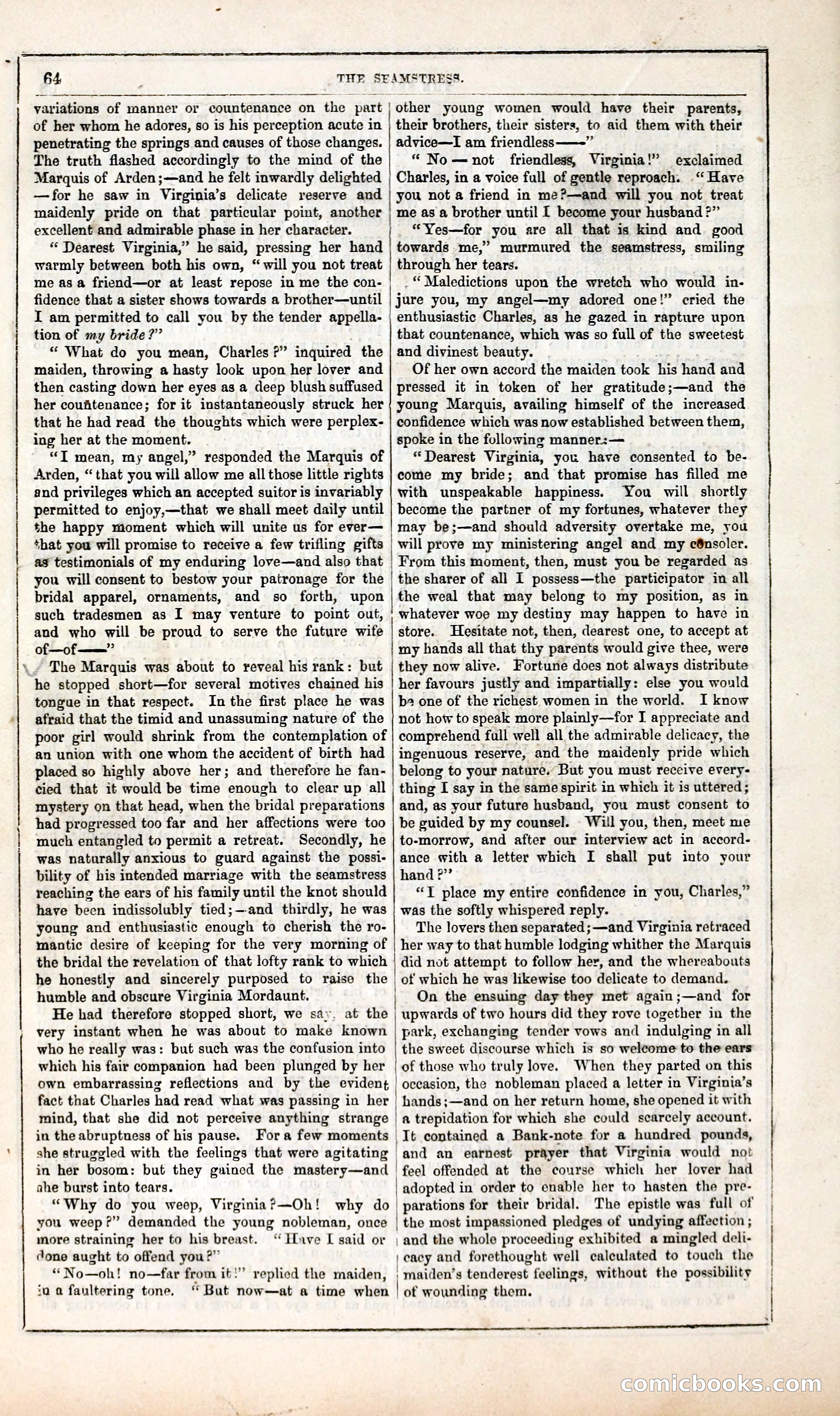
A restored page from Penny Dreadfuls, 1853. Page through the whole issue in the reader above.
📄 Transcribed text from this page (OCR, searchable)
Machine-transcribed from the original scan — historical spelling and the odd misread are preserved.
64, THE SEAMSTRESS. —_s ——- - a $$ eee variations of manner or countenance on the part | other young women would have their parents, of her whom he adores, so is his perception acute in | their brothers, their sisters, to aid them with their penetrating the springs and causes of those changes. | advice—I am friendless——~” The truth flashed accordingly to the mind of the| “ No—not friendless, Virginia!” exclaimed Marquis of Arden;—and he felt inwardly delighted | Charles, in a voice full of gentle reproach. “ Have —for he saw in Virginia’s delicate reserve and | you not a friend in me?—and will you not treat maidenly pride on that particular point, another | me as a brother until 1 become your husband ?” excellent and admirable phase in her character. | *“Yes—for you are all that is kind and good * Dearest Virginia,” he said, pressing her hand | towards me,’ murmured the seamstress, smiling warmly between both his own, “will you not treat | through her tears. me as a friend—or at least repose in me thecon- | . “ Maledictions upon the wretch who would in- fidence that a sister shows towards a brother—until | jure you, my angel—my adored one!” cried the I am permitted to call you by the tender appella- | enthusiastic Charles, as he gazed in rapture upon tion of my bride?” that countenance, which was so full of the sweetest “ What do you mean, Charles ?” inquired the | and divinest beauty. : | maiden, throwing a hasty look upon her lover and| Of her own accord the maiden took his hand and then casting down her eyes as a deep blush suffused | pressed it in token of her gratitude;—and the her coufitenance; for it instantaneously struck her { young Marquis, availing himself of the increased that he had read the thoughts which were perplex- | confidence which was now established between them, ing her at the moment. spoke in the following manner:— “T mean, my angel,” responded the Marquis of | “Dearest Virginia, you have consented to be- Arden, “that you will allow me all those little rights | come my bride; and that promise has filled me and privileges which an accepted suitor is invariably | with unspeakable happiness. You will shortly permitted to enjoy,—that we shall meet daily until | become the partner of my fortunes, whatever they the happy moment which will unite us for ever— | may be;—and should adversity overtake me, you that you will promise to receive a few trifling gifts | will prove my ministering angel and my c@nsoler. as testimonials of my enduring love—and also that | From this moment, then, must you be regarded as you will consent to bestow your patronage for the | the sharer of all I possess—the participator in all bridal apparel, ornaments, and so forth, upon |the weal that may belong to my position, as in such tradesmen as I may venture to point out, | whatever woe my destiny may happen to have in and who will be proud to serve the future wife | store. Hesitate not, then, dearest one, to accept at of—of ——” my hands all that thy parents would give thee, were The Marquis was about to reveal his rank: but | they now alive. Fortune does not always distribute he stopped short—for several motives chained his | her favours justly and impartially: else you would tongue in that respect. In the first place he was | b2 one of the richest women in the world. I know afraid that the timid and unassuming nature of the | not how to speak more plainly—for I appreciate and poor girl would shrink from the contemplation of | comprehend full well all the admirable delicacy, the an union with one whom the accident of birth had | ingenuous reserve, and the maidenly pride which placed so highly above her; and therefore he fan- | belong to your nature. But you must reccive every- cied that it would be time enough to clear up all | thing I say in the same spirit in which it 1s uttered; mystery on that head, when the bridal preparations | and, as your future husband, you must consent to had progressed too far and her affections were too | be guided by my counsel. Will you, then, meet me much entangled to permit a retreat. Secondly, he | to-morrow, and after our interview act in accord- was naturally anxious to guard against the possi- | ance with a letter which I shall put into your bility of his intended marriage with the seamstress | hand ?”’ reaching the ears of his family until the knot should | “TI place my entire confidence in you, Charles,” have been indissolubly tied;~—and thirdly, he was | was the softly whispered reply. young and enthusiastic enough to cherish the ro-| The lovers then separated;—and Virginia retraced mantic desire of keeping for the very morning of | her way to that humble lodging whither the Marquis the bridal the revelation of that lofty rank to which | did not attempt to follow her, and the whereabouts he honestly and sincerely purposed to raise the | of which he was likewise too delicate to demand. humble and obscure Virginia Mordaunt. On the ensuing day they met again ;—and for He had therefore stopped short, we say, at the | upwards of two hours did they rove together in the very instant when he was about to make known | park, exchanging tender vows and indulging in all who he really was: but such was the confusion into | the sweet discourse which is so welcome to the ears which his fair companion had been plunged by her | of those who truly love. When they parted on this own embarrassing reflections and by the evident | occasion, the nobleman placed a letter in Virginia’s fact that Charles had read what was passing in her | hands;—and on her return home, she opened it with mind, that she did not perceive anything strange | a trepidation for which she could scarcely account. in the abruptness of his pause. Fora few moments It contained a Bank-note for a hundred pounds, she struggled with the feelings that were agitating and an earnest prayer that Virginia would not in her bosom: but they gained the mastery—and | feel offended at the course which her lover had ahe burst into tears. | adopted in order to enable her to hasten the pre- “Why do you weep, Virginia?—Oh! why do/| parations for their bridal. The epistle was full of you weep?” demanded the young nobleman, once | the most impassioned pledges of undying affection ; more straining her to his breast. “Have [ said or | and the whole proceeding exhibited a mingled deli- done aught to offend you?” }eacy and forethought well calculated to touch the “ No—oh! no—far from it!” replied the maiden, | maiden’s tenderest feelings, without the possibility ‘na faultering tone, ‘ But now—at a time when | of wounding them. ———E GomMmichbooks : nee sr a ee ee