
Penny Dreadfuls, 1853 · page 39 of 151
The Seamstress; or, The White Slave of England — page 39: what you’re looking at
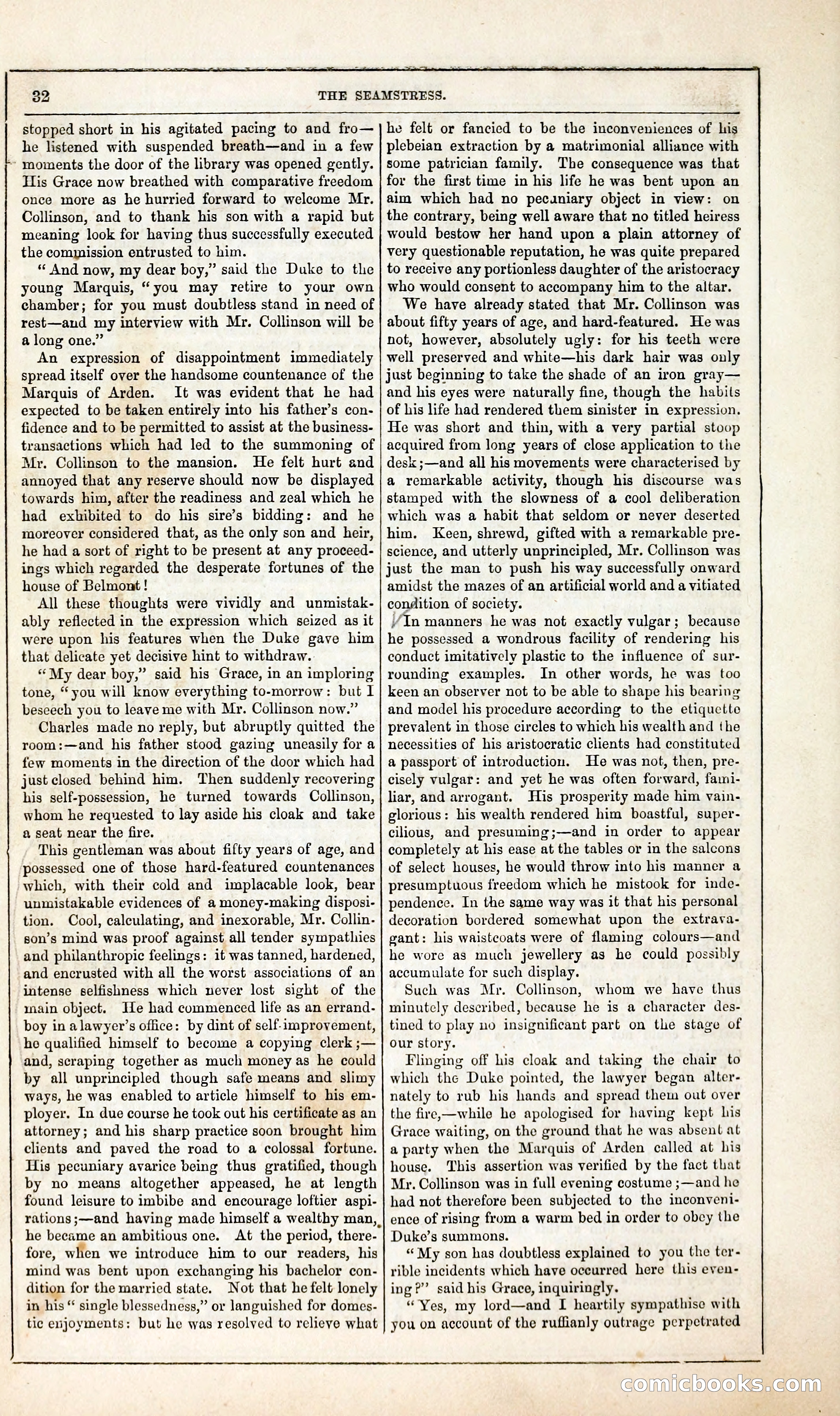
A restored page from Penny Dreadfuls, 1853. Page through the whole issue in the reader above.
📄 Transcribed text from this page (OCR, searchable)
Machine-transcribed from the original scan — historical spelling and the odd misread are preserved.
es o2 THE SEAMSTRESS. stopped short in his agitated pacing to and fro— he listened with suspended breath—and in a few ~ moments the door of the library was opened gently. His Grace now breathed with comparative freedom once more as he hurried forward to welcome Mr. Collinson, and to thank his son with a rapid but meaning look for having thus successfully executed _ the commission entrusted to him. “ And now, my dear boy,” said the Duke to the young Marquis, “ you may retire to your own chamber; for you must doubtless stand in need of rest—aud my interview with Mr. Collinson will be a long one.” An expression of disappointment immediately spread itself over the handsome countenance of the Marquis of Arden. It was evident that he had expected to be taken entirely into his father’s con- fidence and to be permitted to assist at the business- transactions which had led to the summoning of Mr. Collinson to the mansion. He felt hurt and annoyed that any reserve should now be displayed towards him, after the readiness and zeal which he had exhibited to do his sire’s bidding: and he moreover considered that, as the only son and heir, he had a sort of right to be present at any proceed- ings which regarded the desperate fortunes of the house of Belmont ! All these thoughts were vividly and unmistak- ably reflected in the expression which seized as it were upon his features when the Duke gave him that delicate yet decisive hint to withdraw. “My dear boy,” said his Grace, in an imploring tone, “you will know everything to-morrow: but I beseech you to leave me with Mr. Collinson now.” Charles made no reply, but abruptly quitted the room:—and his father stood gazing uneasily for a few moments in the direction of the door which had just closed behind him. Then suddenly recovering his self-possession, he turned towards Collinson, whom he requested to lay aside his cloak and take a seat near the fire. This gentleman was about fifty years of age, and possessed one of those hard-featured countenances which, with their cold and implacable look, bear unmistakable evidences of a money-making disposi- tion. Cool, calculating, and inexorable, Mr. Collin- son’s mind was proof against all tender sympathies and philanthropic feelings: it was tanned, hardened, and encrusted with all the worst associations of an intense selfishness which never lost sight of the main object. Ue had commenced life as an errand- boy in alawyer’s office: by dint of self-improvement, he qualified himself to become a copying clerk ;— and, scraping together as much money as he could by all unprincipled though safe means and slimy ways, he was enabled to article himself to his em- ployer. In due course he took out his certificate as an attorney; and his sharp practice soon brought him clients and paved the road to a colossal fortune. His pecuniary avarice being thus gratified, though by no means altogether appeased, he at length found leisure to imbibe and encourage loftier aspi- rations ;—and having made himself a wealthy man, he became an ambitious one. At the period, there- fore, when we introduce him to our readers, his mind was bent upon exchanging his bachelor con- dition for the married state. Not that he felt lonely in his “ single blessedness,” or languished for domes- tic enjoyments: but he was resolved to relieve what he felt or fancied to be the inconveniences of his plebeian extraction by a matrimonial alliance with some patrician family. The consequence was that for the first time in his life he was bent upon an aim which had no pecuniary object in view: on the contrary, being well aware that no titled heiress would bestow her hand upon a plain attorney of very questionable reputation, he was quite prepared to receive any portionless daughter of the aristocracy who would consent to accompany him to the altar. We have already stated that Mr. Collinson was about fifty years of age, and hard-featured. He was not, however, absolutely ugly: for his teeth were well preserved and white—his dark hair was only just beginning to take the shade of an iron gray— and his eyes were naturally fine, though the habits of his life had rendered them sinister in expression. He was short and thin, with a very partial stoop acquired from long years of close application to the desk ;—and all his movements were characterised by a remarkable activity, though his discourse was stamped with the slowness of a cool deliberation which was a habit that seldom or never deserted him. Keen, shrewd, gifted with a remarkable pre- science, and utterly unprincipled, Mr. Collinson was just the man to push his way successfully onward amidst the mazes of an artificial world and a vitiated condition of society. In manners he was not exactly vulgar; becauso he possessed a wondrous facility of rendering his conduct imitatively plastic to the influence of sur- rounding examples. In other words, he was too keen an observer not to be able to shape his bearing and model his procedure according to the etiquette prevalent in those circles to which his wealth and the necessities of his aristocratic clients had constituted a passport of introduction. He was not, then, pre- cisely vulgar: and yet he was often forward, fami- liar, and arrogant. His prosperity made him vain- glorious: his wealth rendered him boastful, super- cilious, and presuming ;—and in order to appear completely at his ease at the tables or in the salcons of select houses, he would throw into his manner a presumptuous freedom which he mistook for inde- pendence. In the same way was it that his personal decoration bordered somewhat upon the extrava- gant: his waistcoats were of flaming colours—and he wore as much jewellery as he could possibly accumulate for such display. Such was Mr. Collinson, whom we have thus minutely described, because he is a character des- tined to play no insignificant part on the stage of our story. . Flingine off his cloak and taking the chair to which the Duke pointed, the lawyer began alter- nately to rub his hands and spread them out over the fire,—while he apologised for having kept his Grace waiting, on the ground that he was absent at a party when the Marquis of Arden called at his house. This assertion was verified by the fact that Mr. Collinson was in full evening costume ;—and he had not therefore been subjected to the inconveni- ence of rising from a warm bed in order to obey the Duke’s summons. “My son has doubtless explained to you the ter- rible incidents which have occurred here this even- ing?” said his Grace, inquiringly. “Yes, my lord—and I heartily sympathise with you on account of the ruffianly outrage perpetrated Ls EOMIGdoOO .S