
Penny Dreadfuls, 1853 · page 31 of 151
The Seamstress; or, The White Slave of England — page 31: what you’re looking at
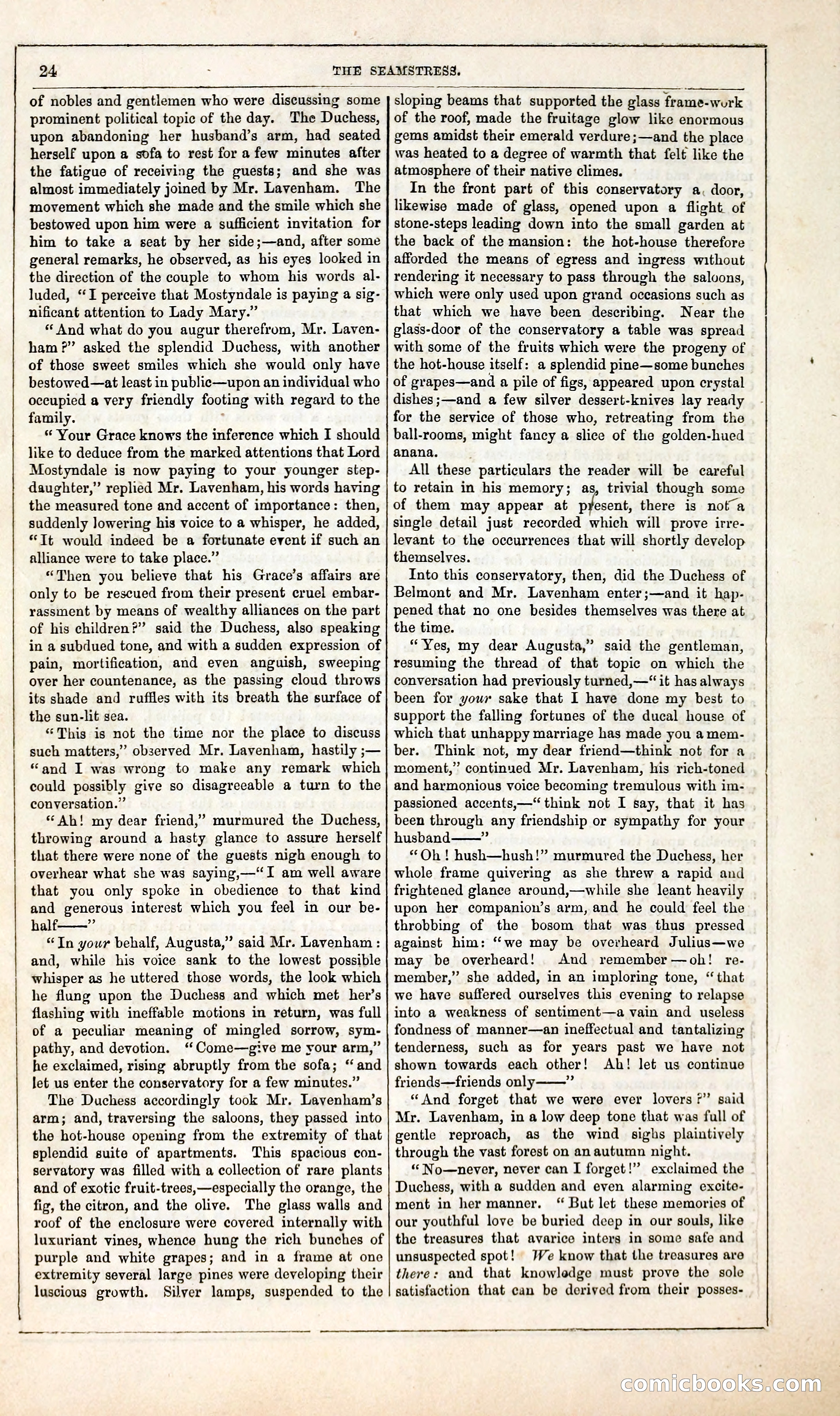
A restored page from Penny Dreadfuls, 1853. Page through the whole issue in the reader above.
📄 Transcribed text from this page (OCR, searchable)
Machine-transcribed from the original scan — historical spelling and the odd misread are preserved.
me i 24 - THE SEAMSTRESS. of nobles and gentlemen who were discussing some prominent political topic of the day. The Duchess, upon abandoning her husband’s arm, had seated herself upon a sofa to rest for afew minutes after the fatigue of receiving the guests; and she was almost immediately joined by Mr. Lavenham. The movement which she made and the smile which she bestowed upon him were a sufficient invitation for him to take a seat by her side;—and, after some general remarks, he observed, as his eyes looked in the direction of the couple to whom his words al- luded, “I perceive that Mostyndale is paying a sig- nificant attention to Lady Mary.” * And what do you augur therefrom, Mr. Laven- ham P” asked the splendid Duchess, with another of those sweet smiles which she would only have bestowed—at least in public—upon an individual who occupied a very friendly footing with regard to the family. “ Your Grace knows the inference which I should like to deduce from the marked attentions that Lord Mostyndale is now paying to your younger step- dauchter,” replied Mr. Lavenham, his words having the measured tone and accent of importance: then, suddenly lowering his voice to a whisper, he added, ‘It would indeed be a fortunate event if such an alliance were to take place.” “Then you believe that his Grace’s affairs are only to be rescued from their present cruel embar- rassment by means of wealthy alliances on the part of his children?” said the Duchess, also speaking in a subdued tone, and with a sudden expression of pain, mortification, and even anguish, sweeping over her countenance, as the passing cloud throws its shade and ruffles with its breath the surface of the sun-lit sea. “This is not the time nor the place to discuss such matters,” observed Mr. Lavenham, hastily ;— “and I was wrong to make any remark which could possibly give so disagreeable a turn to the conversation.” “Ah! my dear friend,’ murmured the Duchess, throwing around a hasty glance to assure herself that there were none of the guests nigh enough to overhear what she was saying,—“I am well aware that you only spoke in obedience to that kind and generous interest which you feel in our be- half-——” “Tn your behalf, Augusta,” said Mr. Lavenham : and, while his voice sank to the lowest possible whisper as he uttered those words, the look which he flung upon the Duchess and which met her’s flashing with ineffable motions in return, was full of a peculiar meaning of mingled sorrow, sym- pathy, and devotion. ‘‘Come—give me your arm,” he exclaimed, rising abruptly from the sofa; “ and let us enter the conservatory for a few minutes.” The Duchess accordingly took Mr. Layenham’s arm; and, traversing the saloons, they passed into the hot-house opening from the extremity of that splendid suite of apartments. This spacious con- servatory was filled with a collection of rare plants and of exotic fruit-trees,—especially the orange, the fig, the citron, and the olive. The glass walls and roof of the enclosure were covered internally with luxuriant vines, whence hung the rich bunches of purple and white grapes; and in a frame at one extremity several large pines were developing their luscious growth. Silver lamps, suspended to the sloping beams that supported the glass frame-work of the roof, made the fruitage glow like enormous gems amidst their emerald verdure;—and the place was heated to a degree of warmth that felt like the atmosphere of their native climes. In the front part of this conservatory a, door, likewise made of glass, opened upon a flight. of stone-steps leading down into the small garden at the back of the mansion: the hot-house therefore afforded the means of egress and ingress without rendering it necessary to pass through the salvons, which were only used upon grand occasions such as that which we have been describing. Near the glass-door of the conservatory a table was spread with some of the fruits which were the progeny of the hot-house itself: a splendid pine—some bunches of grapes—and a pile of figs, appeared upon crystal dishes ;—and a few silver dessert-knives lay ready for the service of those who, retreating from the ball-rooms, might fancy a slice of the golden-hued anana. : All these particulars the reader will be careful to retain in his memory; as, trivial though some of them may appear at piesent, there is nota single detail just recorded which will prove irre- levant to the occurrences that will shortly develop themselves. 7 Into this conservatory, then, did the Duchess of Belmont and Mr. Lavenham enter;—and it hap- pened that no one besides themselves was there at the time. “Yes, my dear Augusta,” said the gentleman, resuming the thread of that topic on which the conversation had previously turned,—“ it has always been for your sake that I have done my best to support the falling fortunes of the ducal house of which that unhappy marriage has made you amem- ber. Think not, my dear friend—think not for a moment,” continued Mr. Lavenham, his rich-toned and harmonious voice becoming tremulous with im- passioned accents,—“ think not I say, that it has been through any friendship or sympathy for your husband——” * Oh ! hush—hush!” murmured the Duchess, her whole frame quivering as she threw a rapid and frightened glance around,—while she leant heavily upon her companion’s arm, and he could feel the throbbing of the bosom that was thus pressed against him: “we may be overheard Julius—we may be overheard! And remember—oh! re- member,” she added, in an imploring tone, “ that we have suffered ourselves this evening to relapse into a weakness of sentiment—a vain and useless fondness of manner—an ineffectual and tantalizing tenderness, such as for years past we have not shown towards each other! Ah! let us continue friends—friends only——”’ “And forget that we were ever lovers?” said Mr. Lavenham, in a low deep tone that was full of gentle reproach, as the wind sighs plaintively through the vast forest on an autumn night. “ No—never, never can I forget!” exclaimed the Duchess, with a sudden and even alarming excite- ment in her manner. “ But let these memories of our youthful love be buried deep in our souls, like the treasures that avarice inters in some safe and unsuspected spot! Je know that the treasures are there: and that knowledge must prove the sole satisfaction that can be derived from their posses- ——< Connicaooks co AL