
Penny Dreadfuls, 1853 · page 22 of 151
The Seamstress; or, The White Slave of England — page 22: what you’re looking at
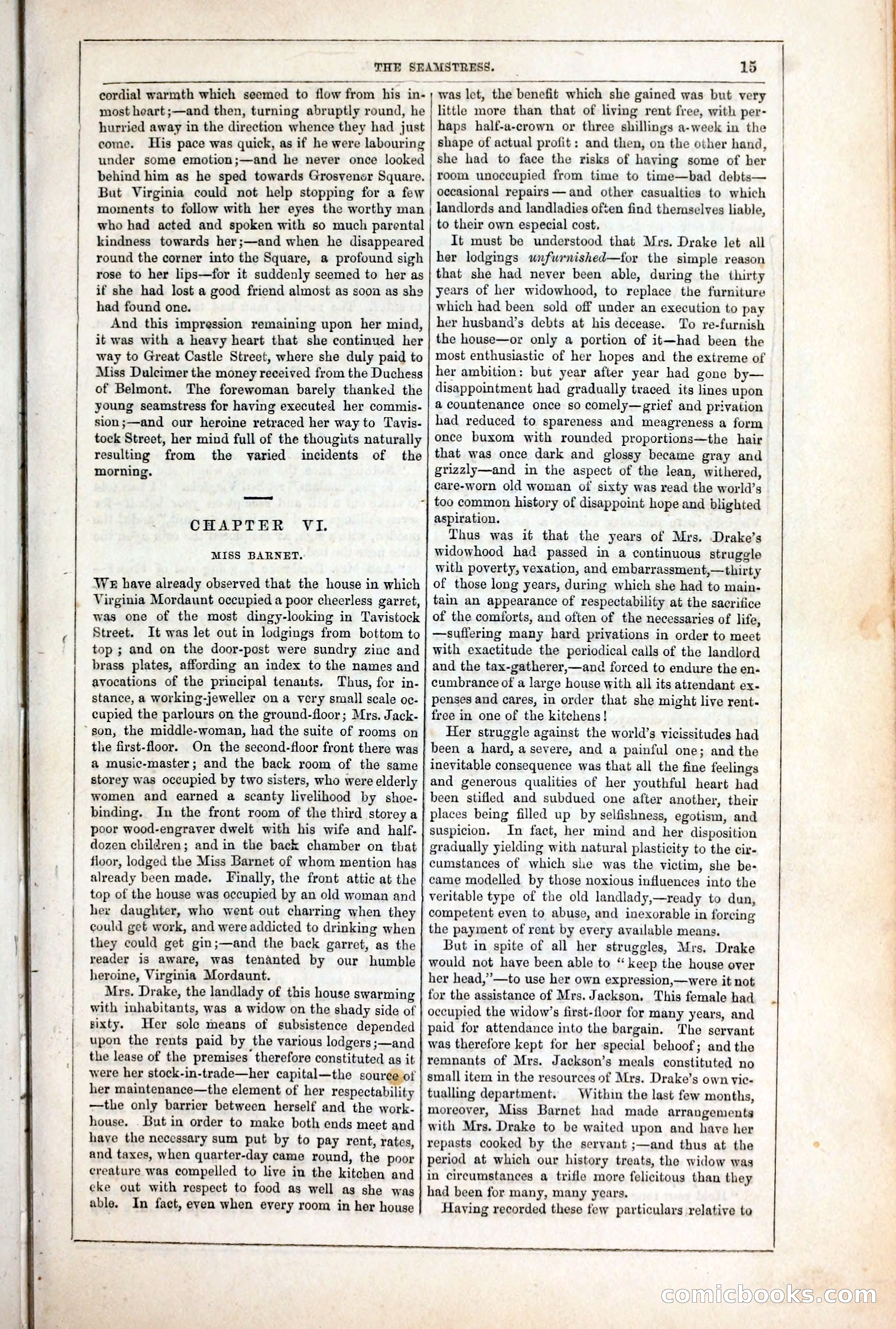
A restored page from Penny Dreadfuls, 1853. Page through the whole issue in the reader above.
📄 Transcribed text from this page (OCR, searchable)
Machine-transcribed from the original scan — historical spelling and the odd misread are preserved.
— THE SEAMSTRESS. cordial warmth which seemed to flow from his in- most heart ;—and then, turning abruptly round, he hurried away in the direction whence they had just come. His pace was quick, as if he were labouring under some emotion;—and he never once looked behind him as he sped towards Grosvenor Square. But Virginia could not help stopping for a few moments to follow with her eyes the worthy man who had acted and spoken with so much parental kindness towards her;—and when he disappeared round the corner into the Square, a profound sigh rose to her lips—for it suddenly seemed to her as if she had lost a good friend almost as sooa as she had found one. And this impression remaining upon her mind, it was with a heavy heart that she continued her way to Great Castle Street, where she duly paid to Miss Dulcimer the money received from the Duchess of Belmont. The forewoman barely thanked the young seamstress for having executed her commis- sion;—and our heroine retraced her way to Tavis- tock Street, her mind full of the thougits naturally resulting from the varied incidents of the morning. .—— — - CHAPTER VI. MISS BARNET. WE have already observed that the house in which Virginia Mordaunt occupied a poor cheerless garret, was one of the most dingy-looking in Tavistock Street. It was let out in lodgings from bottom to top ; and on the door-post were sundry zine and brass plates, affording an index to the names and avocations of the principal tenauts. Thus, for in- stance, a working-jeweller on a yery small scale oc- cupied the parlours on the ground-floor; Mrs. Jack- ‘son, the middle-woman, had the suite of rooms on the first-floor. On the second-floor front there was a music-master; and the back room of the same storey was occupied by two sisters, who were elderly women and earned a scanty livelihood by shoe- binding. In the front room of the third storey a poor wood-engraver dwelt with his wife and half- dozen children; and in the back chamber on that floor, lodged the Miss Barnet of whom mention has already been made, Finally, the front attic at the top of the house was occupied by an old woman and her daughter, who went out charring when they could get work, and were addicted to drinking when they could get gin;—and the back garret, as the veader is aware, was tenanted by our humble heroine, Virginia Mordaunt. Mrs. Drake, the landlady of this house swarming with inhabitants, was a widow on the shady side of gixty. Her sole means of subsistence depended upon the rents paid by the various lodgers ;—and the lease of the premises therefore constituted as it were her stock-in-trade—her capital—the source of her maintenance—the element of her respectability —the only barrier between herself and the work- house. But in order to make both ends meet and haye the necessary sum put by to pay rent, rates, and taxes, when quarter-day came round, the poor creature was compelled to live in the kitchen and eke out with respect to food as well as she was able. In fact, even when every room in her house was let, the benefit which she gained was but very little more than that of living rent free, with per- haps half-a-crown or three shillings a-week in the shape of actual profit: and then, on the other hand, she had to face the risks of having some of her room unoccupied from time to time—bad debts— occasional repairs —and other casualties to which landlords and landladies often find themselves liable, to their own especial cost, It must be understood that Mrs. Drake let all her lodgings unfurnished—for the simple reason that she had never been able, during the thirty years of her widowhood, to replace the furniture which had been sold off under an execution to pay her husband’s debts at his decease. To re-furnish the house—or only a portion of it—had been the most enthusiastic of her hopes and the extreme of her ambition: but year after year had gone by— disappointment had gradually traced its lines upon a countenance once so comely—grief and privation had reduced to spareness and meagreness a form once buxom with rounded proportions—the hair that was once dark and glossy became gray and grizzly—and in the aspect of the lean, withered, care-worn old woman of sixty was read the world’s too common history of disappoint hope and blighted aspiration. Thus was it that the years of Mrs. Drake’s widowhood had passed in a continuous struggle with poverty, vexation, and embarrassment,—thirty of those long years, during which she had to main- tain an appearance of respectability at the sacrifice of the comforts, and often of the necessaries of life, —suffering many hard privations in order to meet with exactitude the periodical calls of the landlord and the tax-gatherer,—and forced to endure the en- cumbrance of a large house with all its atrendant ex- penses and cares, in order that she might live rent- free in one of the kitchens! Her struggle against the world’s vicissitudes had been a hard, a severe, and a painful one; and the inevitable consequence was that all the fine feelings and generous qualities of her youthful heart had been stifled and subdued one after another, their places being filled up by selfishness, egotism, and suspicion. In fact, her mind and her disposition gradually yielding with natural plasticity to the cir- cumstances of which she was the victim, she be- came modelled by those noxious influences into the veritable type of the old landlady,—ready to dun, competent even to abuse, and inexorable in forcing the payment of rent by every available means. But in spite of all her struggles, Mrs. Drake would not have been able to “keep the house over her head,’—to use her own expression,—were it not for the assistance of Mrs. Jackson. This female had. occupied the widow’s first-floor for many years, and paid for attendance into the bargain. The servant was therefore kept for her special behoof; and the remnants of Mrs. Jackson’s meals constituted no small item in the resources of Mrs. Drake’s own vie- tualling department. Within the last few months, moreover, Miss Barnet had made arrangements with Mrs. Drake to be waited upon and have her repasts cooked by the servant ;—and thus at the period at which our history treats, the widow was in circumstances a trifle more felicitous than they had been for many, many years. Having recorded these few particulars relative to COnniElaae <S (E@)