
Penny Dreadfuls, 1853 · page 19 of 151
The Seamstress; or, The White Slave of England — page 19: what you’re looking at
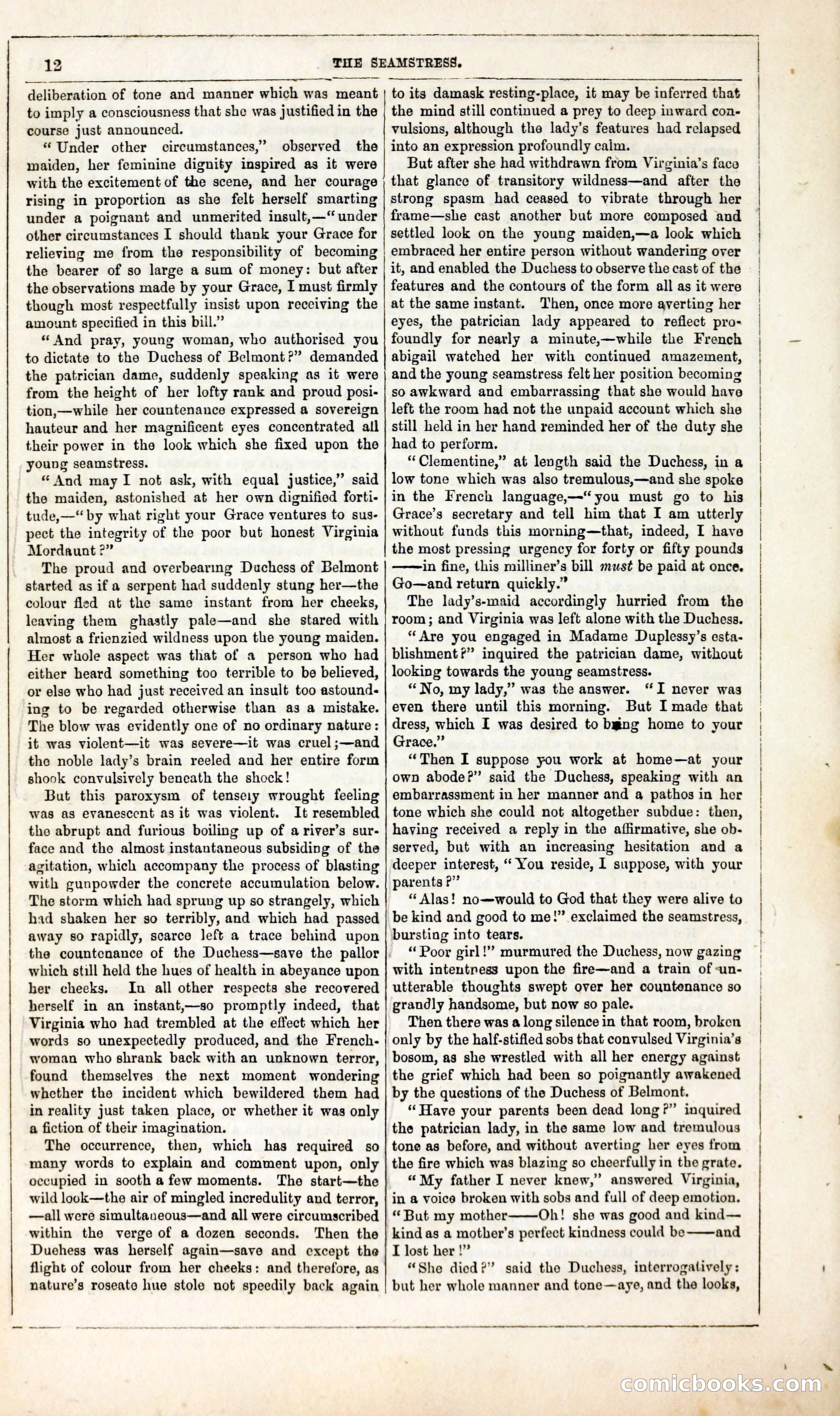
A restored page from Penny Dreadfuls, 1853. Page through the whole issue in the reader above.
📄 Transcribed text from this page (OCR, searchable)
Machine-transcribed from the original scan — historical spelling and the odd misread are preserved.
eb TT A TE TT Se 12 deliberation of tone and manner which was meant to imply a consciousness that she was justified in the course just announced. ‘Under other circumstances,” observed the maiden, her feminine dignity inspired as it were with the excitement of the scene, and her courage rising in proportion as she felt herself smarting under a poignant and unmerited insult,—“ under other circumstances I should thank your Grace for relieving me from the responsibility of becoming the bearer of so large a sum of money: but after the observations made by your Grace, I must firmly though most respectfully insist upon receiving the amount specified in this bill.” «And pray, young woman, who authorised you to dictate to the Duchess of Belmont?” demanded the patrician dame, suddenly speaking as it were from the height of her lofty rank and proud posi- tion,—while her countenance expressed a sovereign hauteur and her magnificent eyes concentrated all their power in the look which she fixed upon the young seamstress. “And may I not ask, with equal justice,” said the maiden, astonished at her own dignified forti- tude,—“ by what right your Grace ventures to sus- pect the integrity of the poor but honest Virginia Mordaunt ?” The proud and overbearing Duchess of Belmont started as if a serpent had suddenly stung her—the colour fled at the same instant from her cheeks, leaving them ghastly pale—and she stared with almost a frienzied wildness upon the young maiden. Her whole aspect was that of a person who had either heard something too terrible to be believed, or else who had just received an insult too astound. ing to be regarded otherwise than as a mistake. The blow was evidently one of no ordinary nature: it was violent—it was severe—it was cruel ;—and the noble lady’s brain reeled and her entire form shook convulsively beneath the shock! But this paroxysm of tenseiy wrought feeling was as evanescent as it was violent. It resembled the abrupt and furious boiling up of ariver’s sur- face and the almost instantaneous subsiding of the agitation, which accompany the process of blasting with gunpowder the concrete accumulation below. The storm which had sprung up so strangely, which had shaken her so terribly, and which had passed away so rapidly, scarce left a trace behind upon the countenance of the Duchess—save the pallor which still held the hues of health in abeyance upon ber cheeks. In all other respects she recovered herself in an instant,—so promptly indeed, that Virginia who had trembled at the effect which her words so unexpectedly produced, and the French- woman who shrank back with an unknown terror, found themselves the next moment wondering whether the incident which bewildered them had In reality just taken place, or whether it was only a fiction of their imagination. The occurrence, then, which has required so many words to explain and comment upon, only occupied in sooth a few moments. The start—the wild look—the air of mingled incredulity and terror, —all were simultaueous—and all were circumscribed within the verge of a dozen seconds. Then the Duehess was herself again—save and except the flight of colour from her cheeks: and therefore, as nature’s roseate hue stole not speedily back again THE SEAMSTRESS. to its damask resting-place, it may be inferred that the mind still continued a prey to deep inward coa- vulsions, although the lady’s features had relapsed into an expression profoundly calm. But after she had withdrawn from Virginia’s face that glance of transitory wildness—and after the strong spasm had ceased to vibrate through her frame—she cast another but more composed and settled look on the young maiden,—a look which embraced her entire person without wandering over it, and enabled the Duchess to observe the cast of the features and the contours of the form all as it were at the same instant. Then, once more averting her eyes, the patrician lady appeared to reflect pro- foundly for nearly a minute,—while the French abigail watched her with continued amazement, and the young seamstress felt her position becoming so awkward and embarrassing that she would have left the room had not the unpaid account which she still held in her hand reminded her of the duty she had to perform. “Clementine,” at length said the Duchess, in a low tone which was also tremulous,—and she spoke in the French language,—=“ you must go to his Grace’s secretary and tell him that I am utterly without funds this morning—that, indeed, I have the most pressing urgency for forty or fifty pounds ——in fine, this milliner’s bill must be paid at once. Go—and return quickly.” The lady’s-maid accordingly hurried from the room; and Virginia was left alone with the Duchess. “Are you engaged in Madame Duplessy’s esta- blishment?” inquired the patrician dame, without looking towards the young seamstress. * No, my lady,” was the answer. “I never was even there until this morning. But I made that dress, which I was desired to bgng home to your Grace.” “Then I suppose you work at home—at your own abode?” said the Duchess, speaking with an embarrassment in her manner and a pathos in her tone which she could not altogether subdue: then, having received a reply in the affirmative, she ob- served, but with an increasing hesitation and a deeper interest, “You reside, I suppose, with your parents ?”’ “ Alas! no—would to God that they were alive to be kind and good to me!” exclaimed the seamstress, bursting into tears. “Poor girl!’ murmured the Duchess, now gazing with intentness upon the fire—and a train of «un- utterable thoughts swept over her countenance so grandly handsome, but now so pale. Then there was a long silence in that room, broken only by the half-stifled sobs that convulsed Virginia’s bosom, as she wrestled with all her energy against the grief which had been so poignantly awakened by the questions of the Duchess of Belmont. “Have your parents been dead long?” inquired the patrician lady, in the same low and tremulous tone as before, and without averting her eyes from the fire which was blazing so cheerfully in the grate. “My father I never knew,” answered Virginia, in a voice broken with sobs and full of deep emotion. “But my mother——Oh! she was good and kind— kind as a mother’s perfect kindness could be ———and I lost her !” “She died?” said the Duchess, interrogatively: but her whole manner and tone—aye, and the looks, EOMIGdoOO “S (€(0) im i.