
Penny Dreadfuls, 1853 · page 115 of 151
The Seamstress; or, The White Slave of England — page 115: what you’re looking at
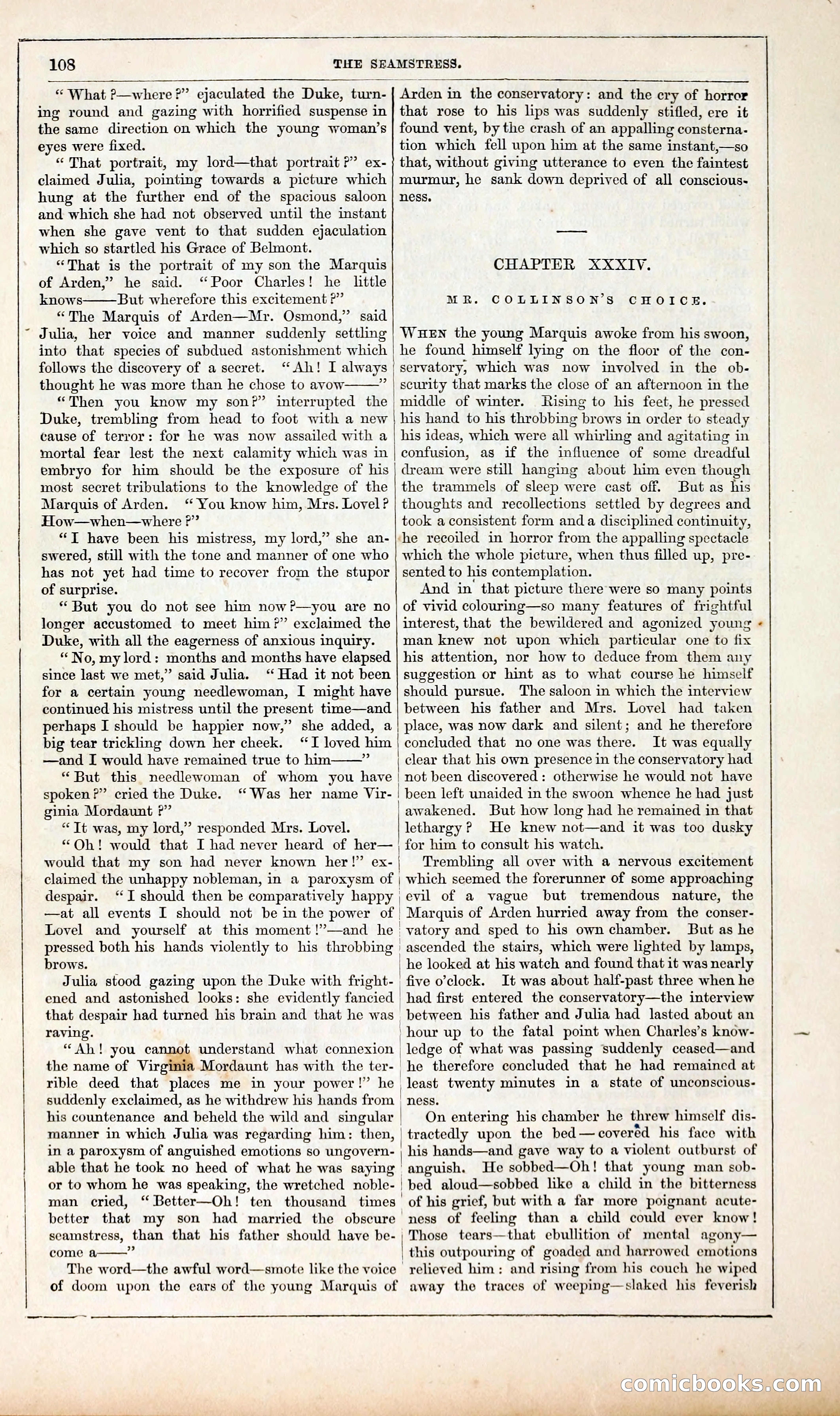
A restored page from Penny Dreadfuls, 1853. Page through the whole issue in the reader above.
📄 Transcribed text from this page (OCR, searchable)
Machine-transcribed from the original scan — historical spelling and the odd misread are preserved.
a ee 108 THE SEAMSTRESS. -—_—~_——_——_— “ What ?—where ?” ejaculated the Duke, turn- ing round and gazing with horrified suspense in the same direction on which the young woman’s eyes were fixed. “ That portrait, my lord—that portrait?” ex- claimed Julia, pointing towards a picture which hung at the further end of the spacious saloon and which she had not observed until the instant when she gave vent to that sudden ejaculation which so startled his Grace of Belmont. “That is the portrait of my son the Marquis of Arden,” he said. “Poor Charles! he little knows But wherefore this excitement ?” “The Marquis of Arden—Mr. Osmond,” said Julia, her voice and manner suddenly settling into that species of subdued astonishment which follows the discovery of a secret. “Ah! I always | thought he was more than he chose to avow * “Then you know my son?” interrupted the Duke, trembling from head to foot with a new cause of terror: for he was now assailed with a mortal fear lest the next calamity which was in embryo for him should be the exposure of his most secret tribulations to the knowledge of the Marquis of Arden. ‘ You know him, Mrs. Lovel? How—when—where ?” “TI have been his mistress, my lord,” she an- swered, still with the tone and manner of one who has not yet had time to recover from the stupor of surprise. * But you do not see him now?—you are no longer accustomed to meet him?” exclaimed the Duke, with all the eagerness of anxious inquiry. “No, my lord: months and months have elapsed since last we met,” said Julia. ‘‘ Had it not been for a certain young needlewoman, I might have continued his mistress until the present time—and perhaps I should be happier now,” she added, a big tear trickling down her cheek. “TI loved him —and I would have remained true to him i that rose to his lips was suddenly stifled, ere it found vent, by the crash of an appalling consterna- tion which fell upon him at the same instant,—so that, without giving utterance to even the faintest murmur, he sank down deprived of all conscious- ness. —— CHAPTER XXXIV. MR. COLLINSON’S CHOICE. WHEN the young Marquis awoke from his swoon, he found himself lying on the floor of the con- servatory, which was now involved in the ob- scurity that marks the close of an afternoon in the middle of winter. Rising to his feet, he pressed his hand to his throbbing brows in order to steady his ideas, which were all whirling and agitating in confusion, as if the influence of some dreadful dream were still hanging about him even though the trammels of sleep were cast off. But as his thoughts and recollections settled by degrees and took a consistent form anda disciplined continuity, ‘he recoiled in horror from the appalling spectacle which the whole picture, when thus filled up, pre- sented to his contemplation. And in that picture there were so many points of vivid colouring—so many features of frightful interest, that the bewildered and agonized young man knew not upon which particular one to fix his attention, nor how to deduce from them any suggestion or hint as to what course he hinself should pursue. The saloon in which the interview between his father and Mrs. Lovel had taken place, was now dark and silent; and he therefore concluded that no one was there. It was equally clear that his own presence in the conservatory had “But this needlewoman of whom you have | not been discovered: otherwise he would not have spoken ?” cried the Duke. ginia Mordaunt ?”’ “Tt was, my lord,” responded Mrs. Lovel. “Oh! would that I had never heard of her— “Was her name Vir- would that my son had never known her!” a been left unaided in the swoon whence he had just awakened. But how long had he remained in that lethargy ? He knew not—and it was too dusky for him to consult his watch. Trembling all over with a nervous excitement claimed the unhappy nobleman, in a paroxysm of | which seemed the forerunner of some approaching despair. ‘“‘I should then be comparatively happy —at all events I should not be in the power of | Lovel and yourself at this moment !”’—and he brows. Julia stood gazing upon the Duke with fright- _vatory and sped to his own chamber. pressed both his hands violently to his throbbing | ened and astonished looks: she evidently fancied that despair had turned his brain and that he was raving. “Ah! you cannot understand what connexion the name of Virginia Mordaunt has with the ter- rible deed that places me in your power!” he suddenly exclaimed, as he withdrew his hands from his countenance and beheld the wild and singular manner in which Julia was regarding him: then, in a paroxysm of anguished emotions so ungovern- able that he took no heed of what he was saying or to whom he was speaking, the wretched noble- | man cried, “ Better—Oh! ten thousand times better that my son had married the obscure’ seamstress, than that his father should have be- come a Be The word—the awful word—smote like the voice | of doom upon the ears of the young Marquis of ———— ee evil of a vague but tremendous nature, the Marquis of Arden hurried away from the conser- But as he ascended the stairs, which were lighted by lamps, he looked at his watch and found that it was nearly five o’clock. It was about half-past three when he had first entered the conservatory—the interview between his father and Julia had lasted about an hour up to the fatal pomt when Charles’s know- ledge of what was passing suddenly ceased—and he therefore concluded that he had remained at least twenty minutes in a state of unconscious- ness. On entering his chamber he threw himself dis- tractedly upon the bed—covered his face with his hands—and gave way to a violent outburst of anguish. He sobbed—Oh! that young man sob- bed aloud—sobbed hke a child in the bitterness of his grief, but with a far more poignant acute- ness of feeling than a child could ever know! Those tears—that ebullition of mental agony— this outpouring of goaded and harrowed emotions relieved him: and rising from his couch he wiped away the traces of weeping—slaked his feverish Arden in the conservatory: and the cry of horror