
Penny Dreadfuls, 1853 · page 107 of 151
The Seamstress; or, The White Slave of England — page 107: what you’re looking at
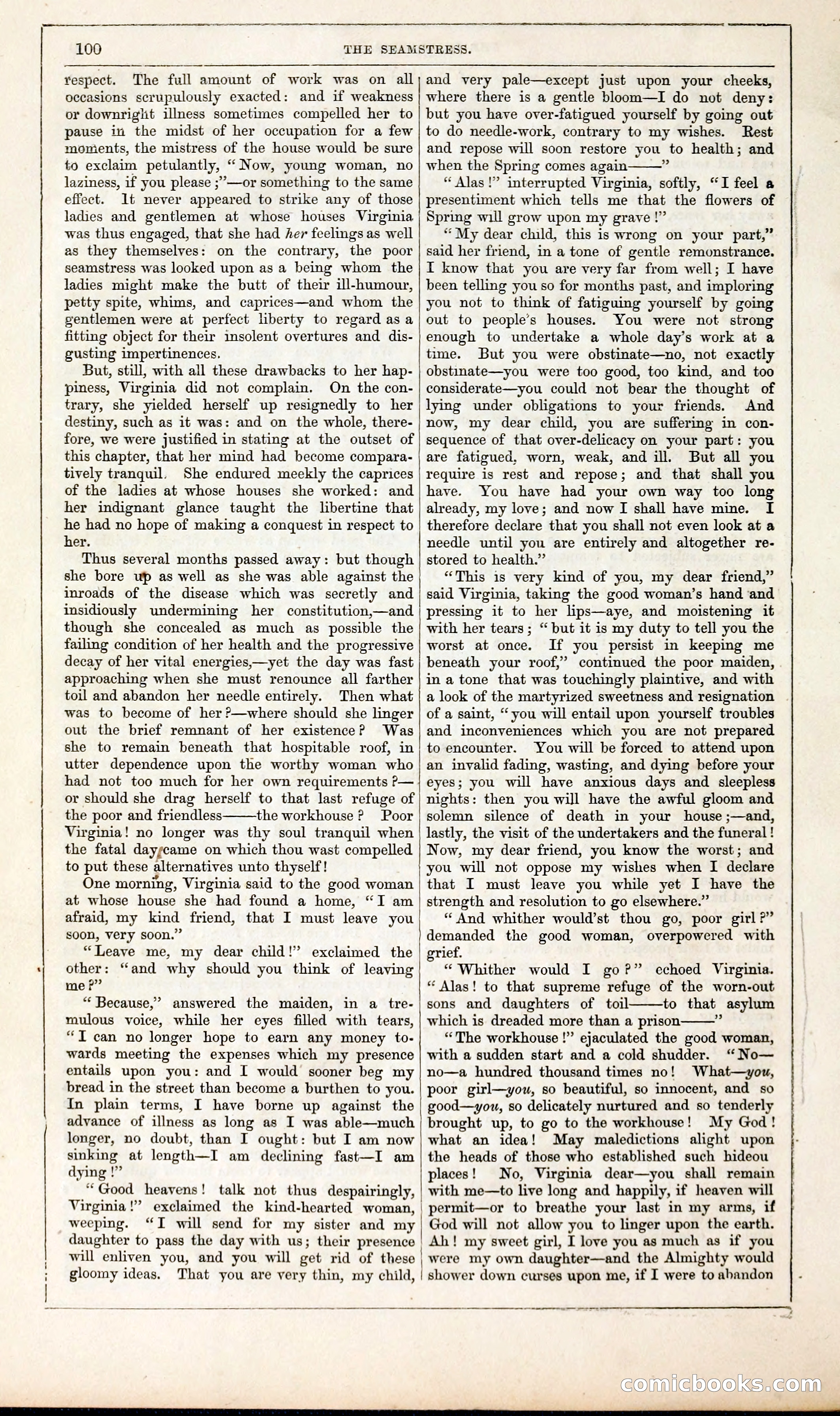
A restored page from Penny Dreadfuls, 1853. Page through the whole issue in the reader above.
📄 Transcribed text from this page (OCR, searchable)
Machine-transcribed from the original scan — historical spelling and the odd misread are preserved.
wma ee | ee 100 — —— respect. The full amount of work was on all occasions scrupulously exacted: and if weakness or downright illness sometimes compelled her to pause in the midst of her occupation for a few monients, the mistress of the house would be sure to exclaim petulantly, “ Now, young woman, no laziness, if you please ;’—or something to the same effect. 1t never appeared to strike any of those ladies and gentlemen at whose houses Virginia was thus engaged, that she had her feelings as well as they themselves: on the contrary, the poor seamstress was looked upon as a being whom the ladies might make the butt of their ill-humour, petty spite, whims, and caprices—and whom the gentlemen were at perfect liberty to regard asa fitting object for their insolent overtures and dis- gusting impertinences. But, still, with all these drawbacks to her hap- piness, Virginia did not complain. On the con- trary, she yielded herself up resignedly to her destiny, such as it was: and on the whole, there- fore, we were justified in stating at the outset of this chapter, that her mind had become compara- tively tranquil. She endured meekly the caprices of the ladies at whose houses she worked: and her indignant glance taught the libertine that he had no hope of making a conquest in respect to her. Thus several months passed away: but though she bore wp as well as she was able against the inroads of the disease which was secretly and insidiously undermining her constitution,—and though she concealed as much as possible the failing condition of her health and the progressive decay of her vital energies,—yet the day was fast approaching when she must renounce all farther toil and abandon her needle entirely. Then what was to become of her ?—where should she linger out the brief remnant of her existence? Was she to remain beneath that hospitable roof, in utter dependence upon the worthy woman who had not too much for her own requirements P— or should she drag herself to that last refuge of the poor and friendless the workhouse P Poor Virginia! no longer was thy soul tranquil when the fatal dayycame on which thou wast compelled to put these alternatives unto thyself! One morning, Virginia said to the good woman at whose house she had found a home, “I am afraid, my kind friend, that I must leave you soon, very soon.” “Leave me, my dear child!” exclaimed the other: “and why should you think of leaving me ?” ““ Because,” answered the maiden, in a tre- mulous voice, while her eyes filled with tears, “I can no longer hope to earn any money to- wards meeting the expenses which my presence entails upon you: and I would sooner beg my bread in the street than become a burthen to you. In plain terms, I have borne up against the advance of illness as long as I was able—much longer, no doubt, than I ought: but I am now sinking at length—I am declining fast—I am dying !” “Good heavens! talk not thus despairingly, THE SEAMSTRESS. and very pale—except just upon your cheeks, where there is a gentle bloom—I do not deny: but you have over-fatigued yourself by going out to do needle-work, contrary to my wishes. Rest and repose will soon restore you to health; and when the Spring comes again ” “ Alas!” interrupted Virginia, softly, “I feel a presentiment which tells me that the flowers of Spring will grow upon my grave !” “My dear child, this is wrong on your part,” said her friend, in a tone of gentle remonstrance. I know that you are very far from well; I have been telling you so for months past, and imploring you not to think of fatiguing yourself by going out to people’s houses. You were not strong enough to undertake a whole day’s work at a time. But you were obstinate—no, not exactly obstinate—you were too good, too kind, and too considerate—you could not bear the thought of lying under obligations to your friends. And now, my dear child, you are suffering in con- sequence of that over-delicacy on your part: you are fatigued, worn, weak, and ill. But all you require is rest and repose; and that shall you have. You have had your own way too long already, my love; and now I shall have mine. I therefore declare that you shall not even look at a needle until you are entirely and altogether re- stored to health.” “This is very kind of you, my dear friend,” said Virginia, taking the good woman’s hand and pressing it to her lips—aye, and moistening it with her tears; “ but it is my duty to tell you the worst at once. If you persist in keeping me beneath your roof,’ continued the poor maiden, in a tone that was touchingly plaintive, and with a look of the martyrized sweetness and resignation of a saint, “you will entail upon yourself troubles and inconveniences which you are not prepared to encounter. You will be forced to attend upon an invalid fading, wasting, and dying before your eyes; you will have anxious days and sleepless nights: then you will have the awful gloom and solemn silence of death in your house ;—and, lastly, the visit of the undertakers and the funeral ! Now, my dear friend, you know the worst; and you will not oppose my wishes when I declare that I must leave you while yet I have the strength and resolution to go elsewhere.” “And whither would’st thou go, poor girl ?” demanded the good woman, overpowered with erief. “ Whither would I go?” echoed Virginia. “ Alas! to that supreme refuge of the worn-out sons and daughters of toil to that asylum which is dreaded more than a prison 24 “The workhouse!” ejaculated the good woman, with a sudden start and a cold shudder. “No— no—a hundred thousand times no! What—youw, poor girl—you, so beautiful, so innocent, and so good—you, so delicately nurtured and so tenderly brought up, to go to the workhouse! My God! what an idea! May maledictions alight upon the heads of those who established such hideou places! No, Virginia dear—you shall remain with me—to live long and happily, if heaven will Virginia!” exclaimed the kind-hearted woman, | permit—or to breathe your last in my arms, if weeping. “JT will send for my sister and my| God will not allow you to linger upon the earth. daughter to pass the day with us; their presence | Ah! my sweet girl, I love you as much as if you will enliven you, and you will get rid of these gloomy ideas. — eee were my own daughter—and the Almighty would That you are very thin, my child, | shower down curses upon me, if I were to abandon _-_—_-- ew ee CU EOMIGdoOO <SiiG ——_