
Penny Dreadfuls, 1853 · page 100 of 151
The Seamstress; or, The White Slave of England — page 100: what you’re looking at
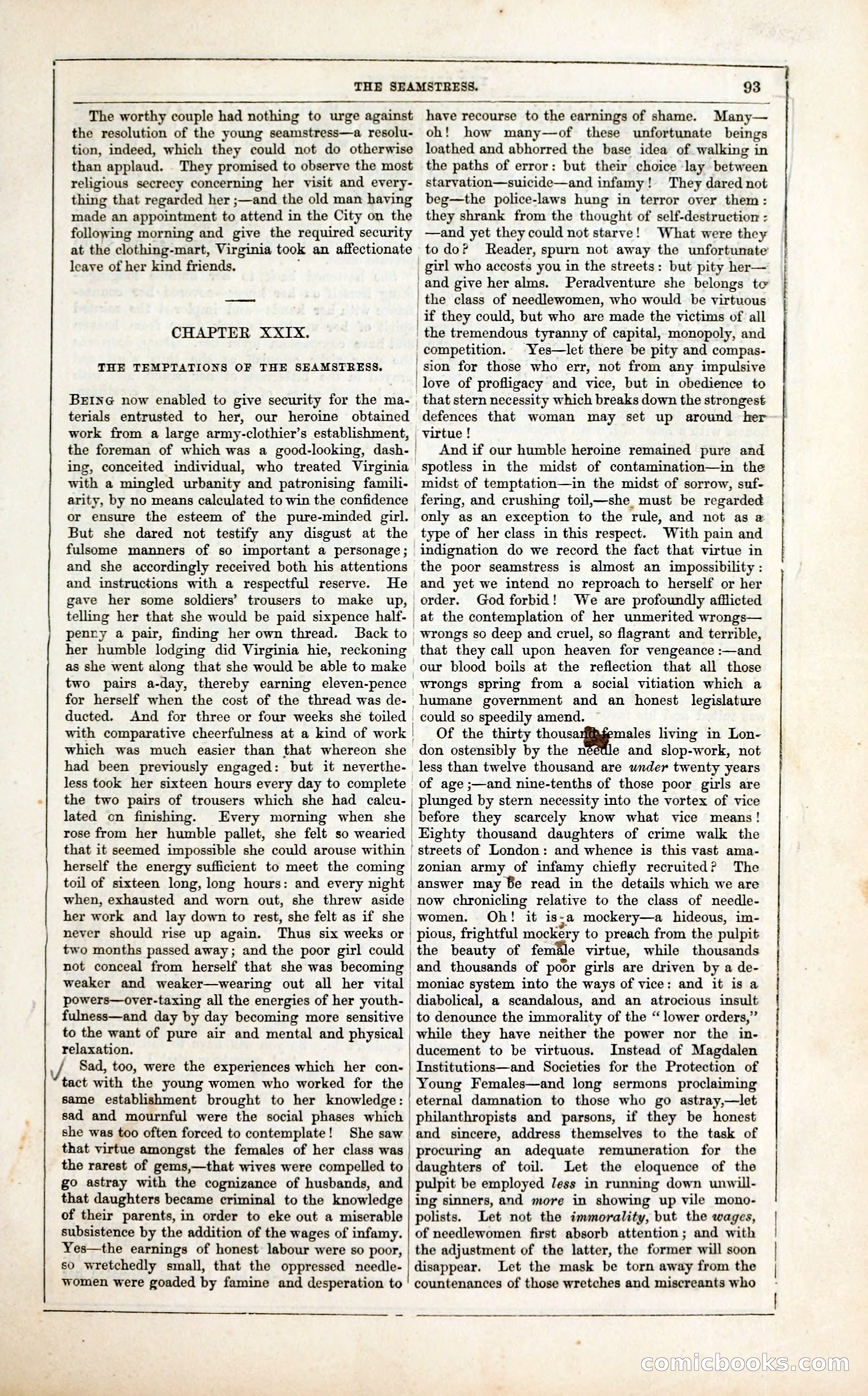
A restored page from Penny Dreadfuls, 1853. Page through the whole issue in the reader above.
📄 Transcribed text from this page (OCR, searchable)
Machine-transcribed from the original scan — historical spelling and the odd misread are preserved.
\ THE SEAMSTRESS. The worthy couple had nothing to urge against the resolution of the young seamstress—a resolu- tion, indeed, which they could not do otherwise than applaud. They promised to observe the most religious secrecy concerning her visit and every- thing that regarded her ;—and the old man having made an appointment to attend in the City on the following morning and give the required security at the clothing-mart, Virginia took an affectionate leave of her kind friends. ; a | | CHAPTER XXIX. THE TEMPTATIONS OF THE SEAMSTRESS. BEING now enabled to give security for the ma- terials entrusted to her, our heroine obtained work from a large army-clothier’s establishment, the foreman of which was a good-looking, dash- | ing, conceited individual, who treated Virginia with a mingled urbanity and patronising famili- arity, by no means calculated to win the confidence or ensure the esteem of the pure-minded girl. But she dared not testify any disgust at the fulsome manners of so important a personage; and she accordingly received both his attentions and instructions with a respectful reserve. He gave her some soldiers’ trousers to make up, telling her that she would be paid sixpence half- penny a pair, finding her own thread. Back to her humble lodging did Virginia hie, reckoning as she went along that she would be able to make > two pairs a-day, thereby earning eleven-pence for herself when the cost of the thread was de-— ducted. And for three or four weeks she toiled | with comparative cheerfulness at a kind of work | which was much easier than that whereon she had been previously engaged: but it neverthe- less took her sixteen hours every day to complete the two pairs of trousers which she had calcu- | lated on finishing. Every morning when she_ rose from her humble pallet, she felt so wearied that it seemed impossible she could arouse within | herself the energy sufficient to meet the coming toil of sixteen long, long hours: and every night when, exhausted and worn out, she threw aside her work and lay down to rest, she felt as if she never should rise up again. Thus six weeks or | two months passed away; and the poor girl could not conceal from herself that she was becoming | weaker and weaker—wearing out all her vital powers—over-taxing all the energies of her youth- fulness—and day by day becoming more sensitive to the want of pure air and mental and physical | relaxation. Sad, too, were the experiences which her con- tact with the young women who worked for the same establishment brought to her knowledge: sad and mournful were the social phases which she was too often forced to contemplate! She saw that virtue amongst the females of her class was the rarest of gems,—that wives were compelled to go astray with the cognizance of husbands, and that daughters became criminal to the knowledge of their parents, in order to eke out a miserable subsistence by the addition of the wages of infamy. Yes—the earnings of honest labour were so poor, so wretchedly small, that the oppressed needle- women were goaded by famine and desperation to women. 93 — have recourse to the earnings of shame. Many— oh! how many—of these unfortunate beings loathed and abhorred the base idea of walking in the paths of error: but their choice lay between starvation—suicide—and infamy! They dared not beg—the police-laws hung in terror over them: they shrank from the thought of self-destruetion : —and yet they could not starve! What were they todo? Reader, spurn not away the unfortunate’ girl who accosts you in the streets: but pity her— and give her alms. Peradventure she belongs to the class of needlewomen, who would be virtuous if they could, but who are made the victims of all the tremendous tyranny of capital, monopoly, and competition. Yes—let there be pity and compas- sion for those who err, not from any impulsive love of profligacy and vice, but in obedience to that stern necessity which breaks down the strongest defences that woman may set up around her virtue ! And if our humble heroine remained pure and spotless in the midst of contamination—in the midst of temptation—in the midst of sorrow, suf- fering, and crushing toil,—she_ must be regarded only as an exception to the rule, and not as a type of her class in this respect. With pain and indignation do we record the fact that virtue in the poor seamstress is almost an impossibility: and yet we intend no reproach to herself or her order. God forbid! We are profoundly afflicted at the contemplation of her unmerited wrongs— wrongs so deep and cruel, so flagrant and terrible, that they call upon heaven for vengeance :—and our blood boils at the reflection that all those wrongs spring from a social vitiation which a humane government and an honest legislature could so speedily amend. Of the thirty thous males living in Lon- don ostensibly by the nééale and slop-work, not less than twelve thousand are wnder twenty years of age ;—and nine-tenths of those poor girls are plunged by stern necessity into the vortex of vice before they scarcely know what vice means! Eighty thousand daughters of crime walk the streets of London: and whence is this vast ama- -zonian army of infamy chiefly recruited? The answer may Be read in the details which we are now chronicling relative to the class of needle- Oh! it is-a mockery—a hideous, im- pious, frightful mockery to preach from the pulpit the beauty of female virtue, while thousands and thousands of poor girls are driven by a de- moniac system into the ways of vice: and it is a 'diabolical, a scandalous, and an atrocious insult to denounce the immorality of the “ lower orders,” while they have neither the power nor the in- ducement to be virtuous. Instead of Magdalen Institutions—and Societies for the Protection of Young Females—and long sermons proclaiming eternal damnation to those who go astray,—let philanthropists and parsons, if they be honest and sincere, address themselves to the task of procuring an adequate remuneration for the daughters of toil. Let the eloquence of the pulpit be employed Jess in running down unwill- ing sinners, and more in showing up vile mono- polists. Let not the immorality, but the wages, of needlewomen first absorb attention; and with the adjustment of the latter, the former will soon disappear. Let the mask be torn away from the countenances of those wretches and miscreants who ee ee ee Sn ee Go 6)(6)() <S (C (0)