
Penny Dreadfuls, 1890 · page 252 of 271
Roxy Hastings — page 252: what you’re looking at
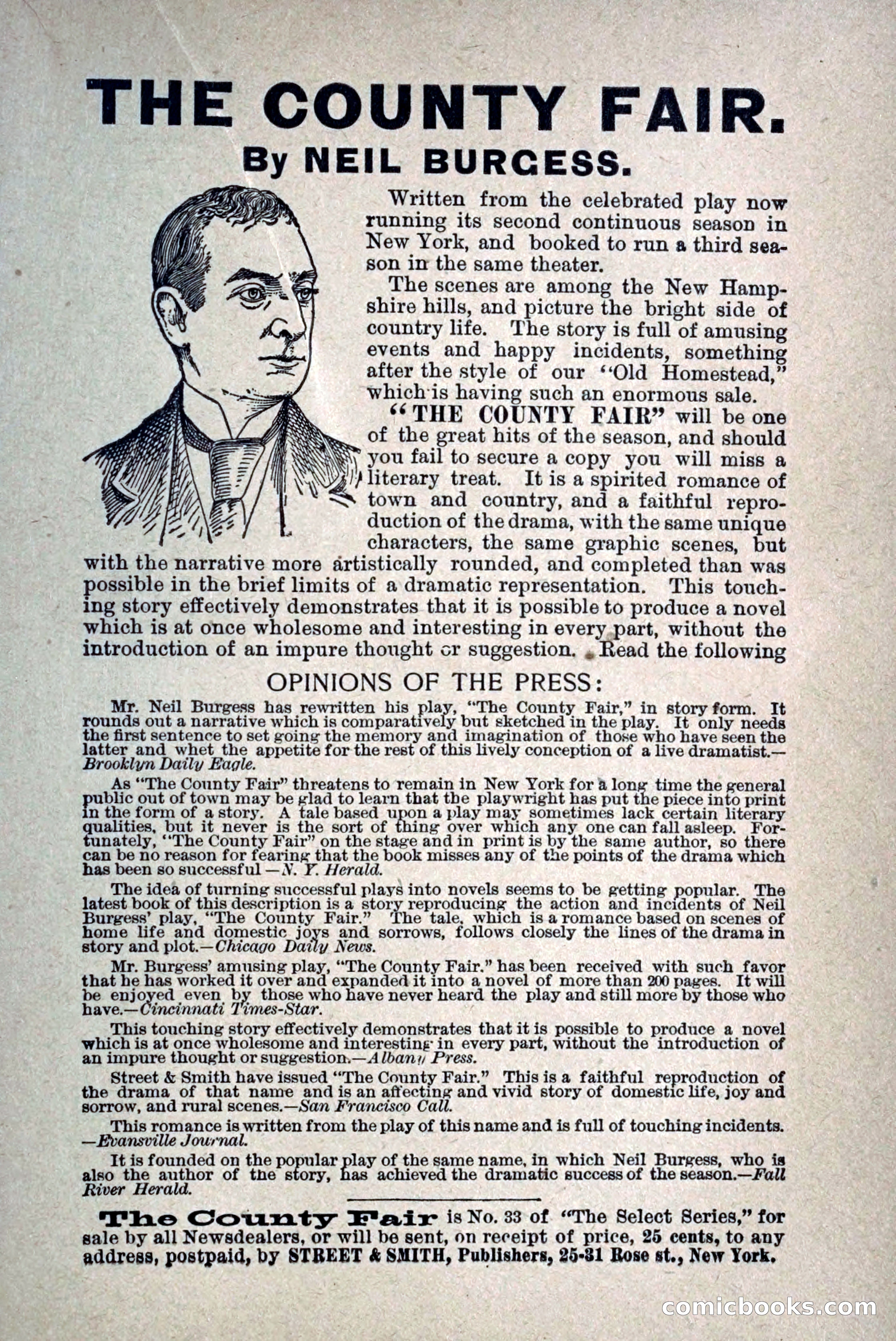
A restored page from Penny Dreadfuls, 1890. Page through the whole issue in the reader above.
📄 Transcribed text from this page (OCR, searchable)
Machine-transcribed from the original scan — historical spelling and the odd misread are preserved.
THE COUNTY FAIR. By NEIL BURCESS. TASSG yy Written from the celebrated play now UF “(VSD running its second continuous season in New York, and booked to run a third sea- son in the same theater. The scenes are among the New Hamp- shire hills, and picture the bright side of country life. The story is full of amusing events and happy incidents, something after the style of our ‘‘Old Homestead,” whichis having such an enormous gale. i<N **THE COUNTY FAIR” will be one 7; Wy. Of the great hits of the season, and should H WS) you fail to secure a copy you will miss a WW), : 9 \ 4! literary treat. Itisa spirited romance of — town and country, and a faithful repro- duction of the drama, with the same unique characters, the same graphic scenes, but with the narrative more artistically rounded, and completed than was ossible in the brief limits of a dramatic representation. This touch- ing story effectively demonstrates that it is possible to produce a novel which is at once wholesome and interesting in every part, without the introduction of an impure thought cr suggestion. , Read the following OPINIONS OF THE PRESS: Mr. Neil Burgess has rewritten his play, “The County Fair,” in story form. It rounds out a narrative which is comparatively but sketched in the play. It only needs the first sentence to set going the memory and imagination of those who have seen the latter and whet the appetite for the rest of this lively conception of a live dramatist.— Brooklyn Daily Eagle. As “The County Fair” threatens to remain in New York for & long time the general ublic out of town may be glad to learn that the playwright has put the piece into print n the form of astory. A tale based open a play may sometimes lack certain literary ualities, but it never is the sort of thing over which any one can fall asleep. For- unately, ‘“‘The County Fair” on the stage and in print is by the same author, so there can be no reason for fearing that the book misses any of the points of the drama which has been so successful —N. F. Herald. The idea of turning successful plays into novels seems to be getting popular. The latest book of this description is a story reproducing the action and incidents of Neil Burgess’ play, “The County Fair.” ‘The tale, which is a romance based on scenes of home life and domestic joys and sorrows, follows closely the lines of the drama in story and plot.—Chicago Daily News. Mr. Burgess’ amusing play, “The County Fair.” has been received with such favor that he has worked it over and expanded it into a novel of more than 200 pages. i be ore even by those who have never heard the play and still more by those who ave.— C7 ene \ Py SS SS ! neinnati Times-Star. This touching story effectively demonstrates that itis possible to produce a novel which is at once wholesome and interesting in every part, without the introduction of an impure thought or suggestion.— Albany Press. Street & Smith have issued “The County Fair.” Thisisa faithful reproduction of the drama of that name and is an affecting and vivid story of domestic life, joy and sorrow, and rural scenes.—San Francisco Call. This romance is written from the play of this name and is full of touching incidents. —Evansville Journal. It is founded on the popular play of the same name, in which Neil Burgess, who is ste gs peta of the story, has achieved the dramatic success of the season.—Fall iver Herald. The County Fain is No. 33 of “The Select Series,” for sale by all Newsdealers, or will be sent, on receipt of price, 25 cents, to any address, postpaid, by STREET & SMITH, Publishers, 25-31 Rose st., New York, Gomichoo gs) c (0) im