
Penny Dreadfuls, 1890 · page 25 of 271
Roxy Hastings — page 25: what you’re looking at
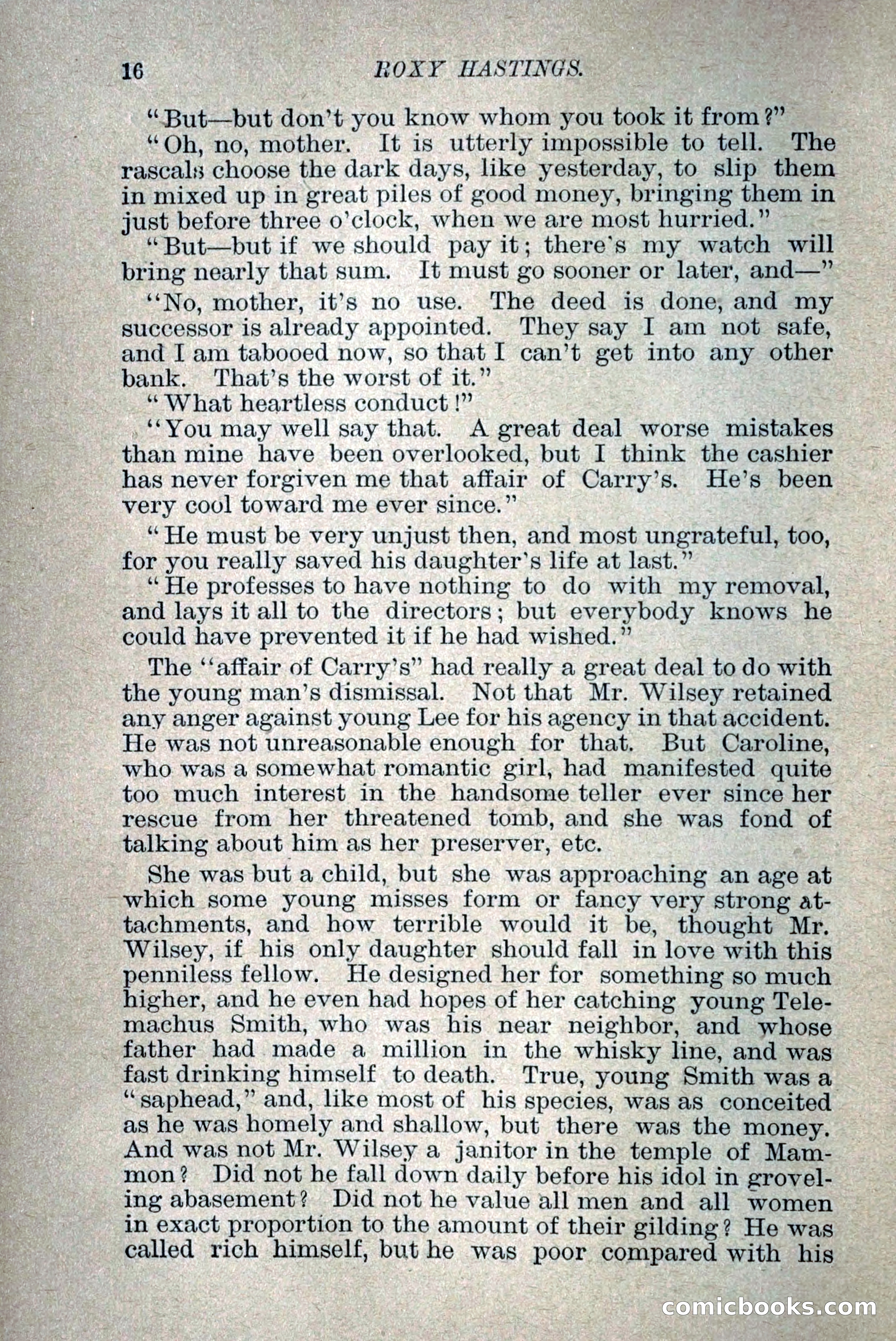
A restored page from Penny Dreadfuls, 1890. Page through the whole issue in the reader above.
📄 Transcribed text from this page (OCR, searchable)
Machine-transcribed from the original scan — historical spelling and the odd misread are preserved.
16 tOXY HASTINGS. | = “But—but don’t you know whom you took it from?” “Oh, no, mother. It is utterly impossible to tell. The rascals; choose the dark days, like yesterday, to slip them in mixed up in great piles of good money, bringing them in just before three o’clock, when we are most hurried.” — “But—but if we should pay it; there’s my watch will bring nearly that sum. It must go sooner or later, and—” ‘‘No, mother, it’s no use. The deed is done, and my successor is already appointed. They say I am not safe, and I am tabooed now, so that I can’t get into any other bank. That’s the worst of it.” “What heartless conduct !” **You may well say that. A great deal worse mistakes than mine have been overlooked, but I think the cashier has never forgiven me that affair of Carry’s. He’s been very cool toward me ever since.” “He must be very unjust then, and most ungrateful, too, for you really saved his daughter's life at last.” | ‘He professes to have nothing to do with my removal, and lays it all to the directors; but everybody knows he could have prevented it if he had wished.” The ‘‘affair of Carry’s” had really a great deal to do with the young man’s dismissal. Not that Mr. Wilsey retained any anger against young Lee for his agency in that accident. He was not unreasonable enough for that. But Caroline, who was a somewhat romantic girl, had manifested quite too much interest in the handsome teller ever since her rescue from her threatened tomb, and she was fond of talking about him as her preserver, etc. She was but a child, but she was approaching an age at “which some young misses form or fancy very strong at- tachments, and how terrible would it be, thought Mr. Wilsey, if his only daughter should fall in love with this penniless fellow. He designed her for something so much higher, and he even had hopes of her catching young Tele- machus Smith, who was his near neighbor, and whose father had made a million in the whisky line, and was — fast drinking himself to death. True, young Smith was a “saphead,” and, like most of his species, was as conceited as he was homely and shallow, but there was the money. And was not Mr. Wilsey a janitor in the temple of Mam- mon? Did not he fall down daily before his idol in grovyel- ing abasement? Did not he value all men and all women in exact proportion to the amount of their gilding? He was called rich himself, but he was poor compared with his Ecomicbooks.com