
Penny Dreadfuls, 1890 · page 224 of 271
Roxy Hastings — page 224: what you’re looking at
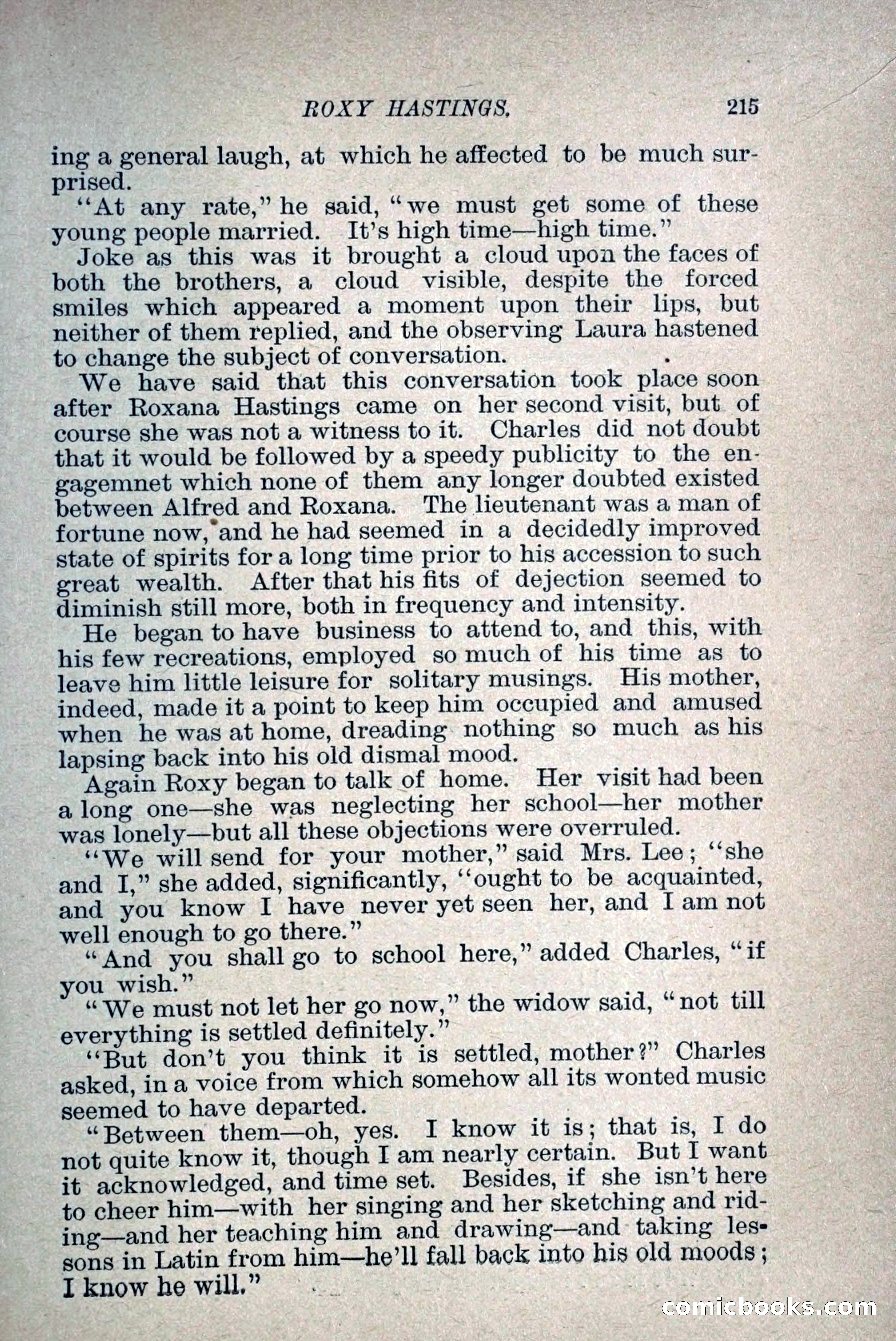
A restored page from Penny Dreadfuls, 1890. Page through the whole issue in the reader above.
📄 Transcribed text from this page (OCR, searchable)
Machine-transcribed from the original scan — historical spelling and the odd misread are preserved.
ROXY HASTINGS, 215 ing a general laugh, at which he affected to be much sur- prised. ‘““At any rate,” he said, “we must get some of these young people married. It’s high time—high time.” Joke as this was it brought a cloud upon the faces of both the brothers, a cloud visible, despite the forced smiles which appeared a moment upon their lips, but neither of them replied, and the observing Laura hastened to change the subject of conversation. ; We have said that this conversation took place soon after Roxana Hastings came on her second visit, but of course she was not a witness to it. Charles did not doubt that it would be followed by a speedy publicity to the en- gagemnet which none of them any longer doubted existed between Alfred and Roxana. The lieutenant was a man of fortune now, and he had seemed in a decidedly improved state of spirits for a long time prior to his accession to such great wealth. After that his fits of dejection seemed to diminish still more, both in frequency and intensity. He began to have business to attend to, and this, with his few recreations, employed so much of his time as to leave him little leisure for solitary musings. His mother, indeed, made it a point to keep him occupied and amused when he was at home, dreading. nothing so much as his lapsing back into his old dismal mood. Again Roxy began to talk of home. Her visit had been along one—she was neglecting her school—her mother was lonely—but all these objections were overruled. “We will send for your mother,” said Mrs. Lee; ‘‘she and I,” she added, significantly, ‘‘ought to be acquainted, and you know I have never yet seen her, and I am not well enough to go there.” “And you shall go to school here,” added Charles, “if you wish.” “We must not let her go now,” the widow said, “not till everything is settled definitely.” “But don’t you think it is settled, mother?” Charles asked, in a voice from which somehow all its wonted music seemed to have departed. | “Between them—oh, yes. I know it is; that is, I do not quite know it, though [ am nearly certain. But I want it acknowledged, and time set. Besides, if she isn’t here to cheer him—with her singing and her sketching and rid- ing—and her teaching him and drawing—and taking les» sons in Latin from him—he’ll fall back into his old moods ; I know he will.” sty Gomichoo “S €o m