
Penny Dreadfuls, 1890 · page 205 of 271
Roxy Hastings — page 205: what you’re looking at
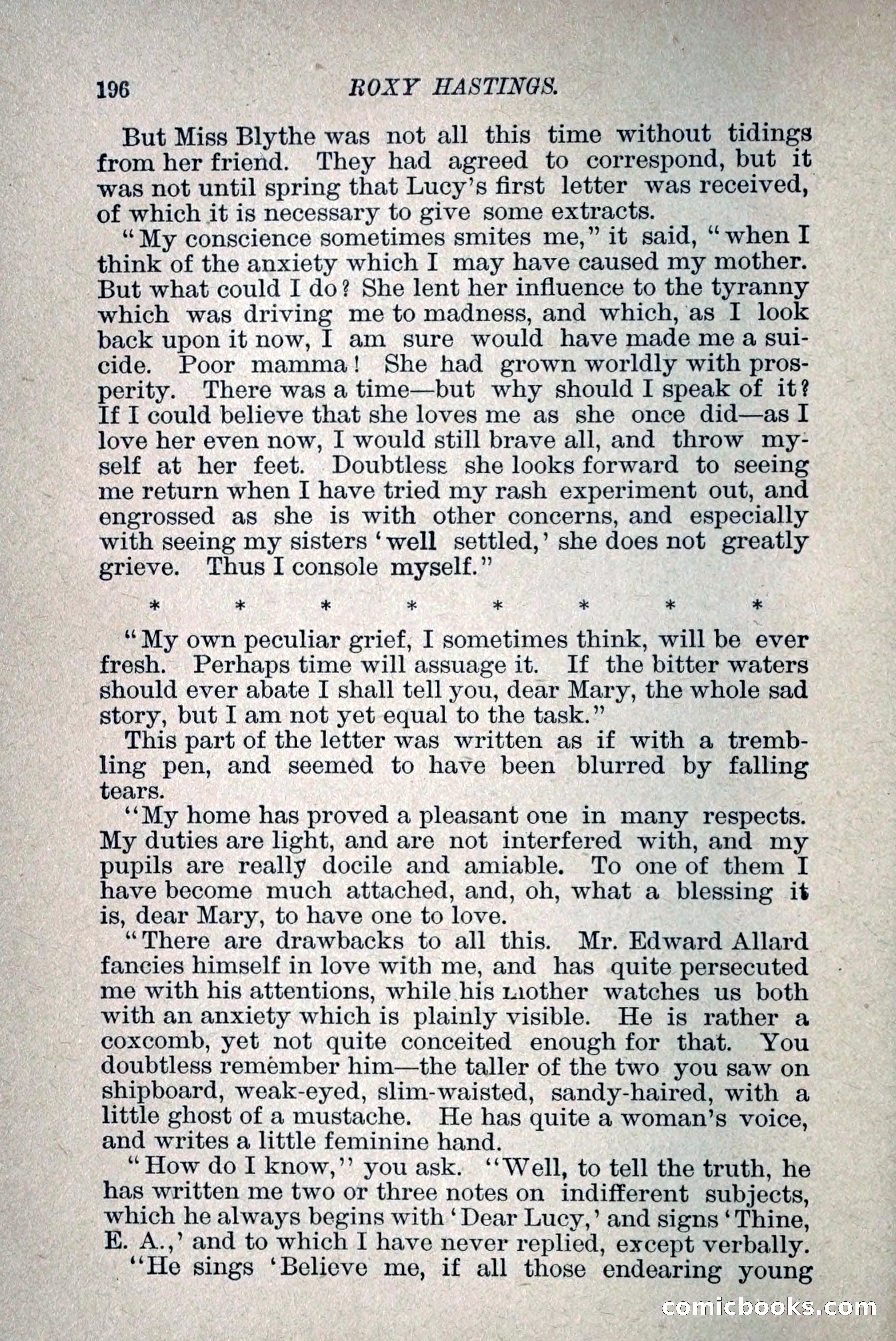
A restored page from Penny Dreadfuls, 1890. Page through the whole issue in the reader above.
📄 Transcribed text from this page (OCR, searchable)
Machine-transcribed from the original scan — historical spelling and the odd misread are preserved.
196 ROXY HASTINGS. But Miss Blythe was not all this time without tidings from her friend. They had agreed to correspond, but it was not until spring that Lucy’s first letter was received, of which it is necessary to give some extracts. “My conscience sometimes smites me,” it said, “when I think of the anxiety which I may have caused my mother. But what could I do? She lent her influence to the tyranny which was driving me to madness, and which, as I look back upon it now, I am sure would have made me a sui- cide. Poor mamma! She had grown worldly with pros- perity. There was a time—but why should I speak of it? If I could believe that she loves me as she once did—as I love her even now, I would still brave all, and throw my- self at her feet. Doubtless she looks forward to seeing me return when I have tried my rash experiment out, and engrossed as she is with other concerns, and especially with seeing my sisters ‘well settled,’ she does not greatly grieve. Thus I console myself.” * +x * “* * * * * “My own peculiar grief, I sometimes think, will be ever fresh. Perhaps time will assuage it. If the bitter waters should ever abate I shall tell you, dear Mary, the whole sad story, but I am not yet equal to the task.” This part of the letter was written as if with a tremb- ling pen, and seemed to have been blurred by falling tears. ‘“My home has proved a pleasant one in many respects. My duties are light, and are not interfered with, and my pupils are really docile and amiable. To one of them I have become much attached, and, oh, what a blessing it is, dear Mary, to have one to love. “There are drawbacks to all this. Mr. Edward Allard fancies himself in love with me, and has quite persecuted me with his attentions, while his aother watches us both with an anxiety which is plainly visible. He is rather a coxcomb, yet not quite conceited enough for that. You doubtless remember him—the taller of the two you saw on shipboard, weak-eyed, slim-waisted, sandy-haired, with a little ghost of a mustache. He has quite a woman’s voice, and writes a little feminine hand. “ How do I know,’’ you ask. ‘‘ Well, to tell the truth, he has written me two or three notes on indifferent subjects, which he always begins with ‘Dear Lucy,’ and signs ‘Thine, K. A.,’ and to which I have never replied, except verbally. “He sings ‘Believe me, if all those endearing young (ee) Eomicbooks